[English] 日本語
Yorodumi
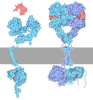
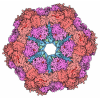
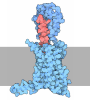
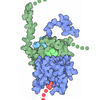
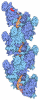
- EMDB-67779: A Wnt3a/Fzd8-CRD/LRP6-E3E4-LA complex with FKBP -

+
Open data


ID or keywords:

Loading...

-
Basic information

Entry
Database: EMDB / ID: EMD-67779
TitleA Wnt3a/Fzd8-CRD/LRP6-E3E4-LA complex with FKBP
Map data
Sample
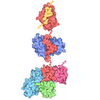
  • Complex: Ternary complex of Wnt3a with Fzd8-CRD and LRP6-E3E4-LA
    • Complex: Wnt3a
      • Protein or peptide: Protein Wnt-3a
    • Complex: Frizzled-8 and LRP6
      • Protein or peptide: Frizzled-8,Peptidyl-prolyl cis-trans isomerase FKBP1A
      • Protein or peptide: Low-density lipoprotein receptor-related protein 6,Serine/threonine-protein kinase mTOR
  • Ligand: 2-acetamido-2-deoxy-beta-D-glucopyranose
  • Ligand: RAPAMYCIN IMMUNOSUPPRESSANT DRUG
KeywordsWnt3a-Fzd8-LRP6 extracellular complex / Cryo-EM structure / FKBP-stabilized Wnt3a homodimer / SIGNALING PROTEIN
Function / homology
Function and homology information


positive regulation of dermatome development / calcium ion transmembrane transport via low voltage-gated calcium channel / positive regulation of collateral sprouting in absence of injury / positive regulation of mesodermal cell fate specification / paraxial mesodermal cell fate commitment / axis elongation involved in somitogenesis / cell proliferation in midbrain / WNT ligand biogenesis and trafficking / positive regulation of biosynthetic process / spinal cord association neuron differentiation ...positive regulation of dermatome development / calcium ion transmembrane transport via low voltage-gated calcium channel / positive regulation of collateral sprouting in absence of injury / positive regulation of mesodermal cell fate specification / paraxial mesodermal cell fate commitment / axis elongation involved in somitogenesis / cell proliferation in midbrain / WNT ligand biogenesis and trafficking / positive regulation of biosynthetic process / spinal cord association neuron differentiation / Disassembly of the destruction complex and recruitment of AXIN to the membrane / positive regulation of multicellular organismal process / Wnt-Frizzled-LRP5/6 complex / negative regulation of axon extension involved in axon guidance / Negative regulation of TCF-dependent signaling by WNT ligand antagonists / positive regulation of cell-cell adhesion mediated by cadherin / Signaling by RNF43 mutants / COP9 signalosome assembly / TCF dependent signaling in response to WNT / Transcriptional and post-translational regulation of MITF-M expression and activity / Regulation of FZD by ubiquitination / neural crest formation / kinase inhibitor activity / cell proliferation in forebrain / secondary palate development / regulation of RNA biosynthetic process / somatic stem cell division / cardiac muscle cell fate commitment / Wnt receptor activity / co-receptor binding / regulation of phosphatidylinositol 3-kinase/protein kinase B signal transduction / macrolide binding / positive regulation of skeletal muscle tissue development / non-canonical Wnt signaling pathway / low-density lipoprotein particle receptor activity / activin receptor binding / TORC1 complex / Wnt-protein binding / toxin transmembrane transporter activity / negative regulation of dopaminergic neuron differentiation / regulation of postsynapse to nucleus signaling pathway / regulation of skeletal muscle contraction by regulation of release of sequestered calcium ion / regulation of cellular response to stress / cytoplasmic side of membrane / cellular response to cholesterol / transforming growth factor beta receptor binding / positive regulation of cardiac muscle cell differentiation / TGFBR1 LBD Mutants in Cancer / post-anal tail morphogenesis / type I transforming growth factor beta receptor binding / negative regulation of activin receptor signaling pathway / dopaminergic neuron differentiation / positive regulation of hepatocyte proliferation / midbrain dopaminergic neuron differentiation / signaling receptor inhibitor activity / mammary gland development / heart trabecula formation / frizzled binding / I-SMAD binding / Class B/2 (Secretin family receptors) / positive regulation of neural precursor cell proliferation / Wnt signalosome / determination of left/right symmetry / regulation of amyloid precursor protein catabolic process / terminal cisterna / ryanodine receptor complex / anterior/posterior pattern specification / Disassembly of the destruction complex and recruitment of AXIN to the membrane / inner ear morphogenesis / 'de novo' protein folding / neural crest cell differentiation / dorsal/ventral neural tube patterning / regulation of cell size / ventricular cardiac muscle tissue morphogenesis / FK506 binding / regulation of axonogenesis / negative regulation of fat cell differentiation / heart looping / midbrain development / regulation of synapse organization / mesoderm development / TGF-beta receptor signaling activates SMADs / negative regulation of smooth muscle cell apoptotic process / hemopoiesis / regulation of cell differentiation / regulation of lipid metabolic process / positive regulation of receptor internalization / mTORC1-mediated signalling / Calcineurin activates NFAT / skeletal muscle cell differentiation / cell fate commitment / regulation of immune response / protein serine/threonine kinase inhibitor activity / canonical Wnt signaling pathway / BMP signaling pathway / somitogenesis / regulation of presynapse assembly / neuronal dense core vesicle / heart morphogenesis / coreceptor activity
Similarity search - Function
Wnt-3 protein / Frizzled 8, cysteine-rich domain / Wnt protein, conserved site / Wnt-1 family signature. / Wnt / Wnt, C-terminal domain / wnt family / found in Wnt-1 / Low density lipoprotein receptor-related protein 5/6 / : ...Wnt-3 protein / Frizzled 8, cysteine-rich domain / Wnt protein, conserved site / Wnt-1 family signature. / Wnt / Wnt, C-terminal domain / wnt family / found in Wnt-1 / Low density lipoprotein receptor-related protein 5/6 / : / Frizzled/Smoothened, transmembrane domain / Frizzled/Smoothened family membrane region / Frizzled/Smoothened family membrane region / Frizzled/secreted frizzled-related protein / Frizzled / Domain of unknown function DUF3385, target of rapamycin protein / Serine/threonine-protein kinase mTOR domain / Domain of unknown function / FKBP12-rapamycin binding domain / Serine/threonine-protein kinase TOR / FKBP12-rapamycin binding domain superfamily / FKBP12-rapamycin binding domain / Frizzled domain / Frizzled cysteine-rich domain superfamily / Fz domain / Frizzled (fz) domain profile. / Rapamycin binding domain / : / Serine/threonine-protein kinase ATR-like, HEAT repeats / Low-density lipoprotein receptor repeat class B / LDL-receptor class B (LDLRB) repeat profile. / LDLR class B repeat / Low-density lipoprotein-receptor YWTD domain / Low-density lipoprotein receptor domain class A / : / FATC domain / PIK-related kinase, FAT / FAT domain / Low-density lipoprotein (LDL) receptor class A, conserved site / LDL-receptor class A (LDLRA) domain signature. / FATC / LDL-receptor class A (LDLRA) domain profile. / FATC domain / PIK-related kinase / FAT domain profile. / FATC domain profile. / : / Low-density lipoprotein receptor domain class A / Low-density lipoprotein (LDL) receptor class A repeat / LDL receptor-like superfamily / Six-bladed beta-propeller, TolB-like / Coagulation Factor Xa inhibitory site / GPCR, family 2-like / G-protein coupled receptors family 2 profile 2. / Phosphatidylinositol 3- and 4-kinases signature 1. / FKBP-type peptidyl-prolyl cis-trans isomerase / FKBP-type peptidyl-prolyl cis-trans isomerase domain / FKBP-type peptidyl-prolyl cis-trans isomerase domain profile. / Phosphatidylinositol 3/4-kinase, conserved site / Phosphatidylinositol 3- and 4-kinases signature 2. / Phosphatidylinositol 3-/4-kinase, catalytic domain superfamily / Phosphoinositide 3-kinase, catalytic domain / Phosphatidylinositol 3- and 4-kinase / Phosphatidylinositol 3- and 4-kinases catalytic domain profile. / Phosphatidylinositol 3-/4-kinase, catalytic domain / Peptidyl-prolyl cis-trans isomerase domain superfamily / Epidermal growth factor-like domain. / EGF-like domain signature 2. / EGF-like domain / Armadillo-like helical / Tetratricopeptide-like helical domain superfamily / Armadillo-type fold / Protein kinase-like domain superfamily
Similarity search - Domain/homology
Serine/threonine-protein kinase mTOR / Low-density lipoprotein receptor-related protein 6 / Protein Wnt-3a / Peptidyl-prolyl cis-trans isomerase FKBP1A / Frizzled-8
Similarity search - Component
Biological speciesMus musculus (house mouse) / Homo sapiens (human)
Methodsingle particle reconstruction / cryo EM / Resolution: 3.01 Å
AuthorsYue D / Sun G / Zhang L / Wang Z / Xu W
Funding support China, 3 items
OrganizationGrant numberCountry
Chinese Academy of Sciences China
National Natural Science Foundation of China (NSFC) China
Ministry of Science and Technology (MoST, China) China
CitationJournal: Cell / Year: 2026
Title: Structural basis of Wnt signalosome extracellular complex assembly.
Authors: Dan Yue / Gangyu Sun / Yunlong Cao / Hongyue Li / Yufeng Yang / Zirun Pan / Lulu Xue / Lu Zhang / Zhizhi Wang / Wenqing Xu /
Abstract: Recognition of Wnt proteins by Frizzled (Fzd) receptors and the low-density lipoprotein receptor-related protein 5/6 (LRP5/6) co-receptor is essential for canonical Wnt signaling. It remains ...Recognition of Wnt proteins by Frizzled (Fzd) receptors and the low-density lipoprotein receptor-related protein 5/6 (LRP5/6) co-receptor is essential for canonical Wnt signaling. It remains enigmatic how Wnt simultaneously interacts with Fzd and LRP5/6 and activates intracellular Wnt/β-catenin signaling. Here, we report cryo-electron microscopy (cryo-EM) structures of Wnt3a/Fzd8/LRP6 extracellular complexes captured in a 2:4:2 stoichiometry, consisting of a Wnt3a-Wnt3a homodimer, whereby each Wnt3a monomer binds to two Fzd8 receptors and one LRP6 co-receptor. This implies that Wnt3a induces Fzd cystine-rich domain (Fzd-CRD) tetramerization, which in turn could promote recruitment of oligomeric Disheveled (Dvl) to Fzd on the cytoplasmic side. Indeed, mutations of key Wnt3a-Wnt3a interface residues abolish Fzd-LRP clustering and downstream signaling, supporting a critical role of Wnt3a-Wnt3a dimerization in Wnt signalosome assembly and signaling. Our structures also show how the Wnt3a N-helical domain recognizes the LRP6 extracellular domain (LRP6-ECD) E3 β-propeller, while the Wnt3a N-C hairpin interacts with the valley between LRP6-E3 and -E4 propellers, underpinning the development of targeted Wnt therapeutics.
History
DepositionDec 17, 2025-
Header (metadata) releaseJun 3, 2026-
Map releaseJun 3, 2026-
UpdateJun 3, 2026-
Current statusJun 3, 2026Processing site: PDBc / Status: Released

-
Structure visualization

Supplemental images

Downloads & links

-
Map

FileDownload / File: emd_67779.map.gz / Format: CCP4 / Size: 244.1 MB / Type: IMAGE STORED AS FLOATING POINT NUMBER (4 BYTES)
Projections & slices

Image control

Size
Brightness
Contrast
Others
AxesZ (Sec.)Y (Row.)X (Col.)
0.83 Å/pix.
x 400 pix.
= 332.8 Å
0.83 Å/pix.
x 400 pix.
= 332.8 Å
0.83 Å/pix.
x 400 pix.
= 332.8 Å

Surface

Projections

Slices (1/3)

Slices (1/2)

Slices (2/3)

Images are generated by Spider.

Voxel sizeX=Y=Z: 0.832 Å
Density
Contour LevelBy AUTHOR: 0.1
Minimum - Maximum-1.1335379 - 1.925655
Average (Standard dev.)0.00044724994 (±0.025771111)
SymmetrySpace group: 1
Details

EMDB XML:

Map geometry
Axis orderXYZ
Origin000
Dimensions400400400
Spacing400400400
CellA=B=C: 332.80002 Å
α=β=γ: 90.0 °

-
Supplemental data

-
Half map: #2

Fileemd_67779_half_map_1.map
Projections & Slices
AxesZYX

Projections

Slices (1/2)
Density Histograms

-
Half map: #1

Fileemd_67779_half_map_2.map
Projections & Slices
AxesZYX

Projections

Slices (1/2)
Density Histograms

-
Sample components

-
Entire : Ternary complex of Wnt3a with Fzd8-CRD and LRP6-E3E4-LA

EntireName: Ternary complex of Wnt3a with Fzd8-CRD and LRP6-E3E4-LA
Components
  • Complex: Ternary complex of Wnt3a with Fzd8-CRD and LRP6-E3E4-LA
    • Complex: Wnt3a
      • Protein or peptide: Protein Wnt-3a
    • Complex: Frizzled-8 and LRP6
      • Protein or peptide: Frizzled-8,Peptidyl-prolyl cis-trans isomerase FKBP1A
      • Protein or peptide: Low-density lipoprotein receptor-related protein 6,Serine/threonine-protein kinase mTOR
  • Ligand: 2-acetamido-2-deoxy-beta-D-glucopyranose
  • Ligand: RAPAMYCIN IMMUNOSUPPRESSANT DRUG

-
Supramolecule #1: Ternary complex of Wnt3a with Fzd8-CRD and LRP6-E3E4-LA

SupramoleculeName: Ternary complex of Wnt3a with Fzd8-CRD and LRP6-E3E4-LA
type: complex / ID: 1 / Parent: 0 / Macromolecule list: #1-#3
Source (natural)Organism: Mus musculus (house mouse)

-
Supramolecule #2: Wnt3a

SupramoleculeName: Wnt3a / type: complex / ID: 2 / Parent: 1 / Macromolecule list: #2
Source (natural)Organism: Mus musculus (house mouse)

-
Supramolecule #3: Frizzled-8 and LRP6

SupramoleculeName: Frizzled-8 and LRP6 / type: complex / ID: 3 / Parent: 1 / Macromolecule list: #1, #3
Source (natural)Organism: Homo sapiens (human)

-
Macromolecule #1: Frizzled-8,Peptidyl-prolyl cis-trans isomerase FKBP1A

MacromoleculeName: Frizzled-8,Peptidyl-prolyl cis-trans isomerase FKBP1A / type: protein_or_peptide / ID: 1 / Number of copies: 5 / Enantiomer: LEVO / EC number: peptidylprolyl isomerase
Source (natural)Organism: Homo sapiens (human)
Molecular weightTheoretical: 29.934635 KDa
Recombinant expressionOrganism: Homo sapiens (human)
SequenceString: HHHHHHHHAS AKELACQEIT VPLCKGIGYN YTYMPNQFNH DTQDEAGLEV HQFWPLVEIQ CSPDLKFFLC SMYTPICLED YKKPLPPCR SVCERAKAGC APLMRQYGFA WPDRMRCDRL PEQGNPDTLC MDYNRTDGGG GSGGGGSGGG GSGGGGSGVQ V ETISPGDG ...String:
HHHHHHHHAS AKELACQEIT VPLCKGIGYN YTYMPNQFNH DTQDEAGLEV HQFWPLVEIQ CSPDLKFFLC SMYTPICLED YKKPLPPCR SVCERAKAGC APLMRQYGFA WPDRMRCDRL PEQGNPDTLC MDYNRTDGGG GSGGGGSGGG GSGGGGSGVQ V ETISPGDG RTFPKRGQTS VVHYTGMLED GKKFDSSRDR NKPFKFMLGK QEVIRGWEEG VAQMSVGQRA KLTISPDYAY GA TGHPGII PPHATLVFDV ELLKLEDYKD DDDK

UniProtKB: Frizzled-8, Peptidyl-prolyl cis-trans isomerase FKBP1A

-
Macromolecule #2: Protein Wnt-3a

MacromoleculeName: Protein Wnt-3a / type: protein_or_peptide / ID: 2 / Number of copies: 2 / Enantiomer: LEVO
Source (natural)Organism: Mus musculus (house mouse)
Molecular weightTheoretical: 37.438258 KDa
Recombinant expressionOrganism: Mus musculus (house mouse)
SequenceString: SYPIWWSLAV GPQYSSLSTQ PILCASIPGL VPKQLRFCRN YVEIMPSVAE GVKAGIQECQ HQFRGRRWNC TTVSNSLAIF GPVLDKATR ESAFVHAIAS AGVAFAVTRS CAEGSAAICG CSSRLQGSPG EGWKWGGCSE DIEFGGMVSR EFADARENRP D ARSAMNRH ...String:
SYPIWWSLAV GPQYSSLSTQ PILCASIPGL VPKQLRFCRN YVEIMPSVAE GVKAGIQECQ HQFRGRRWNC TTVSNSLAIF GPVLDKATR ESAFVHAIAS AGVAFAVTRS CAEGSAAICG CSSRLQGSPG EGWKWGGCSE DIEFGGMVSR EFADARENRP D ARSAMNRH NNEAGRQAIA SHMHLKCKCH GLSGSCEVKT CWWSQPDFRT IGDFLKDKYD SASEMVVEKH RESRGWVETL RP RYTYFKV PTERDLVYYE ASPNFCEPNP ETGSFGTRDR TCNVSSHGID GCDLLCCGRG HNARTERRRE KCHCVFHWCC YVS CQECTR VYDVHTCK

UniProtKB: Protein Wnt-3a

-
Macromolecule #3: Low-density lipoprotein receptor-related protein 6,Serine/threoni...

MacromoleculeName: Low-density lipoprotein receptor-related protein 6,Serine/threonine-protein kinase mTOR
type: protein_or_peptide / ID: 3 / Number of copies: 2 / Enantiomer: LEVO / EC number: non-specific serine/threonine protein kinase
Source (natural)Organism: Homo sapiens (human)
Molecular weightTheoretical: 98.974938 KDa
Recombinant expressionOrganism: Homo sapiens (human)
SequenceString: DYKDDDDKPE AFLLFSRRAD IRRISLETNN NNVAIPLTGV KEASALDFDV TDNRIYWTDI SLKTISRAFM NGSALEHVVE FGLDYPEGM AVDWLGKNLY WADTGTNRIE VSKLDGQHRQ VLVWKDLDSP RALALDPAEG FMYWTEWGGK PKIDRAAMDG S ERTTLVPN ...String:
DYKDDDDKPE AFLLFSRRAD IRRISLETNN NNVAIPLTGV KEASALDFDV TDNRIYWTDI SLKTISRAFM NGSALEHVVE FGLDYPEGM AVDWLGKNLY WADTGTNRIE VSKLDGQHRQ VLVWKDLDSP RALALDPAEG FMYWTEWGGK PKIDRAAMDG S ERTTLVPN VGRANGLTID YAKRRLYWTD LDTNLIESSN MLGLNREVIA DDLPHPFGLT QYQDYIYWTD WSRRSIERAN KT SGQNRTI IQGHLDYVMD ILVFHSSRQS GWNECASSNG HCSHLCLAVP VGGFVCGCPA HYSLNADNRT CSAPTTFLLF SQK SAINRM VIDEQQSPDI ILPIHSLRNV RAIDYDPLDK QLYWIDSRQN MIRKAQEDGS QGFTVVVSSV PSQNLEIQPY DLSI DIYSR YIYWTCEATN VINVTRLDGR SVGVVLKGEQ DRPRAVVVNP EKGYMYFTNL QERSPKIERA ALDGTEREVL FFSGL SKPI ALALDSRLGK LFWADSDLRR IESSDLSGAN RIVLEDSNIL QPVGLTVFEN WLYWIDKQQQ MIEKIDMTGR EGRTKV QAR IAQLSDIHAV KELNLQEYRQ HPCAQDNGGC SHICLVKGDG TTRCSCPMHL VLLQDELSCG EPPTCSPQQF TCFTGEI DC IPVAWRCDGF TECEDHSDEL NCPVCSESQF QCASGQCIDG ALRCNGDANC QDKSDEKNCE VLCLIDQFRC ANGQCIGK H KKCDHNVDCS DKSDELDCYP TEEPAPQAGG GGSGGGGSGG GGSGGGGSEL IRVAILWHEM WHEGLEEASR LYFGERNVK GMFEVLEPLH AMMERGPQTL KETSFNQAYG RDLMEAQEWS RKYMKSGNVK DLTQAWDLYY HVFRRISKQH HHHHHHH

UniProtKB: Low-density lipoprotein receptor-related protein 6, Serine/threonine-protein kinase mTOR

-
Macromolecule #5: 2-acetamido-2-deoxy-beta-D-glucopyranose

MacromoleculeName: 2-acetamido-2-deoxy-beta-D-glucopyranose / type: ligand / ID: 5 / Number of copies: 2 / Formula: NAG
Molecular weightTheoretical: 221.208 Da
Chemical component information

ChemComp-NAG:
2-acetamido-2-deoxy-beta-D-glucopyranose

-
Macromolecule #6: RAPAMYCIN IMMUNOSUPPRESSANT DRUG

MacromoleculeName: RAPAMYCIN IMMUNOSUPPRESSANT DRUG / type: ligand / ID: 6 / Number of copies: 1 / Formula: RAP
Molecular weightTheoretical: 914.172 Da
Chemical component information

ChemComp-RAP:
RAPAMYCIN IMMUNOSUPPRESSANT DRUG / antibiotic*YM

-
Experimental details

-
Structure determination

Methodcryo EM
Processingsingle particle reconstruction
Aggregation stateparticle

-
Sample preparation

Concentration1 mg/mL
BufferpH: 7.5
GridModel: Quantifoil R1.2/1.3 / Material: COPPER / Mesh: 300 / Pretreatment - Type: GLOW DISCHARGE / Pretreatment - Time: 50 sec. / Pretreatment - Atmosphere: OTHER
VitrificationCryogen name: ETHANE / Chamber humidity: 100 % / Chamber temperature: 283.15 K / Instrument: FEI VITROBOT MARK IV

-
Electron microscopy

MicroscopeTFS KRIOS
Image recordingFilm or detector model: GATAN K3 BIOQUANTUM (6k x 4k) / Average electron dose: 60.0 e/Å2
Electron beamAcceleration voltage: 300 kV / Electron source: FIELD EMISSION GUN
Electron opticsIllumination mode: FLOOD BEAM / Imaging mode: BRIGHT FIELD / Nominal defocus max: 2.2 µm / Nominal defocus min: 1.2 µm
Sample stageCooling holder cryogen: NITROGEN
Experimental equipment
Model: Titan Krios / Image courtesy: FEI Company

+
Image processing

CTF correctionType: NONE
Startup modelType of model: PDB ENTRY
PDB model - PDB ID:
Final reconstructionResolution.type: BY AUTHOR / Resolution: 3.01 Å / Resolution method: FSC 0.143 CUT-OFF / Software - Name: cryoSPARC / Number images used: 525970
Initial angle assignmentType: MAXIMUM LIKELIHOOD
Final angle assignmentType: MAXIMUM LIKELIHOOD
FSC plot (resolution estimation)

-
Atomic model buiding 1

Initial model
PDB IDChain

source_name: PDB, initial_model_type: experimental model

source_name: PDB, initial_model_type: experimental model

source_name: PDB, initial_model_type: experimental model
Output model

PDB-21ks:
A Wnt3a/Fzd8-CRD/LRP6-E3E4-LA complex with FKBP

+
About Yorodumi

-
News

-
Feb 9, 2022. New format data for meta-information of EMDB entries

New format data for meta-information of EMDB entries

  • Version 3 of the EMDB header file is now the official format.
  • The previous official version 1.9 will be removed from the archive.

Related info.:EMDB header

External links:wwPDB to switch to version 3 of the EMDB data model

-
Aug 12, 2020. Covid-19 info

Covid-19 info

URL: https://pdbj.org/emnavi/covid19.php

New page: Covid-19 featured information page in EM Navigator.

Related info.:Covid-19 info / Mar 5, 2020. Novel coronavirus structure data

+
Mar 5, 2020. Novel coronavirus structure data

Novel coronavirus structure data

Related info.:Yorodumi Speices / Aug 12, 2020. Covid-19 info

External links:COVID-19 featured content - PDBj / Molecule of the Month (242):Coronavirus Proteases

+
Jan 31, 2019. EMDB accession codes are about to change! (news from PDBe EMDB page)

EMDB accession codes are about to change! (news from PDBe EMDB page)

  • The allocation of 4 digits for EMDB accession codes will soon come to an end. Whilst these codes will remain in use, new EMDB accession codes will include an additional digit and will expand incrementally as the available range of codes is exhausted. The current 4-digit format prefixed with “EMD-” (i.e. EMD-XXXX) will advance to a 5-digit format (i.e. EMD-XXXXX), and so on. It is currently estimated that the 4-digit codes will be depleted around Spring 2019, at which point the 5-digit format will come into force.
  • The EM Navigator/Yorodumi systems omit the EMD- prefix.

Related info.:Q: What is EMD? / ID/Accession-code notation in Yorodumi/EM Navigator

External links:EMDB Accession Codes are Changing Soon! / Contact to PDBj

+
Jul 12, 2017. Major update of PDB

Major update of PDB

  • wwPDB released updated PDB data conforming to the new PDBx/mmCIF dictionary.
  • This is a major update changing the version number from 4 to 5, and with Remediation, in which all the entries are updated.
  • In this update, many items about electron microscopy experimental information are reorganized (e.g. em_software).
  • Now, EM Navigator and Yorodumi are based on the updated data.

External links:wwPDB Remediation / Enriched Model Files Conforming to OneDep Data Standards Now Available in the PDB FTP Archive

-
Yorodumi

Thousand views of thousand structures

  • Yorodumi is a browser for structure data from EMDB, PDB, SASBDB, etc.
  • This page is also the successor to EM Navigator detail page, and also detail information page/front-end page for Omokage search.
  • The word "yorodu" (or yorozu) is an old Japanese word meaning "ten thousand". "mi" (miru) is to see.

Related info.:EMDB / PDB / SASBDB / Comparison of 3 databanks / Yorodumi Search / Aug 31, 2016. New EM Navigator & Yorodumi / Yorodumi Papers / Jmol/JSmol / Function and homology information / Changes in new EM Navigator and Yorodumi

Read more