Japan Agency for Medical Research and Development (AMED)
21gm1410009
日本
Japan Society for the Promotion of Science (JSPS)
20H00501
日本
Japan Society for the Promotion of Science (JSPS)
24H00603
日本
Japan Society for the Promotion of Science (JSPS)
21H05257
日本
Human Frontier Science Program (HFSP)
RGP0010/2011
フランス
National Institutes of Health/National Institute of General Medical Sciences (NIH/NIGMS)
R01GM032543
米国
National Institutes of Health/National Institute on Aging (NIH/NIA)
RF1AG048120
米国
National Institutes of Health/National Institute on Aging (NIH/NIA)
R01AG070895
米国
Japan Society for the Promotion of Science (JSPS)
22K15067
日本
Japan Society for the Promotion of Science (JSPS)
JP25830025
日本
National Institutes of Health/National Institute of General Medical Sciences (NIH/NIGMS)
1R24GM154186
米国
引用
ジャーナル: Res Sq / 年: 2025 タイトル: How Sup35 monomer conformation and amyloid fibril polymorphism determine yeast strain phenotypes. 著者: Motomasa Tanaka / Takashi Nomura / David Boyer / Yusuke Komi / Peng Ge / Rodrigo A Maillard / Piere Rodriguez / Atsushi Yamagata / Mikako Shirouzu / Giuseppe Legname / Bruno Samori / David Eisenberg / 要旨: In the [ ] prion system, the yeast prion protein Sup35 can form structurally distinct amyloid fibrils that lead to distinct transmissible prion states, or strains. However, our understanding of how ...In the [ ] prion system, the yeast prion protein Sup35 can form structurally distinct amyloid fibrils that lead to distinct transmissible prion states, or strains. However, our understanding of how different Sup35 fibril structures arise and translate to phenotypic variations is limited. Here, using cryo-EM and single-monomer force spectroscopy with optical tweezers, we reveal the structural basis of yeast prion propagation in four wild-type and S17R mutant variants of Sup35 that underlie different [ ] strains. Cryo-EM structures show that the four variants form strikingly distinct fibril structures, which exhibit varying stability and chaperone-accessibility. Force spectroscopy suggests the different distinct fibril structures are derived from distinct monomer conformational ensembles. Further, cryo-EM structures indicate that prion strain strength is correlated with enhanced fibril propagation caused by a combination of low fibril stability and a large separation between the Sup35 fibril core and the Ssa1/Sis1 chaperone-binding region. These results provide a structure-based mechanism for the yeast prion strain phenomenon with implications for understanding amyloid propagation in human neurodegenerative diseases.
 ムービー
ムービー コントローラー


 データを開く
 基本情報
基本情報
 マップデータ
 試料
試料 キーワード
キーワード 機能・相同性情報
 Saccharomyces cerevisiae (パン酵母)
 データ登録者
 日本,
日本,  フランス,
フランス,  米国, 11件
  引用
引用 構造の表示
構造の表示
 ダウンロードとリンク
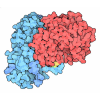
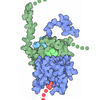
 emd_66705.png
 http://ftp.pdbj.org/pub/emdb/structures/EMD-66705



 Z (Sec.)
 Y (Row.)
 X (Col.)


 試料の構成要素
 Escherichia coli (大腸菌)
 解析
解析 電子顕微鏡法
 FIELD EMISSION GUN

