 Movie
Movie Controller


+ Open data

- Basic information
| Entry | Database: PDB / ID: 9xbn | ||||||||||||||||||||||||||||||||||||
|---|---|---|---|---|---|---|---|---|---|---|---|---|---|---|---|---|---|---|---|---|---|---|---|---|---|---|---|---|---|---|---|---|---|---|---|---|---|
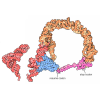
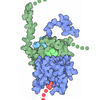
| Title | Cryo-EM structure of Sup35NM fibril formed at 4 degrees (Sc4) | ||||||||||||||||||||||||||||||||||||
 Components Components | Eukaryotic peptide chain release factor GTP-binding subunit | ||||||||||||||||||||||||||||||||||||
 Keywords Keywords | PROTEIN FIBRIL / Yeast / Sup35NM / Amyloid | ||||||||||||||||||||||||||||||||||||
| Function / homology |  Function and homology information Function and homology informationEukaryotic Translation Termination / translation release factor complex / translation release factor activity / nuclear-transcribed mRNA catabolic process, deadenylation-dependent decay / Nonsense Mediated Decay (NMD) independent of the Exon Junction Complex (EJC) / Nonsense Mediated Decay (NMD) enhanced by the Exon Junction Complex (EJC) / translational termination / cytoplasmic stress granule / ribosome binding / Hydrolases; Acting on acid anhydrides; Acting on GTP to facilitate cellular and subcellular movement ...Eukaryotic Translation Termination / translation release factor complex / translation release factor activity / nuclear-transcribed mRNA catabolic process, deadenylation-dependent decay / Nonsense Mediated Decay (NMD) independent of the Exon Junction Complex (EJC) / Nonsense Mediated Decay (NMD) enhanced by the Exon Junction Complex (EJC) / translational termination / cytoplasmic stress granule / ribosome binding / Hydrolases; Acting on acid anhydrides; Acting on GTP to facilitate cellular and subcellular movement / translation / mRNA binding / GTPase activity / GTP binding / identical protein binding / cytosol / cytoplasm Similarity search - Function | ||||||||||||||||||||||||||||||||||||
| Biological species |   Saccharomyces cerevisiae (brewer's yeast) Saccharomyces cerevisiae (brewer's yeast) | ||||||||||||||||||||||||||||||||||||
| Method | ELECTRON MICROSCOPY / helical reconstruction / cryo EM / Resolution: 3.1 Å | ||||||||||||||||||||||||||||||||||||
 Authors Authors | Nomura, T. / Boyer, D.R. / Tanaka, M. | ||||||||||||||||||||||||||||||||||||
| Funding support |  Japan, Japan,  France, France,  United States, 11items United States, 11items
| ||||||||||||||||||||||||||||||||||||
 Citation Citation | Journal: Res Sq / Year: 2025 Title: How Sup35 monomer conformation and amyloid fibril polymorphism determine yeast strain phenotypes. Authors: Motomasa Tanaka / Takashi Nomura / David Boyer / Yusuke Komi / Peng Ge / Rodrigo A Maillard / Piere Rodriguez / Atsushi Yamagata / Mikako Shirouzu / Giuseppe Legname / Bruno Samori / David Eisenberg / Abstract: In the [ ] prion system, the yeast prion protein Sup35 can form structurally distinct amyloid fibrils that lead to distinct transmissible prion states, or strains. However, our understanding of how ...In the [ ] prion system, the yeast prion protein Sup35 can form structurally distinct amyloid fibrils that lead to distinct transmissible prion states, or strains. However, our understanding of how different Sup35 fibril structures arise and translate to phenotypic variations is limited. Here, using cryo-EM and single-monomer force spectroscopy with optical tweezers, we reveal the structural basis of yeast prion propagation in four wild-type and S17R mutant variants of Sup35 that underlie different [ ] strains. Cryo-EM structures show that the four variants form strikingly distinct fibril structures, which exhibit varying stability and chaperone-accessibility. Force spectroscopy suggests the different distinct fibril structures are derived from distinct monomer conformational ensembles. Further, cryo-EM structures indicate that prion strain strength is correlated with enhanced fibril propagation caused by a combination of low fibril stability and a large separation between the Sup35 fibril core and the Ssa1/Sis1 chaperone-binding region. These results provide a structure-based mechanism for the yeast prion strain phenomenon with implications for understanding amyloid propagation in human neurodegenerative diseases. | ||||||||||||||||||||||||||||||||||||
| History |
|
- Structure visualization
| Structure viewer | Molecule: MolmilJmol/JSmol |
|---|
- Downloads & links
-Download
| PDBx/mmCIF format | 9xbn.cif.gz | 64.1 KB | Display | PDBx/mmCIF format |
|---|---|---|---|---|
| PDB format | pdb9xbn.ent.gz | 38.7 KB | Display | PDB format |
| PDBx/mmJSON format | 9xbn.json.gz | Tree view | PDBx/mmJSON format | |
| Others |  Other downloads Other downloads |
-Validation report
| Arichive directory | https://data.pdbj.org/pub/pdb/validation_reports/xb/9xbnftp://data.pdbj.org/pub/pdb/validation_reports/xb/9xbn | HTTPS FTP |
|---|
-Related structure data
| Related structure data |  66706MC  9xbkC  9xblC  9xbmC  9xboC  9xbpC C: citing same article ( M: map data used to model this data |
|---|---|
| Similar structure data |


-Links
 PDBj
PDBj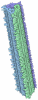
- Assembly
| Deposited unit | 
|
|---|---|
| 1 |
|
-Components
| #1: Protein | Mass: 29513.445 Da / Num. of mol.: 5 Source method: isolated from a genetically manipulated source Source: (gene. exp.) Saccharomyces cerevisiae (brewer's yeast)Gene: SUP35, GST1, PNM2, SAL3, SUF12, SUP2, YDR172W, YD9395.05 Production host:   Escherichia coli (E. coli) Escherichia coli (E. coli)References: UniProt: P05453, Hydrolases; Acting on acid anhydrides; Acting on GTP to facilitate cellular and subcellular movement Has protein modification | N | |
|---|
-Experimental details
-Experiment
| Experiment | Method: ELECTRON MICROSCOPY |
|---|---|
| EM experiment | Aggregation state: FILAMENT / 3D reconstruction method: helical reconstruction |
- Sample preparation
| Component | Name: Amyloid fibril of Sup35NM Sc4 / Type: COMPLEX / Entity ID: all / Source: RECOMBINANT |
|---|---|
| Molecular weight | Experimental value: NO |
| Source (natural) | Organism: Saccharomyces cerevisiae (brewer's yeast) |
| Source (recombinant) | Organism: Escherichia coli (E. coli) |
| Buffer solution | pH: 7.4 |
| Specimen | Embedding applied: NO / Shadowing applied: NO / Staining applied: NO / Vitrification applied: YES |
| Vitrification | Cryogen name: ETHANE |
- Electron microscopy imaging
| Experimental equipment |  Model: Titan Krios / Image courtesy: FEI Company |
|---|---|
| Microscopy | Model: TFS KRIOS |
| Electron gun | Electron source:  FIELD EMISSION GUN / Accelerating voltage: 300 kV / Illumination mode: FLOOD BEAM FIELD EMISSION GUN / Accelerating voltage: 300 kV / Illumination mode: FLOOD BEAM |
| Electron lens | Mode: BRIGHT FIELD / Nominal defocus max: 2000 nm / Nominal defocus min: 1000 nm |
| Image recording | Electron dose: 40.5 e/Å2 / Film or detector model: GATAN K3 BIOQUANTUM (6k x 4k) |
- Processing
| EM software |
| ||||||||||||||||||||||||
|---|---|---|---|---|---|---|---|---|---|---|---|---|---|---|---|---|---|---|---|---|---|---|---|---|---|
| CTF correction | Type: PHASE FLIPPING AND AMPLITUDE CORRECTION | ||||||||||||||||||||||||
| Helical symmerty | Angular rotation/subunit: -1.82 ° / Axial rise/subunit: 4.83 Å / Axial symmetry: C1 | ||||||||||||||||||||||||
| 3D reconstruction | Resolution: 3.1 Å / Resolution method: FSC 0.143 CUT-OFF / Num. of particles: 86542 / Symmetry type: HELICAL | ||||||||||||||||||||||||
| Refinement | Highest resolution: 3.1 Å Stereochemistry target values: REAL-SPACE (WEIGHTED MAP SUM AT ATOM CENTERS) | ||||||||||||||||||||||||
| Refine LS restraints |
|
