 Movie
Movie Controller


+ Open data

- Basic information
| Entry |  | |||||||||
|---|---|---|---|---|---|---|---|---|---|---|
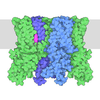
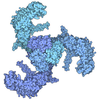
| Title | Structure of hTRPV1 in apo state | |||||||||
 Map data Map data | ||||||||||
 Sample Sample |
| |||||||||
 Keywords Keywords | Complex / Ion channel / MEMBRANE PROTEIN | |||||||||
| Function / homology |  Function and homology information Function and homology informationchemosensory behavior / response to capsazepine / temperature-gated ion channel activity / thermoception / cellular response to alkaloid / dendritic spine membrane / excitatory extracellular ligand-gated monoatomic ion channel activity / TRP channels / cellular response to ATP / intracellularly gated calcium channel activity ...chemosensory behavior / response to capsazepine / temperature-gated ion channel activity / thermoception / cellular response to alkaloid / dendritic spine membrane / excitatory extracellular ligand-gated monoatomic ion channel activity / TRP channels / cellular response to ATP / intracellularly gated calcium channel activity / detection of temperature stimulus involved in sensory perception of pain / calcium ion import across plasma membrane / voltage-gated calcium channel activity / cellular response to acidic pH / extracellular ligand-gated monoatomic ion channel activity / phosphatidylinositol binding / phosphoprotein binding / GABA-ergic synapse / calcium ion transmembrane transport / calcium channel activity / transmembrane signaling receptor activity / cellular response to heat / protein homotetramerization / calmodulin binding / cell surface receptor signaling pathway / postsynaptic membrane / negative regulation of transcription by RNA polymerase II / ATP binding / membrane / metal ion binding / plasma membrane Similarity search - Function | |||||||||
| Biological species |  Homo sapiens (human) Homo sapiens (human) | |||||||||
| Method | single particle reconstruction / cryo EM / Resolution: 2.63 Å | |||||||||
 Authors Authors | Min YM / Zonglin DZ / Yang YY | |||||||||
| Funding support |  China, 1 items China, 1 items
| |||||||||
 Citation Citation | Journal: Phytomedicine / Year: 2026 Title: Structural insights into TRPA1 and TRPV1 modulation by flavonoid glycosides from licorice for cough relief. Authors: Yang Yi / Guifang Duan / Zonglin Dai / Xiaogang Zhou / Jian Huang / Zhengtong Jin / Ao Yang / Yue Li / Zhuo Huang / Min Ye / Abstract: BACKGROUND: Transient receptor potential vanilloid 1 (TRPV1) and ankyrin 1 (TRPA1) are two nociceptive TRP channel subtypes that play central roles in cough hypersensitivity. PURPOSE: This study evaluated the antitussive efficacy of liquiritin apioside (LIQA) and liquiritin (LIQ), two major flavonoid glycosides from licorice, in acute chemically induced cough models, and ...PURPOSE: This study evaluated the antitussive efficacy of liquiritin apioside (LIQA) and liquiritin (LIQ), two major flavonoid glycosides from licorice, in acute chemically induced cough models, and investigated their modulations of TRPA1 and TRPV1. METHODS: In guinea pig models, cough was induced by capsaicin (a TRPV1 agonist) and cinnamaldehyde (a TRPA1 agonist), respectively. The inhibitory effects of LIQA and LIQ against TRPA1 and TRPV1 were ...METHODS: In guinea pig models, cough was induced by capsaicin (a TRPV1 agonist) and cinnamaldehyde (a TRPA1 agonist), respectively. The inhibitory effects of LIQA and LIQ against TRPA1 and TRPV1 were assessed using electrophysiological profiling and fluorescence-based calcium assays. To elucidate the underlying mechanisms, high-resolution cryo-electron microscopy (cryo-EM) structural analysis, and molecular simulations were conducted. RESULTS: LIQA and LIQ significantly reduced cough frequency in the guinea pig models. Electrophysiological profiling revealed that LIQA suppressed human TRPA1 (hTRPA1) channel activity, while LIQ ...RESULTS: LIQA and LIQ significantly reduced cough frequency in the guinea pig models. Electrophysiological profiling revealed that LIQA suppressed human TRPA1 (hTRPA1) channel activity, while LIQ blocked human TRPV1 (hTRPV1) activation. High-resolution cryo-EM structures of hTRPA1/LIQA (2.59 Å) and hTRPV1/LIQ (3.05 Å) complexes were obtained. Structural analysis indicates that LIQA stabilizes hTRPA1 in a closed conformation with T624 at the coupling region site, whereas LIQ interacts with S512 through hydrogen bonding in the deep S4-S5 site of hTRPV1, thereby inhibiting pore opening. CONCLUSION: This study establishes LIQA and LIQ as lead compounds with acute antitussive activities mediated by TRPA1/TRPV1 modulation. | |||||||||
| History |
|
- Structure visualization
| Supplemental images |
|---|

- Downloads & links
-EMDB archive
| Map data | emd_65348.map.gz | 97.1 MB | EMDB map data format | |
|---|---|---|---|---|
| Header (meta data) | emd-65348-v30.xmlemd-65348.xml | 16.5 KB 16.5 KB | Display Display | EMDB header |
| FSC (resolution estimation) | emd_65348_fsc.xml | 9.9 KB | Display | FSC data file |
| Images |  emd_65348.png emd_65348.png | 41.3 KB | ||
| Filedesc metadata | emd-65348.cif.gz | 6.1 KB | ||
| Others | emd_65348_half_map_1.map.gzemd_65348_half_map_2.map.gz | 95.4 MB 95.4 MB | ||
| Archive directory |  https://data.pdbj.org/pub/emdb/structures/EMD-65348ftp://data.pdbj.org/pub/emdb/structures/EMD-65348 https://data.pdbj.org/pub/emdb/structures/EMD-65348ftp://data.pdbj.org/pub/emdb/structures/EMD-65348 | HTTPS FTP |
-Related structure data
| Related structure data |  9vu0MC  9vtzC  9vu1C M: atomic model generated by this map C: citing same article ( |
|---|---|
| Similar structure data |


-Links
| EMDB pages | EMDB (EBI/PDBe) / EMDataResource |
|---|---|
| Related items in Molecule of the Month |
-Map
| File | Download / File: emd_65348.map.gz / Format: CCP4 / Size: 103 MB / Type: IMAGE STORED AS FLOATING POINT NUMBER (4 BYTES) | ||||||||||||||||||||||||||||||||||||
|---|---|---|---|---|---|---|---|---|---|---|---|---|---|---|---|---|---|---|---|---|---|---|---|---|---|---|---|---|---|---|---|---|---|---|---|---|---|
| Projections & slices | Image control
Images are generated by Spider. | ||||||||||||||||||||||||||||||||||||
| Voxel size | X=Y=Z: 0.85 Å | ||||||||||||||||||||||||||||||||||||
| Density |
| ||||||||||||||||||||||||||||||||||||
| Symmetry | Space group: 1 | ||||||||||||||||||||||||||||||||||||
| Details | EMDB XML:
|
 Z (Sec.)
 Y (Row.)
 X (Col.)


-Supplemental data
-Half map: #2
| File | emd_65348_half_map_1.map | ||||||||||||
|---|---|---|---|---|---|---|---|---|---|---|---|---|---|
| Projections & Slices |
| ||||||||||||
| Density Histograms |


-Half map: #1
| File | emd_65348_half_map_2.map | ||||||||||||
|---|---|---|---|---|---|---|---|---|---|---|---|---|---|
| Projections & Slices |
| ||||||||||||
| Density Histograms |


- Sample components
-Entire : TRPV1-apo
| Entire | Name: TRPV1-apo |
|---|---|
| Components |
|
-Supramolecule #1: TRPV1-apo
| Supramolecule | Name: TRPV1-apo / type: complex / ID: 1 / Parent: 0 / Macromolecule list: #1 |
|---|---|
| Source (natural) | Organism: Homo sapiens (human) |
-Macromolecule #1: Transient receptor potential cation channel subfamily V member 1
| Macromolecule | Name: Transient receptor potential cation channel subfamily V member 1 type: protein_or_peptide / ID: 1 / Number of copies: 4 / Enantiomer: LEVO |
|---|---|
| Source (natural) | Organism: Homo sapiens (human) |
| Molecular weight | Theoretical: 95.063062 KDa |
| Recombinant expression | Organism: Homo sapiens (human) |
| Sequence | String: MKKWSSTDLG AAADPLQKDT CPDPLDGDPN SRPPPAKPQL STAKSRTRLF GKGDSEEAFP VDCPHEEGEL DSCPTITVSP VITIQRPGD GPTGARLLSQ DSVAASTEKT LRLYDRRSIF EAVAQNNCQD LESLLLFLQK SKKHLTDNEF KDPETGKTCL L KAMLNLHD ...String: MKKWSSTDLG AAADPLQKDT CPDPLDGDPN SRPPPAKPQL STAKSRTRLF GKGDSEEAFP VDCPHEEGEL DSCPTITVSP VITIQRPGD GPTGARLLSQ DSVAASTEKT LRLYDRRSIF EAVAQNNCQD LESLLLFLQK SKKHLTDNEF KDPETGKTCL L KAMLNLHD GQNTTIPLLL EIARQTDSLK ELVNASYTDS YYKGQTALHI AIERRNMALV TLLVENGADV QAAAHGDFFK KT KGRPGFY FGELPLSLAA CTNQLGIVKF LLQNSWQTAD ISARDSVGNT VLHALVEVAD NTADNTKFVT SMYNEILMLG AKL HPTLKL EELTNKKGMT PLALAAGTGK IGVLAYILQR EIQEPECRHL SRKFTEWAYG PVHSSLYDLS CIDTCEKNSV LEVI AYSSS ETPNRHDMLL VEPLNRLLQD KWDRFVKRIF YFNFLVYCLY MIIFTMAAYY RPVDGLPPFK MEKTGDYFRV TGEIL SVLG GVYFFFRGIQ YFLQRRPSMK TLFVDSYSEM LFFLQSLFML ATVVLYFSHL KEYVASMVFS LALGWTNMLY YTRGFQ QMG IYAVMIEKMI LRDLCRFMFV YIVFLFGFST AVVTLIEDGK NDSLPSESTS HRWRGPACRP PDSSYNSLYS TCLELFK FT IGMGDLEFTE NYDFKAVFII LLLAYVILTY ILLLNMLIAL MGETVNKIAQ ESKNIWKLQR AITILDTEKS FLKCMRKA F RSGKLLQVGY TPDGKDDYRW CFRVDEVNWT TWNTNVGIIN EDPGNCEGVK RTLSFSLRSS RVSGRHWKNF ALVPLLREA SARDRQSAQP EEVYLRQFSG SLKPEDAEVF KSPAASGEK UniProtKB: Transient receptor potential cation channel subfamily V member 1 |
-Macromolecule #2: (2S)-3-(hexadecanoyloxy)-2-[(9Z)-octadec-9-enoyloxy]propyl 2-(tri...
| Macromolecule | Name: (2S)-3-(hexadecanoyloxy)-2-[(9Z)-octadec-9-enoyloxy]propyl 2-(trimethylammonio)ethyl phosphate type: ligand / ID: 2 / Number of copies: 4 / Formula: POV |
|---|---|
| Molecular weight | Theoretical: 760.076 Da |
| Chemical component information | 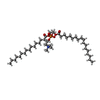 ChemComp-POV: |
-Macromolecule #3: 1-palmitoyl-2-oleoyl-sn-glycero-3-phosphoinositol
| Macromolecule | Name: 1-palmitoyl-2-oleoyl-sn-glycero-3-phosphoinositol / type: ligand / ID: 3 / Number of copies: 4 / Formula: YBG |
|---|---|
| Molecular weight | Theoretical: 837.069 Da |
| Chemical component information |  ChemComp-YBG: |
-Experimental details
-Structure determination
| Method | cryo EM |
|---|---|
 Processing Processing | single particle reconstruction |
| Aggregation state | particle |
-Sample preparation
| Buffer | pH: 7.4 |
|---|---|
| Vitrification | Cryogen name: ETHANE |
- Electron microscopy
| Microscope | TFS KRIOS |
|---|---|
| Image recording | Film or detector model: FEI FALCON IV (4k x 4k) / Average electron dose: 50.0 e/Å2 |
| Electron beam | Acceleration voltage: 300 kV / Electron source:  FIELD EMISSION GUN FIELD EMISSION GUN |
| Electron optics | Illumination mode: FLOOD BEAM / Imaging mode: BRIGHT FIELD / Nominal defocus max: 1.6 µm / Nominal defocus min: 0.8 µm |
| Experimental equipment |  Model: Titan Krios / Image courtesy: FEI Company |


