 Movie
Movie Controller


+ Open data

- Basic information
| Entry | Database: PDB / ID: 9vu0 | ||||||||||||||||||||||||
|---|---|---|---|---|---|---|---|---|---|---|---|---|---|---|---|---|---|---|---|---|---|---|---|---|---|
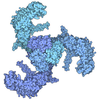
| Title | Structure of hTRPV1 in apo state | ||||||||||||||||||||||||
 Components Components | Transient receptor potential cation channel subfamily V member 1 | ||||||||||||||||||||||||
 Keywords Keywords | MEMBRANE PROTEIN / Complex / Ion channel | ||||||||||||||||||||||||
| Function / homology |  Function and homology information Function and homology informationchemosensory behavior / response to capsazepine / temperature-gated ion channel activity / thermoception / cellular response to alkaloid / dendritic spine membrane / excitatory extracellular ligand-gated monoatomic ion channel activity / TRP channels / cellular response to ATP / intracellularly gated calcium channel activity ...chemosensory behavior / response to capsazepine / temperature-gated ion channel activity / thermoception / cellular response to alkaloid / dendritic spine membrane / excitatory extracellular ligand-gated monoatomic ion channel activity / TRP channels / cellular response to ATP / intracellularly gated calcium channel activity / detection of temperature stimulus involved in sensory perception of pain / calcium ion import across plasma membrane / voltage-gated calcium channel activity / cellular response to acidic pH / extracellular ligand-gated monoatomic ion channel activity / phosphatidylinositol binding / phosphoprotein binding / GABA-ergic synapse / calcium ion transmembrane transport / calcium channel activity / transmembrane signaling receptor activity / cellular response to heat / protein homotetramerization / calmodulin binding / cell surface receptor signaling pathway / postsynaptic membrane / negative regulation of transcription by RNA polymerase II / ATP binding / membrane / metal ion binding / plasma membrane Similarity search - Function | ||||||||||||||||||||||||
| Biological species |  Homo sapiens (human) Homo sapiens (human) | ||||||||||||||||||||||||
| Method | ELECTRON MICROSCOPY / single particle reconstruction / cryo EM / Resolution: 2.63 Å | ||||||||||||||||||||||||
 Authors Authors | Min, Y.M. / Zonglin, D.Z. / Yang, Y.Y. | ||||||||||||||||||||||||
| Funding support |  China, 1items China, 1items
| ||||||||||||||||||||||||
 Citation Citation | Journal: Phytomedicine / Year: 2026 Title: Structural insights into TRPA1 and TRPV1 modulation by flavonoid glycosides from licorice for cough relief. Authors: Yang Yi / Guifang Duan / Zonglin Dai / Xiaogang Zhou / Jian Huang / Zhengtong Jin / Ao Yang / Yue Li / Zhuo Huang / Min Ye / Abstract: BACKGROUND: Transient receptor potential vanilloid 1 (TRPV1) and ankyrin 1 (TRPA1) are two nociceptive TRP channel subtypes that play central roles in cough hypersensitivity. PURPOSE: This study evaluated the antitussive efficacy of liquiritin apioside (LIQA) and liquiritin (LIQ), two major flavonoid glycosides from licorice, in acute chemically induced cough models, and ...PURPOSE: This study evaluated the antitussive efficacy of liquiritin apioside (LIQA) and liquiritin (LIQ), two major flavonoid glycosides from licorice, in acute chemically induced cough models, and investigated their modulations of TRPA1 and TRPV1. METHODS: In guinea pig models, cough was induced by capsaicin (a TRPV1 agonist) and cinnamaldehyde (a TRPA1 agonist), respectively. The inhibitory effects of LIQA and LIQ against TRPA1 and TRPV1 were ...METHODS: In guinea pig models, cough was induced by capsaicin (a TRPV1 agonist) and cinnamaldehyde (a TRPA1 agonist), respectively. The inhibitory effects of LIQA and LIQ against TRPA1 and TRPV1 were assessed using electrophysiological profiling and fluorescence-based calcium assays. To elucidate the underlying mechanisms, high-resolution cryo-electron microscopy (cryo-EM) structural analysis, and molecular simulations were conducted. RESULTS: LIQA and LIQ significantly reduced cough frequency in the guinea pig models. Electrophysiological profiling revealed that LIQA suppressed human TRPA1 (hTRPA1) channel activity, while LIQ ...RESULTS: LIQA and LIQ significantly reduced cough frequency in the guinea pig models. Electrophysiological profiling revealed that LIQA suppressed human TRPA1 (hTRPA1) channel activity, while LIQ blocked human TRPV1 (hTRPV1) activation. High-resolution cryo-EM structures of hTRPA1/LIQA (2.59 Å) and hTRPV1/LIQ (3.05 Å) complexes were obtained. Structural analysis indicates that LIQA stabilizes hTRPA1 in a closed conformation with T624 at the coupling region site, whereas LIQ interacts with S512 through hydrogen bonding in the deep S4-S5 site of hTRPV1, thereby inhibiting pore opening. CONCLUSION: This study establishes LIQA and LIQ as lead compounds with acute antitussive activities mediated by TRPA1/TRPV1 modulation. | ||||||||||||||||||||||||
| History |
|
- Structure visualization
| Structure viewer | Molecule: MolmilJmol/JSmol |
|---|
- Downloads & links
-Download
| PDBx/mmCIF format | 9vu0.cif.gz | 496 KB | Display | PDBx/mmCIF format |
|---|---|---|---|---|
| PDB format | pdb9vu0.ent.gz | 396.4 KB | Display | PDB format |
| PDBx/mmJSON format | 9vu0.json.gz | Tree view | PDBx/mmJSON format | |
| Others |  Other downloads Other downloads |
-Validation report
| Arichive directory | https://data.pdbj.org/pub/pdb/validation_reports/vu/9vu0ftp://data.pdbj.org/pub/pdb/validation_reports/vu/9vu0 | HTTPS FTP |
|---|
-Related structure data
| Related structure data |  65348MC  9vtzC  9vu1C M: map data used to model this data C: citing same article ( |
|---|---|
| Similar structure data |


-Links
 PDBj
PDBj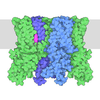
- Assembly
| Deposited unit | 
|
|---|---|
| 1 |
|
-Components
| #1: Protein | Mass: 95063.062 Da / Num. of mol.: 4 Source method: isolated from a genetically manipulated source Source: (gene. exp.) Homo sapiens (human) / Gene: TRPV1, VR1 / Production host: Homo sapiens (human) / References: UniProt: Q8NER1#2: Chemical | ChemComp-POV / (  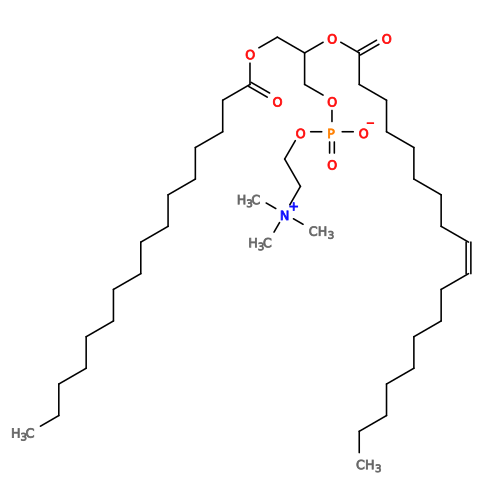 Mass: 760.076 Da / Num. of mol.: 4 / Source method: obtained synthetically / Formula: C42H82NO8P / Feature type: SUBJECT OF INVESTIGATION / Comment: phospholipid*YM Mass: 760.076 Da / Num. of mol.: 4 / Source method: obtained synthetically / Formula: C42H82NO8P / Feature type: SUBJECT OF INVESTIGATION / Comment: phospholipid*YM#3: Chemical | ChemComp-YBG /  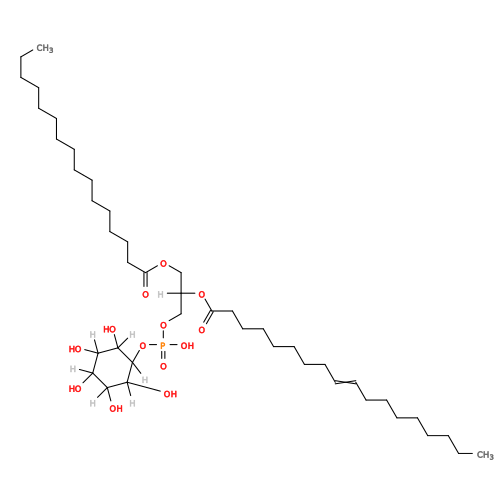 Mass: 837.069 Da / Num. of mol.: 4 / Source method: obtained synthetically / Formula: C43H81O13P / Feature type: SUBJECT OF INVESTIGATION Mass: 837.069 Da / Num. of mol.: 4 / Source method: obtained synthetically / Formula: C43H81O13P / Feature type: SUBJECT OF INVESTIGATIONHas ligand of interest | Y | Has protein modification | N | |
|---|
-Experimental details
-Experiment
| Experiment | Method: ELECTRON MICROSCOPY |
|---|---|
| EM experiment | Aggregation state: PARTICLE / 3D reconstruction method: single particle reconstruction |
- Sample preparation
| Component | Name: TRPV1-apo / Type: COMPLEX / Entity ID: #1 / Source: RECOMBINANT |
|---|---|
| Molecular weight | Experimental value: NO |
| Source (natural) | Organism: Homo sapiens (human) |
| Source (recombinant) | Organism: Homo sapiens (human) |
| Buffer solution | pH: 7.4 |
| Specimen | Embedding applied: NO / Shadowing applied: NO / Staining applied: NO / Vitrification applied: YES |
| Vitrification | Cryogen name: ETHANE |
- Electron microscopy imaging
| Experimental equipment |  Model: Titan Krios / Image courtesy: FEI Company |
|---|---|
| Microscopy | Model: TFS KRIOS |
| Electron gun | Electron source:  FIELD EMISSION GUN / Accelerating voltage: 300 kV / Illumination mode: FLOOD BEAM FIELD EMISSION GUN / Accelerating voltage: 300 kV / Illumination mode: FLOOD BEAM |
| Electron lens | Mode: BRIGHT FIELD / Nominal defocus max: 1600 nm / Nominal defocus min: 800 nm |
| Image recording | Electron dose: 50 e/Å2 / Film or detector model: FEI FALCON IV (4k x 4k) |
- Processing
| EM software |
| ||||||||||||||||||||||||
|---|---|---|---|---|---|---|---|---|---|---|---|---|---|---|---|---|---|---|---|---|---|---|---|---|---|
| CTF correction | Type: NONE | ||||||||||||||||||||||||
| 3D reconstruction | Resolution: 2.63 Å / Resolution method: FSC 0.143 CUT-OFF / Num. of particles: 123334 / Symmetry type: POINT | ||||||||||||||||||||||||
| Refinement | Highest resolution: 2.63 Å / Cross valid method: NONE Stereochemistry target values: REAL-SPACE (WEIGHTED MAP SUM AT ATOM CENTERS) | ||||||||||||||||||||||||
| Refine LS restraints |
|
