[English] 日本語
Yorodumi
- EMDB-54360: VPS34-CI bound to NRBF2 MIT domain (residues 1-79), unsharpened c... -

+
Open data


ID or keywords:

Loading...

-
Basic information

Entry
Database: EMDB / ID: EMD-54360
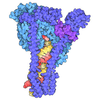
TitleVPS34-CI bound to NRBF2 MIT domain (residues 1-79), unsharpened composite EM map
Map dataVPS34-CI bound to NRBF2 MIT domain (residues 1-88)
Sample
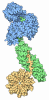
  • Complex: Human VPS34-CI (VPS34/VPS15/BECLIN1/ATG14L) in complex with NRBF2 MIT domain (residues 1-79)
    • Protein or peptide: Nuclear receptor-binding factor 2
    • Protein or peptide: Beclin 1-associated autophagy-related key regulator
    • Protein or peptide: Beclin-1
    • Protein or peptide: Phosphatidylinositol 3-kinase catalytic subunit type 3
  • Protein or peptide: Phosphoinositide 3-kinase regulatory subunit 4
  • Ligand: GUANOSINE-5'-DIPHOSPHATE
  • Ligand: MAGNESIUM ION
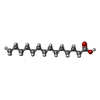
  • Ligand: MYRISTIC ACID
  • Ligand: ZINC ION
KeywordsLipid kinase / GTPase / kinase / autophagy / SIGNALING PROTEIN
Function / homology
Function and homology information


extrinsic component of omegasome membrane / phosphatidylinositol 3-kinase inhibitor activity / extrinsic component of phagophore assembly site membrane / nucleus-vacuole junction / cellular response to aluminum ion / positive regulation of protein lipidation / positive regulation of stress granule assembly / postsynaptic endosome / Toll Like Receptor 9 (TLR9) Cascade / Synthesis of PIPs at the late endosome membrane ...extrinsic component of omegasome membrane / phosphatidylinositol 3-kinase inhibitor activity / extrinsic component of phagophore assembly site membrane / nucleus-vacuole junction / cellular response to aluminum ion / positive regulation of protein lipidation / positive regulation of stress granule assembly / postsynaptic endosome / Toll Like Receptor 9 (TLR9) Cascade / Synthesis of PIPs at the late endosome membrane / phosphatidylinositol 3-kinase complex, class III / cellular response to oxygen-glucose deprivation / Synthesis of PIPs at the early endosome membrane / phosphatidylinositol 3-kinase complex, class III, type II / phosphatidylinositol 3-kinase complex, class III, type I / response to mitochondrial depolarisation / presynaptic endosome / positive regulation of attachment of mitotic spindle microtubules to kinetochore / host-mediated activation of viral genome replication / mitochondria-associated endoplasmic reticulum membrane contact site / engulfment of apoptotic cell / regulation of protein complex stability / negative regulation of lysosome organization / phosphatidylinositol kinase activity / SMAD protein signal transduction / positive regulation of autophagosome assembly / phosphatidylinositol 3-kinase regulator activity / Synthesis of PIPs at the Golgi membrane / cytoplasmic side of mitochondrial outer membrane / early endosome to late endosome transport / phagophore assembly site membrane / receptor catabolic process / response to L-leucine / protein targeting to lysosome / protein targeting to vacuole / late endosome to vacuole transport / endosome organization / Dengue virus modulates apoptosis / pexophagy / positive regulation of natural killer cell mediated cytotoxicity / phagophore assembly site / Translation of Replicase and Assembly of the Replication Transcription Complex / cellular response to nitrogen starvation / negative regulation of programmed cell death / phosphatidylinositol 3-kinase / phosphatidylinositol-3-phosphate biosynthetic process / 1-phosphatidylinositol-3-kinase activity / post-transcriptional regulation of gene expression / response to vitamin E / Macroautophagy / endosome to lysosome transport / p38MAPK cascade / autophagosome membrane docking / response to iron(II) ion / RSV-host interactions / cytoplasmic pattern recognition receptor signaling pathway / phosphatidylinositol phosphate biosynthetic process / negative regulation of protein phosphorylation / phosphatidylinositol-mediated signaling / autolysosome / autophagosome membrane / PI3K Cascade / autophagosome maturation / RHO GTPases Activate NADPH Oxidases / JNK cascade / mitotic metaphase chromosome alignment / axoneme / synaptic vesicle endocytosis / cellular response to glucose starvation / cellular defense response / autophagosome assembly / mitophagy / phosphatidylinositol 3-kinase binding / regulation of macroautophagy / positive regulation of intrinsic apoptotic signaling pathway / phagocytic vesicle / protein-membrane adaptor activity / positive regulation of autophagy / response to endoplasmic reticulum stress / autophagosome / cellular response to epidermal growth factor stimulus / cellular response to copper ion / cellular response to amino acid starvation / cellular response to starvation / regulation of autophagy / macroautophagy / regulation of cytokinesis / phosphatidylinositol 3-kinase/protein kinase B signal transduction / Antigen Presentation: Folding, assembly and peptide loading of class I MHC / trans-Golgi network / circadian rhythm / protein processing / Nuclear Receptor transcription pathway / positive regulation of protein phosphorylation / response to lead ion / GABA-ergic synapse / ISG15 antiviral mechanism / cellular response to hydrogen peroxide / phagocytic vesicle membrane / autophagy
Similarity search - Function
Nuclear receptor-binding factor 2, C-terminal / Nuclear receptor-binding factor 2, MIT domain / Nuclear receptor-binding factor 2 / Nuclear receptor-binding factor 2, autophagy regulator / MIT domain of nuclear receptor-binding factor 2 / UV radiation resistance protein/autophagy-related protein 14 / Vacuolar sorting 38 and autophagy-related subunit 14 / Serine/threonine-protein kinase Vps15-like / Beclin-1, BH3 domain / Beclin-1 BH3 domain, Bcl-2-interacting ...Nuclear receptor-binding factor 2, C-terminal / Nuclear receptor-binding factor 2, MIT domain / Nuclear receptor-binding factor 2 / Nuclear receptor-binding factor 2, autophagy regulator / MIT domain of nuclear receptor-binding factor 2 / UV radiation resistance protein/autophagy-related protein 14 / Vacuolar sorting 38 and autophagy-related subunit 14 / Serine/threonine-protein kinase Vps15-like / Beclin-1, BH3 domain / Beclin-1 BH3 domain, Bcl-2-interacting / Atg6/Beclin / Atg6/Beclin C-terminal domain superfamily / Atg6, BARA domain / Atg6/beclin, coiled-coil domain / Apg6 BARA domain / Apg6 coiled-coil region / Phosphatidylinositol 3-kinase, Vps34 type / : / : / PIK3R4-like, middle domain / HEAT, type 2 / HEAT repeat profile. / C2 phosphatidylinositol 3-kinase-type domain / Phosphoinositide 3-kinase C2 / C2 phosphatidylinositol 3-kinase (PI3K)-type domain profile. / Phosphoinositide 3-kinase, region postulated to contain C2 domain / Phosphoinositide 3-kinase family, accessory domain (PIK domain) / Phosphoinositide 3-kinase family, accessory domain (PIK domain) / Phosphoinositide 3-kinase, accessory (PIK) domain superfamily / Phosphoinositide 3-kinase, accessory (PIK) domain / Phosphatidylinositol kinase / PIK helical domain profile. / Phosphatidylinositol 3- and 4-kinases signature 1. / Phosphatidylinositol 3/4-kinase, conserved site / Phosphatidylinositol 3- and 4-kinases signature 2. / Phosphatidylinositol 3-/4-kinase, catalytic domain superfamily / Phosphoinositide 3-kinase, catalytic domain / Phosphatidylinositol 3- and 4-kinase / Phosphatidylinositol 3- and 4-kinases catalytic domain profile. / Phosphatidylinositol 3-/4-kinase, catalytic domain / C2 domain superfamily / Armadillo-like helical / WD domain, G-beta repeat / Armadillo-type fold / Serine/threonine-protein kinase, active site / Serine/Threonine protein kinases active-site signature. / Trp-Asp (WD) repeats signature. / Protein kinase domain / Trp-Asp (WD) repeats profile. / Trp-Asp (WD) repeats circular profile. / WD40 repeats / WD40 repeat / Serine/Threonine protein kinases, catalytic domain / WD40-repeat-containing domain superfamily / WD40/YVTN repeat-like-containing domain superfamily / Protein kinase domain profile. / Protein kinase domain / Protein kinase-like domain superfamily
Similarity search - Domain/homology
Beclin-1 / Beclin 1-associated autophagy-related key regulator / Phosphatidylinositol 3-kinase catalytic subunit type 3 / Nuclear receptor-binding factor 2 / Phosphoinositide 3-kinase regulatory subunit 4
Similarity search - Component
Biological speciesHomo sapiens (human)
Methodsingle particle reconstruction / cryo EM / Resolution: 3.33 Å
AuthorsSpokaite S / Ohashi Y / Dessus AN / Bourguet M / Williams RL
Funding support United Kingdom, 2 items
OrganizationGrant numberCountry
Medical Research Council (MRC, United Kingdom)MC_U105184308 United Kingdom
Cancer Research UKDRCPGM 100014 United Kingdom
CitationJournal: To Be Published
Title: When VPS34 complexes double down: Two RAB5s for VPS34-CII, two RAB1s for NRBF2-dimerized VPS34-CI
Authors: Spokaite S / Ohashi Y / Dessus AN / Bourguet M / Williams RL
History
DepositionJul 10, 2025-
Header (metadata) releaseJul 22, 2026-
Map releaseJul 22, 2026-
UpdateJul 22, 2026-
Current statusJul 22, 2026Processing site: PDBe / Status: Released

-
Structure visualization

Supplemental images

Downloads & links

-
Map

FileDownload / File: emd_54360.map.gz / Format: CCP4 / Size: 244.1 MB / Type: IMAGE STORED AS FLOATING POINT NUMBER (4 BYTES)
AnnotationVPS34-CI bound to NRBF2 MIT domain (residues 1-88)
Projections & slices

Image control

Size
Brightness
Contrast
Others
AxesZ (Sec.)Y (Row.)X (Col.)
0.86 Å/pix.
x 400 pix.
= 344. Å
0.86 Å/pix.
x 400 pix.
= 344. Å
0.86 Å/pix.
x 400 pix.
= 344. Å

Surface

Projections

Slices (1/3)

Slices (1/2)

Slices (2/3)

Images are generated by Spider.

Voxel sizeX=Y=Z: 0.86 Å
Density
Contour LevelBy AUTHOR: 0.23
Minimum - Maximum-0.029451035 - 1.2989922
Average (Standard dev.)0.020959806 (±0.04041394)
SymmetrySpace group: 1
Details

EMDB XML:

Map geometry
Axis orderXYZ
Origin000
Dimensions400400400
Spacing400400400
CellA=B=C: 344.0 Å
α=β=γ: 90.0 °

-
Supplemental data

-
Sample components

+
Entire : Human VPS34-CI (VPS34/VPS15/BECLIN1/ATG14L) in complex with NRBF2...

EntireName: Human VPS34-CI (VPS34/VPS15/BECLIN1/ATG14L) in complex with NRBF2 MIT domain (residues 1-79)
Components
  • Complex: Human VPS34-CI (VPS34/VPS15/BECLIN1/ATG14L) in complex with NRBF2 MIT domain (residues 1-79)
    • Protein or peptide: Nuclear receptor-binding factor 2
    • Protein or peptide: Beclin 1-associated autophagy-related key regulator
    • Protein or peptide: Beclin-1
    • Protein or peptide: Phosphatidylinositol 3-kinase catalytic subunit type 3
  • Protein or peptide: Phosphoinositide 3-kinase regulatory subunit 4
  • Ligand: GUANOSINE-5'-DIPHOSPHATE
  • Ligand: MAGNESIUM ION
  • Ligand: MYRISTIC ACID
  • Ligand: ZINC ION

+
Supramolecule #1: Human VPS34-CI (VPS34/VPS15/BECLIN1/ATG14L) in complex with NRBF2...

SupramoleculeName: Human VPS34-CI (VPS34/VPS15/BECLIN1/ATG14L) in complex with NRBF2 MIT domain (residues 1-79)
type: complex / ID: 1 / Parent: 0 / Macromolecule list: #5, #4, #3, #1
Source (natural)Organism: Homo sapiens (human)
Molecular weightTheoretical: 373 KDa

+
Macromolecule #1: Phosphatidylinositol 3-kinase catalytic subunit type 3

MacromoleculeName: Phosphatidylinositol 3-kinase catalytic subunit type 3
type: protein_or_peptide / ID: 1 / Details: Full length VPS34 / Number of copies: 1 / Enantiomer: LEVO / EC number: phosphatidylinositol 3-kinase
Source (natural)Organism: Homo sapiens (human)
Molecular weightTheoretical: 101.680328 KDa
Recombinant expressionOrganism: Homo sapiens (human)
SequenceString: MGEAEKFHYI YSCDLDINVQ LKIGSLEGKR EQKSYKAVLE DPMLKFSGLY QETCSDLYVT CQVFAEGKPL ALPVRTSYKA FSTRWNWNE WLKLPVKYPD LPRNAQVALT IWDVYGPGKA VPVGGTTVSL FGKYGMFRQG MHDLKVWPNV EADGSEPTKT P GRTSSTLS ...String:
MGEAEKFHYI YSCDLDINVQ LKIGSLEGKR EQKSYKAVLE DPMLKFSGLY QETCSDLYVT CQVFAEGKPL ALPVRTSYKA FSTRWNWNE WLKLPVKYPD LPRNAQVALT IWDVYGPGKA VPVGGTTVSL FGKYGMFRQG MHDLKVWPNV EADGSEPTKT P GRTSSTLS EDQMSRLAKL TKAHRQGHMV KVDWLDRLTF REIEMINESE KRSSNFMYLM VEFRCVKCDD KEYGIVYYEK DG DESSPIL TSFELVKVPD PQMSMENLVE SKHHKLARSL RSGPSDHDLK PNAATRDQLN IIVSYPPTKQ LTYEEQDLVW KFR YYLTNQ EKALTKFLKC VNWDLPQEAK QALELLGKWK PMDVEDSLEL LSSHYTNPTV RRYAVARLRQ ADDEDLLMYL LQLV QALKY ENFDDIKNGL EPTKKDSQSS VSENVSNSGI NSAEIDSSQI ITSPLPSVSS PPPASKTKEV PDGENLEQDL CTFLI SRAC KNSTLANYLY WYVIVECEDQ DTQQRDPKTH EMYLNVMRRF SQALLKGDKS VRVMRSLLAA QQTFVDRLVH LMKAVQ RES GNRKKKNERL QALLGDNEKM NLSDVELIPL PLEPQVKIRG IIPETATLFK SALMPAQLFF KTEDGGKYPV IFKHGDD LR QDQLILQIIS LMDKLLRKEN LDLKLTPYKV LATSTKHGFM QFIQSVPVAE VLDTEGSIQN FFRKYAPSEN GPNGISAE V MDTYVKSCAG YCVITYILGV GDRHLDNLLL TKTGKLFHID FGYILGRDPK PLPPPMKLNK EMVEGMGGTQ SEQYQEFRK QCYTAFLHLR RYSNLILNLF SLMVDANIPD IALEPDKTVK KVQDKFRLDL SDEEAVHYMQ SLIDESVHAL FAAVVEQIHK FAQYWRK

UniProtKB: Phosphatidylinositol 3-kinase catalytic subunit type 3

+
Macromolecule #2: Phosphoinositide 3-kinase regulatory subunit 4

MacromoleculeName: Phosphoinositide 3-kinase regulatory subunit 4 / type: protein_or_peptide / ID: 2
Details: Full length VPS15 with 13 extra amino acids at the C-terminus, left after TEV cleavage (VPS15-SRPTTASENLYFQ)
Number of copies: 1 / Enantiomer: LEVO / EC number: non-specific serine/threonine protein kinase
Source (natural)Organism: Homo sapiens (human)
Molecular weightTheoretical: 154.659188 KDa
Recombinant expressionOrganism: Homo sapiens (human)
SequenceString: GNQLAGIAPS QILSVESYFS DIHDFEYDKS LGSTRFFKVA RAKHREGLVV VKVFAIQDPT LPLTSYKQEL EELKIRLNSA QNCLPFQKA SEKASEKAAM LFRQYVRDNL YDRISTRPFL NNIEKRWIAF QILTAVDQAH KSGVRHGDIK TENVMVTSWN W VLLTDFAS ...String:
GNQLAGIAPS QILSVESYFS DIHDFEYDKS LGSTRFFKVA RAKHREGLVV VKVFAIQDPT LPLTSYKQEL EELKIRLNSA QNCLPFQKA SEKASEKAAM LFRQYVRDNL YDRISTRPFL NNIEKRWIAF QILTAVDQAH KSGVRHGDIK TENVMVTSWN W VLLTDFAS FKPTYLPEDN PADFNYFFDT SRRRTCYIAP ERFVDGGMFA TELEYMRDPS TPLVDLNSNQ RTRGELKRAM DI FSAGCVI AELFTEGVPL FDLSQLLAYR NGHFFPEQVL NKIEDHSIRE LVTQMIHREP DKRLEAEDYL KQQRGNAFPE IFY TFLQPY MAQFAKETFL SADERILVIR KDLGNIIHNL CGHDLPEKAE GEPKENGLVI LVSVITSCLQ TLKYCDSKLA ALEL ILHLA PRLSVEILLD RITPYLLHFS NDSVPRVRAE ALRTLTKVLA LVKEVPRNDI NIYPEYILPG IAHLAQDDAT IVRLA YAEN IALLAETALR FLELVQLKNL NMENDPNNEE IDEVTHPNGN YDTELQALHE MVQQKVVTLL SDPENIVKQT LMENGI TRL CVFFGRQKAN DVLLSHMITF LNDKNDWHLR GAFFDSIVGV AAYVGWQSSS ILKPLLQQGL SDAEEFVIVK ALYALTC MC QLGLLQKPHV YEFASDIAPF LCHPNLWIRY GAVGFITVVA RQISTADVYC KLMPYLDPYI TQPIIQIERK LVLLSVLK E PVSRSIFDYA LRSKDITSLF RHLHMRQKKR NGSLPDCPPP EDPAIAQLLK KLLSQGMTEE EEDKLLALKD FMMKSNKAK ANIVDQSHLH DSSQKGVIDL AALGITGRQV DLVKTKQEPD DKRARKHVKQ DSNVNEEWKS MFGSLDPPNM PQALPKGSDQ EVIQTGKPP RSESSAGICV PLSTSSQVPE VTTVQNKKPV IPVLSSTILP STYQIRITTC KTELQQLIQQ KREQCNAERI A KQMMENAE WESKPPPPGW RPKGLLVAHL HEHKSAVNRI RVSDEHSLFA TCSNDGTVKI WNSQKMEGKT TTTRSILTYS RI GGRVKTL TFCQGSHYLA IASDNGAVQL LGIEASKLPK SPKIHPLQSR ILDQKEDGCV VDMHHFNSGA QSVLAYATVN GSL VGWDLR SSSNAWTLKH DLKSGLITSF AVDIHQCWLC IGTSSGTMAC WDMRFQLPIS SHCHPSRARI RRLSMHPLYQ SWVI AAVQG NNEVSMWDME TGDRRFTLWA SSAPPLSELQ PSPHSVHGIY CSPADGNPIL LTAGSDMKIR FWDLAYPERS YVVAG STSS PSVSYYRKII EGTEVVQEIQ NKQKVGPSDD TPRRGPESLP VGHHDIITDV ATFQTTQGFI VTASRDGIVK VWKSRP TTA SENLYFQ

UniProtKB: Phosphoinositide 3-kinase regulatory subunit 4

+
Macromolecule #3: Beclin-1

MacromoleculeName: Beclin-1 / type: protein_or_peptide / ID: 3 / Details: Full length BECLIN1 / Number of copies: 2 / Enantiomer: LEVO
Source (natural)Organism: Homo sapiens (human)
Molecular weightTheoretical: 51.953102 KDa
Recombinant expressionOrganism: Homo sapiens (human)
SequenceString: MEGSKTSNNS TMQVSFVCQR CSQPLKLDTS FKILDRVTIQ ELTAPLLTTA QAKPGETQEE ETNSGEEPFI ETPRQDGVSR RFIPPARMM STESANSFTL IGEASDGGTM ENLSRRLKVT GDLFDIMSGQ TDVDHPLCEE CTDTLLDQLD TQLNVTENEC Q NYKRCLEI ...String:
MEGSKTSNNS TMQVSFVCQR CSQPLKLDTS FKILDRVTIQ ELTAPLLTTA QAKPGETQEE ETNSGEEPFI ETPRQDGVSR RFIPPARMM STESANSFTL IGEASDGGTM ENLSRRLKVT GDLFDIMSGQ TDVDHPLCEE CTDTLLDQLD TQLNVTENEC Q NYKRCLEI LEQMNEDDSE QLQMELKELA LEEERLIQEL EDVEKNRKIV AENLEKVQAE AERLDQEEAQ YQREYSEFKR QQ LELDDEL KSVENQMRYA QTQLDKLKKT NVFNATFHIW HSGQFGTINN FRLGRLPSVP VEWNEINAAW GQTVLLLHAL ANK MGLKFQ RYRLVPYGNH SYLESLTDKS KELPLYCSGG LRFFWDNKFD HAMVAFLDCV QQFKEEVEKG ETRFCLPYRM DVEK GKIED TGGSGGSYSI KTQFNSEEQW TKALKFMLTN LKWGLAWVSS QFYNK

UniProtKB: Beclin-1

+
Macromolecule #4: Beclin 1-associated autophagy-related key regulator

MacromoleculeName: Beclin 1-associated autophagy-related key regulator / type: protein_or_peptide / ID: 4
Details: Full length ATG14L with a N256S mutation and an insertion at T2
Number of copies: 1 / Enantiomer: LEVO
Source (natural)Organism: Homo sapiens (human)
Molecular weightTheoretical: 55.461348 KDa
Recombinant expressionOrganism: Homo sapiens (human)
SequenceString: MTASPSGKGA RALEAPGCGP RPLARDLVDS VDDAEGLYVA VERCPLCNTT RRRLTCAKCV QSGDFVYFDG RDRERFIDKK ERLSRLKSK QEEFQKEVLK AMEGKWITDQ LRWKIMSCKM RIEQLKQTIC KGNEEMEKNS EGLLKTKEKN QKLYSRAQRH Q EKKEKIQR ...String:
MTASPSGKGA RALEAPGCGP RPLARDLVDS VDDAEGLYVA VERCPLCNTT RRRLTCAKCV QSGDFVYFDG RDRERFIDKK ERLSRLKSK QEEFQKEVLK AMEGKWITDQ LRWKIMSCKM RIEQLKQTIC KGNEEMEKNS EGLLKTKEKN QKLYSRAQRH Q EKKEKIQR HNRKLGDLVE KKTIDLRSHY ERLANLRRSH ILELTSVIFP IEEVKTGVRD PADVSSESDS AMTSSTVSKL AE ARRTTYL SGRWVCDDHS GDTSISITGP WISLPNNGDY SAYYSWVEEK KTTQGPDMEQ SNPAYTISAA LCYATQLVNI LSH ILDVNL PKKLCNSEFC GENLSKQKFT RAVKKLNANI LYLCFSQHVN LDQLQPLHTL RNLMYLVSPS SEHLGRSGPF EVRA DLEES MEFVDPGVAG ESDESGDERV SDEETDLGTD WENLPSPRFC DIPSQSVEVS QSQSTQASPP IASSSAGGMI SSAAA SVTS WFKAYTGHR

UniProtKB: Beclin 1-associated autophagy-related key regulator

+
Macromolecule #5: Nuclear receptor-binding factor 2

MacromoleculeName: Nuclear receptor-binding factor 2 / type: protein_or_peptide / ID: 5
Details: NRBF2 MIT domain residues 1-79, with an N-terminal His6 tag followed by a spacer and a TEV protease cleavage site.
Number of copies: 1 / Enantiomer: LEVO
Source (natural)Organism: Homo sapiens (human)
Molecular weightTheoretical: 12.814479 KDa
Recombinant expressionOrganism: Escherichia coli (E. coli)
SequenceString:
MAHHHHHHSS GSENLYFQGS HMEVMEGPLN LAHQQSRRAD RLLAAGKYEE AISCHKKAAA YLSEAMKLTQ SEQAHLSLEL QRDSHMKQL LLIQERWKRA QREERLKAQQ N

UniProtKB: Nuclear receptor-binding factor 2

+
Macromolecule #6: GUANOSINE-5'-DIPHOSPHATE
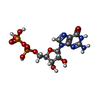
MacromoleculeName: GUANOSINE-5'-DIPHOSPHATE / type: ligand / ID: 6 / Number of copies: 1 / Formula: GDP
Molecular weightTheoretical: 443.201 Da
Chemical component information

ChemComp-GDP:
GUANOSINE-5'-DIPHOSPHATE / GDP, energy-carrying molecule*YM

+
Macromolecule #7: MAGNESIUM ION

MacromoleculeName: MAGNESIUM ION / type: ligand / ID: 7 / Number of copies: 1 / Formula: MG
Molecular weightTheoretical: 24.305 Da

+
Macromolecule #8: MYRISTIC ACID

MacromoleculeName: MYRISTIC ACID / type: ligand / ID: 8 / Number of copies: 1 / Formula: MYR
Molecular weightTheoretical: 228.371 Da
Chemical component information

ChemComp-MYR:
MYRISTIC ACID

+
Macromolecule #9: ZINC ION

MacromoleculeName: ZINC ION / type: ligand / ID: 9 / Number of copies: 2 / Formula: ZN
Molecular weightTheoretical: 65.409 Da

-
Experimental details

-
Structure determination

Methodcryo EM
Processingsingle particle reconstruction
Aggregation stateparticle

-
Sample preparation

Concentration1.5 mg/mL
BufferpH: 8
Component:
ConcentrationFormulaName
50.0 mMC8H18N2O4SHEPES
150.0 mMNaClSodium chloride
1.0 mMC9H15O6PTCEP
5.0 mMMgCl2Magnesium chloride
1.0 mMC10H17N6O12P3AMPPNP
2.0 % w/wC12H26O13Trehalose
0.01 % v/v(C2H4O)nC14H22ONonidet P40 substitute
GridModel: UltrAuFoil R1.2/1.3 / Material: GOLD / Mesh: 300 / Support film - Material: GOLD / Support film - topology: HOLEY / Pretreatment - Type: GLOW DISCHARGE / Pretreatment - Time: 90 sec. / Pretreatment - Atmosphere: AIR
VitrificationCryogen name: ETHANE / Chamber humidity: 100 % / Chamber temperature: 287 K / Instrument: FEI VITROBOT MARK II
Details: 4 uL sample, 0 second wait, 4.5 second blot, blot force +8.
DetailsSample was crosslinked with 20 uM BS3 for 20 minutes on ice, then quenched with 100 mM TRIS pH 8.0 prior to vitrification

-
Electron microscopy

MicroscopeTFS KRIOS
Specialist opticsEnergy filter - Name: GIF Bioquantum / Energy filter - Slit width: 20 eV
Image recordingFilm or detector model: GATAN K3 (6k x 4k) / Number grids imaged: 1 / Number real images: 8059 / Average electron dose: 50.0 e/Å2
Electron beamAcceleration voltage: 300 kV / Electron source: FIELD EMISSION GUN
Electron opticsC2 aperture diameter: 50.0 µm / Illumination mode: FLOOD BEAM / Imaging mode: BRIGHT FIELD / Nominal defocus max: 3.0 µm / Nominal defocus min: 1.4000000000000001 µm / Nominal magnification: 105000
Sample stageSpecimen holder model: FEI TITAN KRIOS AUTOGRID HOLDER / Cooling holder cryogen: NITROGEN
Experimental equipment
Model: Titan Krios / Image courtesy: FEI Company

+
Image processing

Particle selectionNumber selected: 168536 / Details: CrYOLO general model used for picking particles
CTF correctionType: NONE
Startup modelType of model: INSILICO MODEL
Final reconstructionResolution.type: BY AUTHOR / Resolution: 3.33 Å / Resolution method: FSC 0.143 CUT-OFF / Software - Name: cryoSPARC / Number images used: 50167
Initial angle assignmentType: MAXIMUM LIKELIHOOD
Final angle assignmentType: MAXIMUM LIKELIHOOD

-
Atomic model buiding 1

RefinementSpace: REAL / Protocol: FLEXIBLE FIT
Output model

PDB-9rx7:
VPS34-CI bound to NRBF2 MIT domain (residues 1-79)

+
About Yorodumi

-
News

-
Feb 9, 2022. New format data for meta-information of EMDB entries

New format data for meta-information of EMDB entries

  • Version 3 of the EMDB header file is now the official format.
  • The previous official version 1.9 will be removed from the archive.

Related info.:EMDB header

External links:wwPDB to switch to version 3 of the EMDB data model

-
Aug 12, 2020. Covid-19 info

Covid-19 info

URL: https://pdbj.org/emnavi/covid19.php

New page: Covid-19 featured information page in EM Navigator.

Related info.:Covid-19 info / Mar 5, 2020. Novel coronavirus structure data

+
Mar 5, 2020. Novel coronavirus structure data

Novel coronavirus structure data

Related info.:Yorodumi Speices / Aug 12, 2020. Covid-19 info

External links:COVID-19 featured content - PDBj / Molecule of the Month (242):Coronavirus Proteases

+
Jan 31, 2019. EMDB accession codes are about to change! (news from PDBe EMDB page)

EMDB accession codes are about to change! (news from PDBe EMDB page)

  • The allocation of 4 digits for EMDB accession codes will soon come to an end. Whilst these codes will remain in use, new EMDB accession codes will include an additional digit and will expand incrementally as the available range of codes is exhausted. The current 4-digit format prefixed with “EMD-” (i.e. EMD-XXXX) will advance to a 5-digit format (i.e. EMD-XXXXX), and so on. It is currently estimated that the 4-digit codes will be depleted around Spring 2019, at which point the 5-digit format will come into force.
  • The EM Navigator/Yorodumi systems omit the EMD- prefix.

Related info.:Q: What is EMD? / ID/Accession-code notation in Yorodumi/EM Navigator

External links:EMDB Accession Codes are Changing Soon! / Contact to PDBj

+
Jul 12, 2017. Major update of PDB

Major update of PDB

  • wwPDB released updated PDB data conforming to the new PDBx/mmCIF dictionary.
  • This is a major update changing the version number from 4 to 5, and with Remediation, in which all the entries are updated.
  • In this update, many items about electron microscopy experimental information are reorganized (e.g. em_software).
  • Now, EM Navigator and Yorodumi are based on the updated data.

External links:wwPDB Remediation / Enriched Model Files Conforming to OneDep Data Standards Now Available in the PDB FTP Archive

-
Yorodumi

Thousand views of thousand structures

  • Yorodumi is a browser for structure data from EMDB, PDB, SASBDB, etc.
  • This page is also the successor to EM Navigator detail page, and also detail information page/front-end page for Omokage search.
  • The word "yorodu" (or yorozu) is an old Japanese word meaning "ten thousand". "mi" (miru) is to see.

Related info.:EMDB / PDB / SASBDB / Comparison of 3 databanks / Yorodumi Search / Aug 31, 2016. New EM Navigator & Yorodumi / Yorodumi Papers / Jmol/JSmol / Function and homology information / Changes in new EM Navigator and Yorodumi

Read more