ribosome disassembly / guanosine tetraphosphate binding / stringent response / negative regulation of cytoplasmic translational initiation / transcription antitermination factor activity, RNA binding / ornithine decarboxylase inhibitor activity / misfolded RNA binding / Group I intron splicing / RNA folding / translation elongation factor activity ...ribosome disassembly / guanosine tetraphosphate binding / stringent response / negative regulation of cytoplasmic translational initiation / transcription antitermination factor activity, RNA binding / ornithine decarboxylase inhibitor activity / misfolded RNA binding / Group I intron splicing / RNA folding / translation elongation factor activity / transcriptional attenuation / translational termination / endoribonuclease inhibitor activity / positive regulation of ribosome biogenesis / RNA-binding transcription regulator activity / four-way junction DNA binding / negative regulation of cytoplasmic translation / regulation of mRNA stability / translation repressor activity / negative regulation of DNA-templated DNA replication initiation / mRNA regulatory element binding translation repressor activity / positive regulation of RNA splicing / regulation of DNA-templated transcription elongation / response to reactive oxygen species / cytosolic ribosome assembly / ribosome assembly / assembly of large subunit precursor of preribosome / transcription antitermination / DNA endonuclease activity / regulation of cell growth / translational initiation / DNA-templated transcription termination / response to radiation / maintenance of translational fidelity / mRNA 5'-UTR binding / regulation of translation / large ribosomal subunit / transferase activity / ribosomal small subunit assembly / ribosome binding / ribosomal small subunit biogenesis / ribosome biogenesis / 5S rRNA binding / ribosomal large subunit assembly / small ribosomal subunit / cytosolic small ribosomal subunit / small ribosomal subunit rRNA binding / large ribosomal subunit rRNA binding / cytosolic large ribosomal subunit / cytoplasmic translation / tRNA binding / negative regulation of translation / rRNA binding / ribosome / translation / structural constituent of ribosome / response to antibiotic / negative regulation of DNA-templated transcription / hydrolase activity / mRNA binding / GTPase activity / GTP binding / DNA binding / DNA-templated transcription / RNA binding / zinc ion binding / membrane / cytosol / cytoplasm Similarity search - Function
Translation elongation factor EFG/EF2 / : / Elongation factor G, domain III / EFG, domain V / Ribosomal protein uL10 C-terminal region / Elongation Factor G, domain II / Elongation Factor G, domain III / Ribosomal protein L10, eubacterial, conserved site / Ribosomal protein L10 signature. / Ribosomal protein L10 ...Translation elongation factor EFG/EF2 / : / Elongation factor G, domain III / EFG, domain V / Ribosomal protein uL10 C-terminal region / Elongation Factor G, domain II / Elongation Factor G, domain III / Ribosomal protein L10, eubacterial, conserved site / Ribosomal protein L10 signature. / Ribosomal protein L10 / Elongation factor G, domain IV / Translation elongation factor EFG/EF2, domain IV / Elongation factor G, domain IV / Elongation factor G C-terminus / Elongation factor EFG, domain V-like / Elongation factor G C-terminus / EF-G domain III/V-like / : / Tr-type G domain, conserved site / Translational (tr)-type guanine nucleotide-binding (G) domain signature. / Translation elongation factor EFTu-like, domain 2 / Ribosomal protein L11, bacterial-type / Elongation factor Tu domain 2 / Ribosomal protein S21, conserved site / Ribosomal protein S21 signature. / Ribosomal protein L25, short-form / Ribosomal protein S14, bacterial/plastid / Ribosomal protein L31 type A / Translational (tr)-type GTP-binding domain / Elongation factor Tu GTP binding domain / Translational (tr)-type guanine nucleotide-binding (G) domain profile. / Ribosomal protein S16, conserved site / Ribosomal protein S16 signature. / Ribosomal protein S21 superfamily / Ribosomal protein S21 / Ribosomal protein L31 signature. / Ribosomal protein L11, conserved site / Ribosomal protein L11 signature. / Ribosomal protein L31 / Ribosomal protein L31 superfamily / Ribosomal protein L31 / Ribosomal protein S21 / Ribosomal protein L10-like domain superfamily / Ribosomal protein L10P / Ribosomal protein L10 / Ribosomal protein L9 signature. / Ribosomal protein L9, bacteria/chloroplast / Ribosomal protein L9, C-terminal / Ribosomal protein L9, C-terminal domain / Ribosomal protein L16 signature 1. / Ribosomal protein L21, conserved site / Ribosomal protein L21 signature. / Ribosomal protein L9, C-terminal domain superfamily / Ribosomal protein L6, conserved site / Ribosomal protein L6 signature 1. / : / Ribosomal protein L11, N-terminal / Ribosomal protein L11, N-terminal domain / Ribosomal protein L11/L12 / Ribosomal protein L11, C-terminal / Ribosomal protein L11, C-terminal domain superfamily / Ribosomal protein L11/L12, N-terminal domain superfamily / Ribosomal protein L11/L12 / Ribosomal protein L11, RNA binding domain / Ribosomal protein L16 signature 2. / Ribosomal protein L16, conserved site / Ribosomal protein L17 signature. / Ribosomal L25p family / Ribosomal protein L25 / Ribosomal protein L36 signature. / Ribosomal protein L25/Gln-tRNA synthetase, N-terminal / Ribosomal protein L25/Gln-tRNA synthetase, anti-codon-binding domain superfamily / : / Ribosomal protein L33, conserved site / Ribosomal protein L33 signature. / Ribosomal protein L28/L24 superfamily / Ribosomal protein L32p, bacterial type / Ribosomal protein L35, conserved site / Ribosomal protein L35 signature. / Ribosomal protein L9 / Ribosomal protein L9, N-terminal domain superfamily / Ribosomal protein L9, N-terminal / Ribosomal protein L9, N-terminal domain / Ribosomal protein L28 / Ribosomal protein L35, non-mitochondrial / Ribosomal protein S6, conserved site / Ribosomal protein S6 signature. / Ribosomal protein L18, bacterial-type / Ribosomal protein S3, bacterial-type / Ribosomal protein S13, bacterial-type / Ribosomal protein S19, bacterial-type / : / Ribosomal protein S7, bacterial/organellar-type / Ribosomal protein L6, bacterial-type / Ribosomal protein S11, bacterial-type / Ribosomal protein S20 / Ribosomal protein S20 superfamily / Ribosomal protein S20 / Ribosomal protein S4, bacterial-type / Ribosomal protein S5, bacterial-type Similarity search - Domain/homology
Small ribosomal subunit protein uS3 / Small ribosomal subunit protein uS4 / Elongation factor G / Small ribosomal subunit protein bS6 / Small ribosomal subunit protein uS7 / Large ribosomal subunit protein uL15 / Large ribosomal subunit protein uL10 / Large ribosomal subunit protein uL11 / Large ribosomal subunit protein bL19 / Large ribosomal subunit protein bL20 ...Small ribosomal subunit protein uS3 / Small ribosomal subunit protein uS4 / Elongation factor G / Small ribosomal subunit protein bS6 / Small ribosomal subunit protein uS7 / Large ribosomal subunit protein uL15 / Large ribosomal subunit protein uL10 / Large ribosomal subunit protein uL11 / Large ribosomal subunit protein bL19 / Large ribosomal subunit protein bL20 / Large ribosomal subunit protein bL27 / Large ribosomal subunit protein bL28 / Large ribosomal subunit protein uL29 / Large ribosomal subunit protein bL31 / Large ribosomal subunit protein bL32 / Large ribosomal subunit protein bL33 / Large ribosomal subunit protein bL34 / Large ribosomal subunit protein bL35 / Large ribosomal subunit protein bL36A / Large ribosomal subunit protein bL9 / Small ribosomal subunit protein uS10 / Small ribosomal subunit protein uS11 / Small ribosomal subunit protein uS12 / Small ribosomal subunit protein uS13 / Small ribosomal subunit protein bS16 / Small ribosomal subunit protein bS18 / Small ribosomal subunit protein uS19 / Small ribosomal subunit protein bS20 / Small ribosomal subunit protein uS2 / Small ribosomal subunit protein uS5 / Small ribosomal subunit protein uS8 / Small ribosomal subunit protein uS9 / Large ribosomal subunit protein uL13 / Large ribosomal subunit protein uL14 / Large ribosomal subunit protein uL16 / Large ribosomal subunit protein uL23 / Small ribosomal subunit protein uS15 / Large ribosomal subunit protein bL17 / Large ribosomal subunit protein bL21 / Large ribosomal subunit protein uL30 / Large ribosomal subunit protein uL6 / Small ribosomal subunit protein uS14 / Small ribosomal subunit protein uS17 / Large ribosomal subunit protein uL18 / Large ribosomal subunit protein uL2 / Large ribosomal subunit protein uL3 / Large ribosomal subunit protein uL24 / Large ribosomal subunit protein uL4 / Large ribosomal subunit protein uL22 / Large ribosomal subunit protein uL5 / Small ribosomal subunit protein bS21 / Large ribosomal subunit protein bL25 Similarity search - Component
Biological species
Escherichia coli K-12 (bacteria)
Method
single particle reconstruction / cryo EM / Resolution: 3.6 Å
Journal: Nat Commun / Year: 2025 Title: Selective silencing of antibiotic-tethered ribosomes as a resistance mechanism against aminoglycosides. Authors: Nilanjan Ghosh Dastidar / Nicola S Freyer / Valentyn Petrychenko / Ana C de A P Schwarzer / Bee-Zen Peng / Ekaterina Samatova / Christina Kothe / Marlen Schmidt / Frank Peske / Antonio Z ...Authors: Nilanjan Ghosh Dastidar / Nicola S Freyer / Valentyn Petrychenko / Ana C de A P Schwarzer / Bee-Zen Peng / Ekaterina Samatova / Christina Kothe / Marlen Schmidt / Frank Peske / Antonio Z Politi / Henning Urlaub / Niels Fischer / Marina V Rodnina / Ingo Wohlgemuth / Abstract: Antibiotic resistance is a growing threat, underscoring the need to understand the underlying mechanisms. Aminoglycosides kill bacteria by disrupting translation fidelity, leading to the synthesis of ...Antibiotic resistance is a growing threat, underscoring the need to understand the underlying mechanisms. Aminoglycosides kill bacteria by disrupting translation fidelity, leading to the synthesis of aberrant proteins. Surprisingly, mutations in fusA, a gene encoding translation elongation factor G (EF-G), frequently confer resistance, even though EF-G neither participates in mRNA decoding nor blocks aminoglycoside binding. Here, we show that EF-G resistance variants selectively slow ribosome movement along mRNA when aminoglycosides are bound. This delay increases the chance that the drug dissociates before misreading occurs. Over several elongation cycles, this selective silencing of drug-bound ribosomes prevents error cluster formation, preserving proteome and membrane integrity. As a result, fusA mutations confer resistance early in treatment by preventing self-promoted aminoglycoside uptake. Translation on drug-free ribosomes remains sufficiently rapid to sustain near-normal bacterial growth. The mechanism of selective silencing of corrupted targets reveals a previously unrecognized antibiotic resistance strategy with potential therapeutic implications.
Film or detector model: FEI FALCON III (4k x 4k) / Detector mode: INTEGRATING / Number grids imaged: 1 / Average exposure time: 1.0 sec. / Average electron dose: 30.0 e/Å2
Electron beam
Acceleration voltage: 300 kV / Electron source: FIELD EMISSION GUN
In the structure databanks used in Yorodumi, some data are registered as the other names, "COVID-19 virus" and "2019-nCoV". Here are the details of the virus and the list of structure data.
Jan 31, 2019. EMDB accession codes are about to change! (news from PDBe EMDB page)
EMDB accession codes are about to change! (news from PDBe EMDB page)
The allocation of 4 digits for EMDB accession codes will soon come to an end. Whilst these codes will remain in use, new EMDB accession codes will include an additional digit and will expand incrementally as the available range of codes is exhausted. The current 4-digit format prefixed with “EMD-” (i.e. EMD-XXXX) will advance to a 5-digit format (i.e. EMD-XXXXX), and so on. It is currently estimated that the 4-digit codes will be depleted around Spring 2019, at which point the 5-digit format will come into force.
The EM Navigator/Yorodumi systems omit the EMD- prefix.
Related info.:Q: What is EMD? / ID/Accession-code notation in Yorodumi/EM Navigator
Yorodumi is a browser for structure data from EMDB, PDB, SASBDB, etc.
This page is also the successor to EM Navigator detail page, and also detail information page/front-end page for Omokage search.
The word "yorodu" (or yorozu) is an old Japanese word meaning "ten thousand". "mi" (miru) is to see.
Related info.:EMDB / PDB / SASBDB / Comparison of 3 databanks / Yorodumi Search / Aug 31, 2016. New EM Navigator & Yorodumi / Yorodumi Papers / Jmol/JSmol / Function and homology information / Changes in new EM Navigator and Yorodumi
 Movie
Movie Controller

 Yorodumi
 Open data
 Basic information
 Map data
 Sample
 Keywords
 Function and homology information
 Escherichia coli K-12 (bacteria)
 Authors
 Germany, 2 items
  Citation
 Structure visualization
 Downloads & links
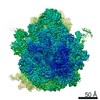
 emd_54254.png
 https://data.pdbj.org/pub/emdb/structures/EMD-54254


 Z (Sec.)
 Y (Row.)
 X (Col.)


 Sample components
 Processing
 Electron microscopy
 FIELD EMISSION GUN