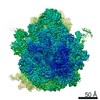
Journal: Nat Commun / Year: 2025 Title: Selective silencing of antibiotic-tethered ribosomes as a resistance mechanism against aminoglycosides. Authors: Nilanjan Ghosh Dastidar / Nicola S Freyer / Valentyn Petrychenko / Ana C de A P Schwarzer / Bee-Zen Peng / Ekaterina Samatova / Christina Kothe / Marlen Schmidt / Frank Peske / Antonio Z ...Authors: Nilanjan Ghosh Dastidar / Nicola S Freyer / Valentyn Petrychenko / Ana C de A P Schwarzer / Bee-Zen Peng / Ekaterina Samatova / Christina Kothe / Marlen Schmidt / Frank Peske / Antonio Z Politi / Henning Urlaub / Niels Fischer / Marina V Rodnina / Ingo Wohlgemuth / Abstract: Antibiotic resistance is a growing threat, underscoring the need to understand the underlying mechanisms. Aminoglycosides kill bacteria by disrupting translation fidelity, leading to the synthesis of ...Antibiotic resistance is a growing threat, underscoring the need to understand the underlying mechanisms. Aminoglycosides kill bacteria by disrupting translation fidelity, leading to the synthesis of aberrant proteins. Surprisingly, mutations in fusA, a gene encoding translation elongation factor G (EF-G), frequently confer resistance, even though EF-G neither participates in mRNA decoding nor blocks aminoglycoside binding. Here, we show that EF-G resistance variants selectively slow ribosome movement along mRNA when aminoglycosides are bound. This delay increases the chance that the drug dissociates before misreading occurs. Over several elongation cycles, this selective silencing of drug-bound ribosomes prevents error cluster formation, preserving proteome and membrane integrity. As a result, fusA mutations confer resistance early in treatment by preventing self-promoted aminoglycoside uptake. Translation on drug-free ribosomes remains sufficiently rapid to sustain near-normal bacterial growth. The mechanism of selective silencing of corrupted targets reveals a previously unrecognized antibiotic resistance strategy with potential therapeutic implications.
Film or detector model: FEI FALCON III (4k x 4k) / Detector mode: INTEGRATING / Number grids imaged: 1 / Average exposure time: 1.0 sec. / Average electron dose: 30.0 e/Å2
Electron beam
Acceleration voltage: 300 kV / Electron source: FIELD EMISSION GUN
In the structure databanks used in Yorodumi, some data are registered as the other names, "COVID-19 virus" and "2019-nCoV". Here are the details of the virus and the list of structure data.
Jan 31, 2019. EMDB accession codes are about to change! (news from PDBe EMDB page)
EMDB accession codes are about to change! (news from PDBe EMDB page)
The allocation of 4 digits for EMDB accession codes will soon come to an end. Whilst these codes will remain in use, new EMDB accession codes will include an additional digit and will expand incrementally as the available range of codes is exhausted. The current 4-digit format prefixed with “EMD-” (i.e. EMD-XXXX) will advance to a 5-digit format (i.e. EMD-XXXXX), and so on. It is currently estimated that the 4-digit codes will be depleted around Spring 2019, at which point the 5-digit format will come into force.
The EM Navigator/Yorodumi systems omit the EMD- prefix.
Related info.:Q: What is EMD? / ID/Accession-code notation in Yorodumi/EM Navigator
Yorodumi is a browser for structure data from EMDB, PDB, SASBDB, etc.
This page is also the successor to EM Navigator detail page, and also detail information page/front-end page for Omokage search.
The word "yorodu" (or yorozu) is an old Japanese word meaning "ten thousand". "mi" (miru) is to see.
Related info.:EMDB / PDB / SASBDB / Comparison of 3 databanks / Yorodumi Search / Aug 31, 2016. New EM Navigator & Yorodumi / Yorodumi Papers / Jmol/JSmol / Function and homology information / Changes in new EM Navigator and Yorodumi
 Movie
Movie Controller

 Yorodumi
 Open data
 Basic information
 Map data
 Sample
 Keywords
 Escherichia coli K-12 (bacteria)
 Authors
 Germany, 2 items
  Citation
 Structure visualization
 Downloads & links
 EMDB map data format
 emd_55124.png
 https://data.pdbj.org/pub/emdb/structures/EMD-55124


 X (Sec.)
 Y (Row.)
 Z (Col.)


 Sample components
 Processing
 Electron microscopy
 FIELD EMISSION GUN