Antibody / Cancer-neoantigen / complex / PROTEIN BINDING
機能・相同性
機能・相同性情報
antigen processing and presentation of peptide antigen via MHC class I / response to mineralocorticoid / GMP binding / LRR domain binding / response to gravity / myoblast proliferation / cardiac muscle cell proliferation / Signaling by RAS GAP mutants / Signaling by RAS GTPase mutants / Activation of RAS in B cells ...antigen processing and presentation of peptide antigen via MHC class I / response to mineralocorticoid / GMP binding / LRR domain binding / response to gravity / myoblast proliferation / cardiac muscle cell proliferation / Signaling by RAS GAP mutants / Signaling by RAS GTPase mutants / Activation of RAS in B cells / GTPase complex / RAS signaling downstream of NF1 loss-of-function variants / RUNX3 regulates p14-ARF / protein phosphatase type 1 complex / SOS-mediated signalling / Activated NTRK3 signals through RAS / Activated NTRK2 signals through RAS / SHC1 events in ERBB4 signaling / Signalling to RAS / negative regulation of programmed cell death / serine/threonine protein kinase complex / SHC-related events triggered by IGF1R / Activated NTRK2 signals through FRS2 and FRS3 / Estrogen-stimulated signaling through PRKCZ / SHC-mediated cascade:FGFR3 / MET activates RAS signaling / positive regulation of Ras protein signal transduction / response to isolation stress / SHC-mediated cascade:FGFR2 / SHC-mediated cascade:FGFR4 / PTK6 Regulates RHO GTPases, RAS GTPase and MAP kinases / Signaling by PDGFRA transmembrane, juxtamembrane and kinase domain mutants / Signaling by PDGFRA extracellular domain mutants / Erythropoietin activates RAS / SHC-mediated cascade:FGFR1 / Signaling by FGFR4 in disease / Signaling by CSF3 (G-CSF) / FRS-mediated FGFR3 signaling / Signaling by FLT3 ITD and TKD mutants / FRS-mediated FGFR2 signaling / FRS-mediated FGFR4 signaling / p38MAPK events / FRS-mediated FGFR1 signaling / Signaling by FGFR3 in disease / Tie2 Signaling / Signaling by FGFR2 in disease / GRB2 events in EGFR signaling / Signaling by FLT3 fusion proteins / SHC1 events in EGFR signaling / FLT3 Signaling / EGFR Transactivation by Gastrin / Signaling by FGFR1 in disease / NCAM signaling for neurite out-growth / liver development / CD209 (DC-SIGN) signaling / positive regulation of TOR signaling / GRB2 events in ERBB2 signaling / Downstream signal transduction / response to glucocorticoid / Insulin receptor signalling cascade / SHC1 events in ERBB2 signaling / regulation of natural killer cell mediated immunity / early endosome lumen / Nef mediated downregulation of MHC class I complex cell surface expression / DAP12 interactions / Constitutive Signaling by Overexpressed ERBB2 / Ras activation upon Ca2+ influx through NMDA receptor / Signaling by phosphorylated juxtamembrane, extracellular and kinase domain KIT mutants / Endosomal/Vacuolar pathway / canonical NF-kappaB signal transduction / VEGFR2 mediated cell proliferation / small monomeric GTPase / Antigen Presentation: Folding, assembly and peptide loading of class I MHC / endomembrane system / FCERI mediated MAPK activation / lumenal side of endoplasmic reticulum membrane / female pregnancy / regulation of iron ion transport / negative regulation of iron ion transport / negative regulation of forebrain neuron differentiation / antigen processing and presentation of exogenous peptide antigen via MHC class Ib / MHC class Ib protein complex / peptide antigen assembly with MHC class I protein complex / ER to Golgi transport vesicle membrane / Signaling by ERBB2 TMD/JMD mutants / HFE-transferrin receptor complex / MHC class I peptide loading complex / transferrin transport / negative regulation of receptor-mediated endocytosis / cellular response to iron ion / positive regulation of T cell cytokine production / Constitutive Signaling by EGFRvIII / antigen processing and presentation of endogenous peptide antigen via MHC class I / Signaling by SCF-KIT / RAF activation / Signaling by high-kinase activity BRAF mutants / Signaling by ERBB2 ECD mutants / peptide antigen assembly with MHC class II protein complex / MHC class I protein complex / MAP2K and MAPK activation 類似検索 - 分子機能
Small GTPase, Ras-type / Small GTPase Ras domain profile. / Ran (Ras-related nuclear proteins) /TC4 subfamily of small GTPases / MHC class I, alpha chain, C-terminal / MHC_I C-terminus / MHC class I alpha chain, alpha1 alpha2 domains / Class I Histocompatibility antigen, domains alpha 1 and 2 / Rho (Ras homology) subfamily of Ras-like small GTPases / Ras subfamily of RAS small GTPases / Small GTPase ...Small GTPase, Ras-type / Small GTPase Ras domain profile. / Ran (Ras-related nuclear proteins) /TC4 subfamily of small GTPases / MHC class I, alpha chain, C-terminal / MHC_I C-terminus / MHC class I alpha chain, alpha1 alpha2 domains / Class I Histocompatibility antigen, domains alpha 1 and 2 / Rho (Ras homology) subfamily of Ras-like small GTPases / Ras subfamily of RAS small GTPases / Small GTPase / Ras family / Beta-2-Microglobulin / : / MHC class I-like antigen recognition-like / MHC class I-like antigen recognition-like superfamily / Rab subfamily of small GTPases / MHC classes I/II-like antigen recognition protein / : / Small GTP-binding protein domain / Immunoglobulin/major histocompatibility complex, conserved site / Immunoglobulins and major histocompatibility complex proteins signature. / Immunoglobulin C-Type / Immunoglobulin C1-set / Immunoglobulin C1-set domain / Ig-like domain profile. / Immunoglobulin-like domain / Immunoglobulin-like domain superfamily / Immunoglobulin-like fold / P-loop containing nucleoside triphosphate hydrolase 類似検索 - ドメイン・相同性
MHC class I antigen / GTPase KRas / Beta-2-microglobulin 類似検索 - 構成要素
ジャーナル: Nat Commun / 年: 2025 タイトル: Engineered antibodies that stabilize drug-modified KRAS neoantigens enable selective and potent cross-HLA immunotherapy. 著者: Lorenzo Maso / Sarah A Mosure / Sergio A Rodriguez-Aponte / Angelina Pizzo / Diamond N Mensah / Matthew Southard / Samantha Sze / Tanvir Ahmed / Brian Vash / Takamitsu Hattori / Epsa Rajak / ...著者: Lorenzo Maso / Sarah A Mosure / Sergio A Rodriguez-Aponte / Angelina Pizzo / Diamond N Mensah / Matthew Southard / Samantha Sze / Tanvir Ahmed / Brian Vash / Takamitsu Hattori / Epsa Rajak / Akiko Koide / Benjamin G Neel / Shohei Koide / Weifeng Liu / Sean T Toenjes / Paul Da Silva Jardine / Rajesh Chopra / Christoph Rader / Lauren E Stopfer / 要旨: Covalent inhibitors of oncoprotein KRAS have initial efficacy, but responses lack durability. Covalently modified oncoproteins are presented as MHC-restricted hapten-peptides (p*MHC) on the cancer ...Covalent inhibitors of oncoprotein KRAS have initial efficacy, but responses lack durability. Covalently modified oncoproteins are presented as MHC-restricted hapten-peptides (p*MHC) on the cancer cell surface, enabling combination of targeted therapy with immunotherapy to overcome drug resistance. Building on indirect evidence of KRAS-derived p*MHCs, we use immunopeptidomics to identify and directly quantify these synthetic neoantigens. To address challenges by their low copy number, we develop AETX-R114, a T cell engaging bispecific antibody with picomolar affinity for MHC-restricted sotorasib-modified KRAS peptides presented by three HLA-A3 supertype alleles. AETX-R114 dramatically increases the half-life and thereby the number of presented p*MHCs, enabling selective and potent killing of resistant cancer cells both in vitro and in vivo. To broaden the therapeutic potential of creating and targeting synthetic neoantigens, we further develop AETX-R302, which recognizes divarasib-modified KRAS peptides presented on alleles from the HLA-A2 and A3 supertypes. Cryo-EM structure determination reveals the molecular basis for breaking HLA supertype restriction. Collectively, our study illustrates how engineered antibodies can transform synthetic neoantigens into actionable cancer immunotherapy targets.
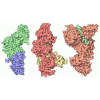
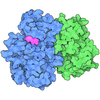
超分子 #1: Binary complex of Fab R302 with divarasib-conjugated KRAS G12C pe...
超分子
名称: Binary complex of Fab R302 with divarasib-conjugated KRAS G12C peptide (5-14) presented by class I MHC having HLA-A*02:01 タイプ: complex / ID: 1 / 親要素: 0 / 含まれる分子: #1-#5
由来(天然)
生物種: Homo sapiens (ヒト)
分子量
理論値: 100 KDa
-
分子 #1: MHC class I antigen
分子
名称: MHC class I antigen / タイプ: protein_or_peptide / ID: 1 / コピー数: 1 / 光学異性体: LEVO
 ムービー
ムービー コントローラー


 データを開く
 基本情報
基本情報
 マップデータ
 試料
試料 キーワード
キーワード 機能・相同性情報
 Homo sapiens (ヒト)
 データ登録者
 引用
引用
 構造の表示
構造の表示
 ダウンロードとリンク
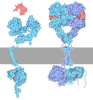
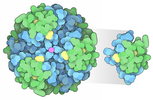
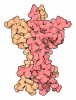
 emd_49361.png
 https://data.pdbj.org/pub/emdb/structures/EMD-49361







 Z (Sec.)
 Y (Row.)
 X (Col.)


 試料の構成要素
 Escherichia coli (大腸菌)
 解析
解析 電子顕微鏡法
 FIELD EMISSION GUN

