 Movie
Movie Controller

[English] 日本語
 Yorodumi
- PDB-9nfb: Structure of the cross-HLA supertype antibody R302 bound to a cla... -
+ Open data

- Basic information
| Entry | Database: PDB / ID: 9nfb | |||||||||||||||||||||||||||
|---|---|---|---|---|---|---|---|---|---|---|---|---|---|---|---|---|---|---|---|---|---|---|---|---|---|---|---|---|
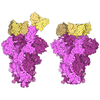
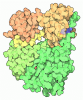
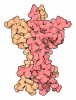
| Title | Structure of the cross-HLA supertype antibody R302 bound to a class I MHC presenting a divarasib-modified KRAS-G12C peptide on HLA-A*02 | |||||||||||||||||||||||||||
 Components Components |
| |||||||||||||||||||||||||||
 Keywords Keywords | PROTEIN BINDING / Antibody / Cancer-neoantigen / complex | |||||||||||||||||||||||||||
| Function / homology |  Function and homology information Function and homology informationantigen processing and presentation of peptide antigen via MHC class I / response to mineralocorticoid / GMP binding / LRR domain binding / response to gravity / myoblast proliferation / cardiac muscle cell proliferation / Signaling by RAS GAP mutants / Signaling by RAS GTPase mutants / Activation of RAS in B cells ...antigen processing and presentation of peptide antigen via MHC class I / response to mineralocorticoid / GMP binding / LRR domain binding / response to gravity / myoblast proliferation / cardiac muscle cell proliferation / Signaling by RAS GAP mutants / Signaling by RAS GTPase mutants / Activation of RAS in B cells / GTPase complex / RAS signaling downstream of NF1 loss-of-function variants / RUNX3 regulates p14-ARF / protein phosphatase type 1 complex / SOS-mediated signalling / Activated NTRK3 signals through RAS / Activated NTRK2 signals through RAS / SHC1 events in ERBB4 signaling / Signalling to RAS / negative regulation of programmed cell death / serine/threonine protein kinase complex / SHC-related events triggered by IGF1R / Activated NTRK2 signals through FRS2 and FRS3 / Estrogen-stimulated signaling through PRKCZ / SHC-mediated cascade:FGFR3 / MET activates RAS signaling / positive regulation of Ras protein signal transduction / response to isolation stress / SHC-mediated cascade:FGFR2 / SHC-mediated cascade:FGFR4 / PTK6 Regulates RHO GTPases, RAS GTPase and MAP kinases / Signaling by PDGFRA transmembrane, juxtamembrane and kinase domain mutants / Signaling by PDGFRA extracellular domain mutants / Erythropoietin activates RAS / SHC-mediated cascade:FGFR1 / Signaling by FGFR4 in disease / Signaling by CSF3 (G-CSF) / FRS-mediated FGFR3 signaling / Signaling by FLT3 ITD and TKD mutants / FRS-mediated FGFR2 signaling / FRS-mediated FGFR4 signaling / p38MAPK events / FRS-mediated FGFR1 signaling / Signaling by FGFR3 in disease / Tie2 Signaling / Signaling by FGFR2 in disease / GRB2 events in EGFR signaling / Signaling by FLT3 fusion proteins / SHC1 events in EGFR signaling / FLT3 Signaling / EGFR Transactivation by Gastrin / Signaling by FGFR1 in disease / NCAM signaling for neurite out-growth / liver development / CD209 (DC-SIGN) signaling / positive regulation of TOR signaling / GRB2 events in ERBB2 signaling / Downstream signal transduction / response to glucocorticoid / Insulin receptor signalling cascade / SHC1 events in ERBB2 signaling / regulation of natural killer cell mediated immunity / early endosome lumen / Nef mediated downregulation of MHC class I complex cell surface expression / DAP12 interactions / Constitutive Signaling by Overexpressed ERBB2 / Ras activation upon Ca2+ influx through NMDA receptor / Signaling by phosphorylated juxtamembrane, extracellular and kinase domain KIT mutants / Endosomal/Vacuolar pathway / canonical NF-kappaB signal transduction / VEGFR2 mediated cell proliferation / small monomeric GTPase / Antigen Presentation: Folding, assembly and peptide loading of class I MHC / endomembrane system / FCERI mediated MAPK activation / lumenal side of endoplasmic reticulum membrane / female pregnancy / regulation of iron ion transport / negative regulation of iron ion transport / negative regulation of forebrain neuron differentiation / antigen processing and presentation of exogenous peptide antigen via MHC class Ib / MHC class Ib protein complex / peptide antigen assembly with MHC class I protein complex / ER to Golgi transport vesicle membrane / Signaling by ERBB2 TMD/JMD mutants / HFE-transferrin receptor complex / MHC class I peptide loading complex / transferrin transport / negative regulation of receptor-mediated endocytosis / cellular response to iron ion / positive regulation of T cell cytokine production / Constitutive Signaling by EGFRvIII / antigen processing and presentation of endogenous peptide antigen via MHC class I / Signaling by SCF-KIT / RAF activation / Signaling by high-kinase activity BRAF mutants / Signaling by ERBB2 ECD mutants / peptide antigen assembly with MHC class II protein complex / MHC class I protein complex / MAP2K and MAPK activation Similarity search - Function | |||||||||||||||||||||||||||
| Biological species |  Homo sapiens (human) Homo sapiens (human) | |||||||||||||||||||||||||||
| Method | ELECTRON MICROSCOPY / single particle reconstruction / cryo EM / Resolution: 3.23 Å | |||||||||||||||||||||||||||
 Authors Authors | Maso, L. | |||||||||||||||||||||||||||
| Funding support | 1items
| |||||||||||||||||||||||||||
 Citation Citation | Journal: Nat Commun / Year: 2025 Title: Engineered antibodies that stabilize drug-modified KRAS neoantigens enable selective and potent cross-HLA immunotherapy. Authors: Lorenzo Maso / Sarah A Mosure / Sergio A Rodriguez-Aponte / Angelina Pizzo / Diamond N Mensah / Matthew Southard / Samantha Sze / Tanvir Ahmed / Brian Vash / Takamitsu Hattori / Epsa Rajak / ...Authors: Lorenzo Maso / Sarah A Mosure / Sergio A Rodriguez-Aponte / Angelina Pizzo / Diamond N Mensah / Matthew Southard / Samantha Sze / Tanvir Ahmed / Brian Vash / Takamitsu Hattori / Epsa Rajak / Akiko Koide / Benjamin G Neel / Shohei Koide / Weifeng Liu / Sean T Toenjes / Paul Da Silva Jardine / Rajesh Chopra / Christoph Rader / Lauren E Stopfer /  Abstract: Covalent inhibitors of oncoprotein KRAS have initial efficacy, but responses lack durability. Covalently modified oncoproteins are presented as MHC-restricted hapten-peptides (p*MHC) on the cancer ...Covalent inhibitors of oncoprotein KRAS have initial efficacy, but responses lack durability. Covalently modified oncoproteins are presented as MHC-restricted hapten-peptides (p*MHC) on the cancer cell surface, enabling combination of targeted therapy with immunotherapy to overcome drug resistance. Building on indirect evidence of KRAS-derived p*MHCs, we use immunopeptidomics to identify and directly quantify these synthetic neoantigens. To address challenges by their low copy number, we develop AETX-R114, a T cell engaging bispecific antibody with picomolar affinity for MHC-restricted sotorasib-modified KRAS peptides presented by three HLA-A3 supertype alleles. AETX-R114 dramatically increases the half-life and thereby the number of presented p*MHCs, enabling selective and potent killing of resistant cancer cells both in vitro and in vivo. To broaden the therapeutic potential of creating and targeting synthetic neoantigens, we further develop AETX-R302, which recognizes divarasib-modified KRAS peptides presented on alleles from the HLA-A2 and A3 supertypes. Cryo-EM structure determination reveals the molecular basis for breaking HLA supertype restriction. Collectively, our study illustrates how engineered antibodies can transform synthetic neoantigens into actionable cancer immunotherapy targets. | |||||||||||||||||||||||||||
| History |
|
- Structure visualization
| Structure viewer | Molecule: MolmilJmol/JSmol |
|---|
- Downloads & links
-Download
| PDBx/mmCIF format | 9nfb.cif.gz | 138 KB | Display | PDBx/mmCIF format |
|---|---|---|---|---|
| PDB format | pdb9nfb.ent.gz | Display | PDB format | |
| PDBx/mmJSON format | 9nfb.json.gz | Tree view | PDBx/mmJSON format | |
| Others |  Other downloads Other downloads |
-Validation report
| Arichive directory | https://data.pdbj.org/pub/pdb/validation_reports/nf/9nfbftp://data.pdbj.org/pub/pdb/validation_reports/nf/9nfb | HTTPS FTP |
|---|
-Related structure data
| Related structure data |  49361MC  9nfcC M: map data used to model this data C: citing same article ( |
|---|---|
| Similar structure data |

-Links
 PDBj
PDBj

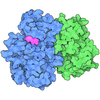
- Assembly
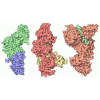
| Deposited unit | 
|
|---|---|
| 1 |
|
-Components
-Protein , 2 types, 2 molecules AB
| #1: Protein | Mass: 35419.988 Da / Num. of mol.: 1 Source method: isolated from a genetically manipulated source Source: (gene. exp.) Homo sapiens (human) / Gene: HLA-A / Production host:   Escherichia coli (E. coli) / References: UniProt: A0A6S7XV52 Escherichia coli (E. coli) / References: UniProt: A0A6S7XV52 |
|---|---|
| #2: Protein | Mass: 11892.291 Da / Num. of mol.: 1 Source method: isolated from a genetically manipulated source Source: (gene. exp.) Homo sapiens (human) / Gene: B2M, CDABP0092, HDCMA22P / Production host: Escherichia coli (E. coli) / References: UniProt: P61769 |
-Antibody , 2 types, 2 molecules DE
| #4: Antibody | Mass: 23972.529 Da / Num. of mol.: 1 Source method: isolated from a genetically manipulated source Source: (gene. exp.) Homo sapiens (human) / Production host: Escherichia coli (E. coli) |
|---|---|
| #5: Antibody | Mass: 24136.109 Da / Num. of mol.: 1 Source method: isolated from a genetically manipulated source Source: (gene. exp.) Homo sapiens (human) / Production host: Escherichia coli (E. coli) |
-Protein/peptide / Non-polymers , 2 types, 2 molecules C
| #3: Protein/peptide | Mass: 945.200 Da / Num. of mol.: 1 / Mutation: G12C Source method: isolated from a genetically manipulated source Source: (gene. exp.) Homo sapiens (human) / Gene: KRAS, KRAS2, RASK2 / Production host: Escherichia coli (E. coli) / References: UniProt: P01116, small monomeric GTPase |
|---|---|
| #6: Chemical | ChemComp-A1AWR / Mass: 624.073 Da / Num. of mol.: 1 / Source method: obtained synthetically / Formula: C29H34ClF4N7O2 / Feature type: SUBJECT OF INVESTIGATION |
-Details
| Has ligand of interest | Y |
|---|---|
| Has protein modification | Y |
-Experimental details
-Experiment
| Experiment | Method: ELECTRON MICROSCOPY |
|---|---|
| EM experiment | Aggregation state: PARTICLE / 3D reconstruction method: single particle reconstruction |
- Sample preparation
| Component | Name: Binary complex of Fab R302 with divarasib-conjugated KRAS G12C peptide (5-14) presented by class I MHC having HLA-A*02:01 Type: COMPLEX / Entity ID: #1-#5 / Source: RECOMBINANT |
|---|---|
| Molecular weight | Value: 0.1 MDa / Experimental value: NO |
| Source (natural) | Organism: Homo sapiens (human) |
| Source (recombinant) | Organism: Escherichia coli (E. coli) |
| Buffer solution | pH: 7.4 |
| Specimen | Conc.: 2.6 mg/ml / Embedding applied: NO / Shadowing applied: NO / Staining applied: NO / Vitrification applied: YES |
| Specimen support | Grid material: COPPER / Grid mesh size: 300 divisions/in. / Grid type: Quantifoil R0.6/1 |
| Vitrification | Instrument: FEI VITROBOT MARK IV / Cryogen name: ETHANE / Humidity: 100 % / Chamber temperature: 277 K / Details: blot time 4 s blot force 5 |
- Electron microscopy imaging
| Experimental equipment |  Model: Titan Krios / Image courtesy: FEI Company |
|---|---|
| Microscopy | Model: TFS KRIOS |
| Electron gun | Electron source:  FIELD EMISSION GUN / Accelerating voltage: 300 kV / Illumination mode: FLOOD BEAM FIELD EMISSION GUN / Accelerating voltage: 300 kV / Illumination mode: FLOOD BEAM |
| Electron lens | Mode: BRIGHT FIELD / Nominal magnification: 105000 X / Nominal defocus max: 2700 nm / Nominal defocus min: 600 nm / Cs: 2.7 mm |
| Specimen holder | Cryogen: NITROGEN |
| Image recording | Electron dose: 46.99 e/Å2 / Film or detector model: GATAN K3 BIOQUANTUM (6k x 4k) |
- Processing
| EM software | Name: Leginon / Version: 3.6 / Category: image acquisition |
|---|---|
| CTF correction | Type: PHASE FLIPPING AND AMPLITUDE CORRECTION |
| 3D reconstruction | Resolution: 3.23 Å / Resolution method: FSC 0.143 CUT-OFF / Num. of particles: 65281 / Symmetry type: POINT |
