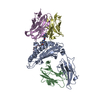
Antibody / Cancer-neoantigen / complex / PROTEIN BINDING
Function / homology
Function and homology information
positive regulation of memory T cell activation / T cell mediated cytotoxicity directed against tumor cell target / positive regulation of CD8-positive, alpha-beta T cell activation / CD8-positive, alpha-beta T cell activation / positive regulation of CD8-positive, alpha-beta T cell proliferation / T cell mediated cytotoxicity / antigen processing and presentation of endogenous peptide antigen via MHC class I via ER pathway, TAP-dependent / response to mineralocorticoid / TAP complex binding / GMP binding ...positive regulation of memory T cell activation / T cell mediated cytotoxicity directed against tumor cell target / positive regulation of CD8-positive, alpha-beta T cell activation / CD8-positive, alpha-beta T cell activation / positive regulation of CD8-positive, alpha-beta T cell proliferation / T cell mediated cytotoxicity / antigen processing and presentation of endogenous peptide antigen via MHC class I via ER pathway, TAP-dependent / response to mineralocorticoid / TAP complex binding / GMP binding / antigen processing and presentation of exogenous peptide antigen via MHC class I / Golgi medial cisterna / LRR domain binding / CD8 receptor binding / response to gravity / myoblast proliferation / protection from natural killer cell mediated cytotoxicity / cardiac muscle cell proliferation / TAP binding / endoplasmic reticulum exit site / Signaling by RAS GAP mutants / Signaling by RAS GTPase mutants / Activation of RAS in B cells / GTPase complex / RAS signaling downstream of NF1 loss-of-function variants / RUNX3 regulates p14-ARF / detection of bacterium / protein phosphatase type 1 complex / antigen processing and presentation of endogenous peptide antigen via MHC class Ib / antigen processing and presentation of endogenous peptide antigen via MHC class I via ER pathway, TAP-independent / SOS-mediated signalling / Activated NTRK3 signals through RAS / Activated NTRK2 signals through RAS / SHC1 events in ERBB4 signaling / Signalling to RAS / negative regulation of programmed cell death / serine/threonine protein kinase complex / beta-2-microglobulin binding / SHC-related events triggered by IGF1R / Activated NTRK2 signals through FRS2 and FRS3 / Estrogen-stimulated signaling through PRKCZ / SHC-mediated cascade:FGFR3 / MET activates RAS signaling / positive regulation of Ras protein signal transduction / response to isolation stress / SHC-mediated cascade:FGFR2 / SHC-mediated cascade:FGFR4 / T cell receptor binding / PTK6 Regulates RHO GTPases, RAS GTPase and MAP kinases / Signaling by PDGFRA transmembrane, juxtamembrane and kinase domain mutants / Signaling by PDGFRA extracellular domain mutants / Erythropoietin activates RAS / SHC-mediated cascade:FGFR1 / Signaling by FGFR4 in disease / Signaling by CSF3 (G-CSF) / FRS-mediated FGFR3 signaling / Signaling by FLT3 ITD and TKD mutants / FRS-mediated FGFR2 signaling / FRS-mediated FGFR4 signaling / p38MAPK events / FRS-mediated FGFR1 signaling / Signaling by FGFR3 in disease / Tie2 Signaling / Signaling by FGFR2 in disease / GRB2 events in EGFR signaling / Signaling by FLT3 fusion proteins / SHC1 events in EGFR signaling / FLT3 Signaling / EGFR Transactivation by Gastrin / Signaling by FGFR1 in disease / NCAM signaling for neurite out-growth / liver development / CD209 (DC-SIGN) signaling / positive regulation of TOR signaling / GRB2 events in ERBB2 signaling / Downstream signal transduction / response to glucocorticoid / Insulin receptor signalling cascade / SHC1 events in ERBB2 signaling / positive regulation of T cell mediated cytotoxicity / regulation of natural killer cell mediated immunity / early endosome lumen / Nef mediated downregulation of MHC class I complex cell surface expression / DAP12 interactions / Constitutive Signaling by Overexpressed ERBB2 / Ras activation upon Ca2+ influx through NMDA receptor / Signaling by phosphorylated juxtamembrane, extracellular and kinase domain KIT mutants / Endosomal/Vacuolar pathway / canonical NF-kappaB signal transduction / VEGFR2 mediated cell proliferation / small monomeric GTPase / Antigen Presentation: Folding, assembly and peptide loading of class I MHC / endomembrane system / FCERI mediated MAPK activation / lumenal side of endoplasmic reticulum membrane / female pregnancy / regulation of iron ion transport / negative regulation of iron ion transport / negative regulation of forebrain neuron differentiation / antigen processing and presentation of exogenous peptide antigen via MHC class Ib Similarity search - Function
Small GTPase, Ras-type / Small GTPase Ras domain profile. / Ran (Ras-related nuclear proteins) /TC4 subfamily of small GTPases / MHC class I, alpha chain, C-terminal / MHC_I C-terminus / MHC class I alpha chain, alpha1 alpha2 domains / Class I Histocompatibility antigen, domains alpha 1 and 2 / Rho (Ras homology) subfamily of Ras-like small GTPases / Ras subfamily of RAS small GTPases / Small GTPase ...Small GTPase, Ras-type / Small GTPase Ras domain profile. / Ran (Ras-related nuclear proteins) /TC4 subfamily of small GTPases / MHC class I, alpha chain, C-terminal / MHC_I C-terminus / MHC class I alpha chain, alpha1 alpha2 domains / Class I Histocompatibility antigen, domains alpha 1 and 2 / Rho (Ras homology) subfamily of Ras-like small GTPases / Ras subfamily of RAS small GTPases / Small GTPase / Ras family / Beta-2-Microglobulin / : / MHC class I-like antigen recognition-like / MHC class I-like antigen recognition-like superfamily / Rab subfamily of small GTPases / MHC classes I/II-like antigen recognition protein / : / Small GTP-binding protein domain / Immunoglobulin/major histocompatibility complex, conserved site / Immunoglobulins and major histocompatibility complex proteins signature. / Immunoglobulin C-Type / Immunoglobulin C1-set / Immunoglobulin C1-set domain / Ig-like domain profile. / Immunoglobulin-like domain / Immunoglobulin-like domain superfamily / Immunoglobulin-like fold / P-loop containing nucleoside triphosphate hydrolase Similarity search - Domain/homology
GTPase KRas / HLA class I histocompatibility antigen, A alpha chain / Beta-2-microglobulin Similarity search - Component
Biological species
Homo sapiens (human)
Method
single particle reconstruction / cryo EM / Resolution: 2.58 Å
Journal: Nat Commun / Year: 2025 Title: Engineered antibodies that stabilize drug-modified KRAS neoantigens enable selective and potent cross-HLA immunotherapy. Authors: Lorenzo Maso / Sarah A Mosure / Sergio A Rodriguez-Aponte / Angelina Pizzo / Diamond N Mensah / Matthew Southard / Samantha Sze / Tanvir Ahmed / Brian Vash / Takamitsu Hattori / Epsa Rajak / ...Authors: Lorenzo Maso / Sarah A Mosure / Sergio A Rodriguez-Aponte / Angelina Pizzo / Diamond N Mensah / Matthew Southard / Samantha Sze / Tanvir Ahmed / Brian Vash / Takamitsu Hattori / Epsa Rajak / Akiko Koide / Benjamin G Neel / Shohei Koide / Weifeng Liu / Sean T Toenjes / Paul Da Silva Jardine / Rajesh Chopra / Christoph Rader / Lauren E Stopfer / Abstract: Covalent inhibitors of oncoprotein KRAS have initial efficacy, but responses lack durability. Covalently modified oncoproteins are presented as MHC-restricted hapten-peptides (p*MHC) on the cancer ...Covalent inhibitors of oncoprotein KRAS have initial efficacy, but responses lack durability. Covalently modified oncoproteins are presented as MHC-restricted hapten-peptides (p*MHC) on the cancer cell surface, enabling combination of targeted therapy with immunotherapy to overcome drug resistance. Building on indirect evidence of KRAS-derived p*MHCs, we use immunopeptidomics to identify and directly quantify these synthetic neoantigens. To address challenges by their low copy number, we develop AETX-R114, a T cell engaging bispecific antibody with picomolar affinity for MHC-restricted sotorasib-modified KRAS peptides presented by three HLA-A3 supertype alleles. AETX-R114 dramatically increases the half-life and thereby the number of presented p*MHCs, enabling selective and potent killing of resistant cancer cells both in vitro and in vivo. To broaden the therapeutic potential of creating and targeting synthetic neoantigens, we further develop AETX-R302, which recognizes divarasib-modified KRAS peptides presented on alleles from the HLA-A2 and A3 supertypes. Cryo-EM structure determination reveals the molecular basis for breaking HLA supertype restriction. Collectively, our study illustrates how engineered antibodies can transform synthetic neoantigens into actionable cancer immunotherapy targets.
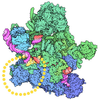
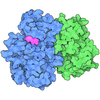
Supramolecule #1: Binary complex of Fab R302 with divarasib-conjugated KRAS G12C pe...
Supramolecule
Name: Binary complex of Fab R302 with divarasib-conjugated KRAS G12C peptide (7-16) presented by class I MHC having HLA-A*03:01 type: complex / ID: 1 / Parent: 0 / Macromolecule list: #1-#5
Source (natural)
Organism: Homo sapiens (human)
Molecular weight
Theoretical: 100 KDa
-
Macromolecule #1: HLA class I histocompatibility antigen, A alpha chain
Macromolecule
Name: HLA class I histocompatibility antigen, A alpha chain / type: protein_or_peptide / ID: 1 / Number of copies: 1 / Enantiomer: LEVO
In the structure databanks used in Yorodumi, some data are registered as the other names, "COVID-19 virus" and "2019-nCoV". Here are the details of the virus and the list of structure data.
Jan 31, 2019. EMDB accession codes are about to change! (news from PDBe EMDB page)
EMDB accession codes are about to change! (news from PDBe EMDB page)
The allocation of 4 digits for EMDB accession codes will soon come to an end. Whilst these codes will remain in use, new EMDB accession codes will include an additional digit and will expand incrementally as the available range of codes is exhausted. The current 4-digit format prefixed with “EMD-” (i.e. EMD-XXXX) will advance to a 5-digit format (i.e. EMD-XXXXX), and so on. It is currently estimated that the 4-digit codes will be depleted around Spring 2019, at which point the 5-digit format will come into force.
The EM Navigator/Yorodumi systems omit the EMD- prefix.
Related info.:Q: What is EMD? / ID/Accession-code notation in Yorodumi/EM Navigator
Yorodumi is a browser for structure data from EMDB, PDB, SASBDB, etc.
This page is also the successor to EM Navigator detail page, and also detail information page/front-end page for Omokage search.
The word "yorodu" (or yorozu) is an old Japanese word meaning "ten thousand". "mi" (miru) is to see.
Related info.:EMDB / PDB / SASBDB / Comparison of 3 databanks / Yorodumi Search / Aug 31, 2016. New EM Navigator & Yorodumi / Yorodumi Papers / Jmol/JSmol / Function and homology information / Changes in new EM Navigator and Yorodumi
 Movie
Movie Controller

 Yorodumi
 Open data
 Basic information
 Map data
 Sample
 Keywords
 Function and homology information
 Homo sapiens (human)
 Authors
 Citation
 Structure visualization
 Downloads & links
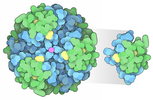
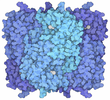
 emd_49362.png
 https://data.pdbj.org/pub/emdb/structures/EMD-49362



 Z (Sec.)
 Y (Row.)
 X (Col.)


 Sample components
 Escherichia coli (E. coli)
 Processing
 Electron microscopy
 FIELD EMISSION GUN