[English] 日本語
Yorodumi
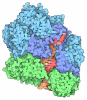
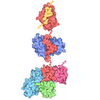
- EMDB-48285: Human PARP1 N-terminal domains bound to nicked DNA -

+
Open data


ID or keywords:

Loading...

-
Basic information

Entry
Database: EMDB / ID: EMD-48285
TitleHuman PARP1 N-terminal domains bound to nicked DNA
Map dataPARP1 NTD-DNA, non-sharpened map
Sample
  • Complex: Full-length human PARP1 bound to nicked DNA and in complex with HPF1 and Timeless fragment
    • Protein or peptide: Poly [ADP-ribose] polymerase 1
    • DNA: DNA (48-MER)
  • Ligand: ZINC ION
KeywordsPARP1 / Zinc-finger domains / nicked DNA / DNA BINDING PROTEIN
Function / homology
Function and homology information


NAD+-histone H2BS6 serine ADP-ribosyltransferase activity / NAD+-histone H3S10 serine ADP-ribosyltransferase activity / NAD+-histone H2BE35 glutamate ADP-ribosyltransferase activity / positive regulation of myofibroblast differentiation / negative regulation of ATP biosynthetic process / NAD+-protein-tyrosine ADP-ribosyltransferase activity / NAD+-protein-histidine ADP-ribosyltransferase activity / regulation of base-excision repair / positive regulation of single strand break repair / regulation of circadian sleep/wake cycle, non-REM sleep ...NAD+-histone H2BS6 serine ADP-ribosyltransferase activity / NAD+-histone H3S10 serine ADP-ribosyltransferase activity / NAD+-histone H2BE35 glutamate ADP-ribosyltransferase activity / positive regulation of myofibroblast differentiation / negative regulation of ATP biosynthetic process / NAD+-protein-tyrosine ADP-ribosyltransferase activity / NAD+-protein-histidine ADP-ribosyltransferase activity / regulation of base-excision repair / positive regulation of single strand break repair / regulation of circadian sleep/wake cycle, non-REM sleep / mitochondrial DNA metabolic process / vRNA Synthesis / carbohydrate biosynthetic process / NAD+-protein-serine ADP-ribosyltransferase activity / NAD DNA ADP-ribosyltransferase activity / negative regulation of adipose tissue development / DNA ADP-ribosylation / regulation of oxidative stress-induced neuron intrinsic apoptotic signaling pathway / replication fork reversal / ATP generation from poly-ADP-D-ribose / positive regulation of necroptotic process / transcription regulator activator activity / response to aldosterone / HDR through MMEJ (alt-NHEJ) / positive regulation of DNA-templated transcription, elongation / NAD+ ADP-ribosyltransferase / signal transduction involved in regulation of gene expression / protein auto-ADP-ribosylation / negative regulation of telomere maintenance via telomere lengthening / mitochondrial DNA repair / NAD+-protein-aspartate ADP-ribosyltransferase activity / protein poly-ADP-ribosylation / positive regulation of intracellular estrogen receptor signaling pathway / NAD+-protein-glutamate ADP-ribosyltransferase activity / negative regulation of cGAS/STING signaling pathway / positive regulation of cardiac muscle hypertrophy / NAD+-protein mono-ADP-ribosyltransferase activity / cellular response to zinc ion / nuclear replication fork / positive regulation of mitochondrial depolarization / decidualization / protein autoprocessing / R-SMAD binding / macrophage differentiation / Transferases; Glycosyltransferases; Pentosyltransferases / negative regulation of transcription elongation by RNA polymerase II / positive regulation of SMAD protein signal transduction / POLB-Dependent Long Patch Base Excision Repair / NAD+ poly-ADP-ribosyltransferase activity / site of DNA damage / SUMOylation of DNA damage response and repair proteins / nucleosome binding / positive regulation of double-strand break repair via homologous recombination / protein localization to chromatin / nucleotidyltransferase activity / transforming growth factor beta receptor signaling pathway / negative regulation of innate immune response / telomere maintenance / nuclear estrogen receptor binding / response to gamma radiation / mitochondrion organization / protein modification process / Downregulation of SMAD2/3:SMAD4 transcriptional activity / enzyme activator activity / cellular response to nerve growth factor stimulus / protein-DNA complex / positive regulation of protein localization to nucleus / DNA Damage Recognition in GG-NER / Dual Incision in GG-NER / cellular response to insulin stimulus / cellular response to amyloid-beta / histone deacetylase binding / NAD binding / Formation of Incision Complex in GG-NER / cellular response to UV / nuclear envelope / double-strand break repair / regulation of protein localization / site of double-strand break / cellular response to oxidative stress / transcription regulator complex / transcription by RNA polymerase II / damaged DNA binding / RNA polymerase II-specific DNA-binding transcription factor binding / chromosome, telomeric region / positive regulation of canonical NF-kappaB signal transduction / nuclear body / innate immune response / DNA repair / negative regulation of DNA-templated transcription / apoptotic process / DNA damage response / ubiquitin protein ligase binding / chromatin binding / protein kinase binding / chromatin / nucleolus / enzyme binding / negative regulation of transcription by RNA polymerase II / protein homodimerization activity
Similarity search - Function
Poly [ADP-ribose] polymerase / PADR1 domain / PADR1 domain superfamily / : / PADR1 domain, zinc ribbon fold / PADR1, N-terminal helical domain / PADR1 domain profile. / PADR1 / Zinc finger poly(ADP-ribose) polymerase (PARP)-type signature. / Zinc finger, PARP-type superfamily ...Poly [ADP-ribose] polymerase / PADR1 domain / PADR1 domain superfamily / : / PADR1 domain, zinc ribbon fold / PADR1, N-terminal helical domain / PADR1 domain profile. / PADR1 / Zinc finger poly(ADP-ribose) polymerase (PARP)-type signature. / Zinc finger, PARP-type superfamily / Poly(ADP-ribose) polymerase and DNA-Ligase Zn-finger region / Zinc finger poly(ADP-ribose) polymerase (PARP)-type profile. / Poly(ADP-ribose) polymerase and DNA-Ligase Zn-finger region / Zinc finger, PARP-type / : / Poly(ADP-ribose) polymerase, regulatory domain / WGR domain / WGR domain superfamily / WGR domain / WGR domain profile. / Proposed nucleic acid binding domain / Poly(ADP-ribose) polymerase, regulatory domain superfamily / Poly(ADP-ribose) polymerase, regulatory domain / PARP alpha-helical domain profile. / BRCA1 C Terminus (BRCT) domain / Poly(ADP-ribose) polymerase catalytic domain / Poly(ADP-ribose) polymerase, catalytic domain / PARP catalytic domain profile. / breast cancer carboxy-terminal domain / BRCT domain profile. / BRCT domain / BRCT domain superfamily
Similarity search - Domain/homology
Poly [ADP-ribose] polymerase 1
Similarity search - Component
Biological speciesHomo sapiens (human)
Methodsingle particle reconstruction / cryo EM / Resolution: 3.6 Å
AuthorsSverzhinsky A / Pascal JM
Funding support Canada, United States, 2 items
OrganizationGrant numberCountry
Canadian Institutes of Health Research (CIHR)PJT374609 Canada
National Institutes of Health/National Cancer Institute (NIH/NCI)CA92584 United States
CitationJournal: Nat Commun / Year: 2026
Title: PARP1-HPF1 structure and dynamics on nicked DNA suggest a mechanism for acute and localized ADP-ribosylation.
Authors: Aleksandr Sverzhinsky / Huijun Xue / Marie-France Langelier / Marcelo V Muniz Corrêa / Joshua Del Mundo / Scott Classen / Michal Hammel / Eli Rothenberg / John M Pascal /
Abstract: PARP1 detection of DNA strand breaks allosterically leads to PARP1 synthesis of poly(ADP-ribose) modifications that signal DNA damage. HPF1 engages activated PARP1 to control modification site ...PARP1 detection of DNA strand breaks allosterically leads to PARP1 synthesis of poly(ADP-ribose) modifications that signal DNA damage. HPF1 engages activated PARP1 to control modification site selection. Understanding of the mechanism of DNA break detection and catalytic activation is incomplete, due largely to limited structural information for full-length PARP1. Here, single-particle cryo-EM provides views of the full complement of PARP1 domains engaging a DNA single-strand break in the presence of HPF1 and a fragment of binding partner Timeless. Cryo-EM, single-molecule DNA dynamics, and small-angle X-ray scattering analysis indicate that PARP1 remains dynamic even when the multi-domain structure is organized on a DNA break, with the minimal catalytic region displaying high mobility relative to domains engaging damage. We propose that the organization of PARP1 domains on a DNA break releases a tethered, constitutively active catalytic region to modify molecules in a radius surrounding the DNA break site.
History
DepositionDec 12, 2024-
Header (metadata) releaseMar 4, 2026-
Map releaseMar 4, 2026-
UpdateMar 4, 2026-
Current statusMar 4, 2026Processing site: RCSB / Status: Released

-
Structure visualization

Supplemental images

Downloads & links

-
Map

FileDownload / File: emd_48285.map.gz / Format: CCP4 / Size: 30.5 MB / Type: IMAGE STORED AS FLOATING POINT NUMBER (4 BYTES)
AnnotationPARP1 NTD-DNA, non-sharpened map
Projections & slices

Image control

Size
Brightness
Contrast
Others
AxesZ (Sec.)Y (Row.)X (Col.)
1.5 Å/pix.
x 200 pix.
= 300.4 Å
1.5 Å/pix.
x 200 pix.
= 300.4 Å
1.5 Å/pix.
x 200 pix.
= 300.4 Å

Surface

Projections

Slices (1/3)

Slices (1/2)

Slices (2/3)

Images are generated by Spider.

Voxel sizeX=Y=Z: 1.502 Å
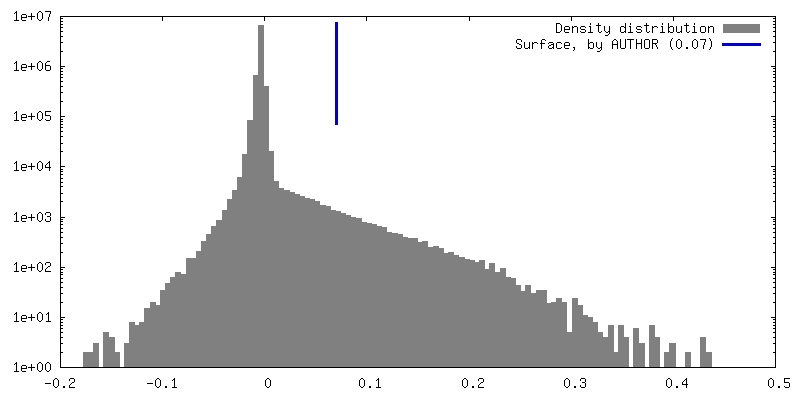
Density
Contour LevelBy AUTHOR: 0.07
Minimum - Maximum-0.18535097 - 0.45451376
Average (Standard dev.)-0.000577492 (±0.007025232)
SymmetrySpace group: 1
Details

EMDB XML:

Map geometry
Axis orderXYZ
Origin000
Dimensions200200200
Spacing200200200
CellA=B=C: 300.4 Å
α=β=γ: 90.0 °

-
Supplemental data

-
Mask #1

Fileemd_48285_msk_1.map
Projections & Slices
AxesZYX

Projections

Slices (1/2)
Density Histograms

-
Additional map: PARP1 NTD-DNA, sharpened map

Fileemd_48285_additional_1.map
AnnotationPARP1 NTD-DNA, sharpened map
Projections & Slices
AxesZYX

Projections

Slices (1/2)
Density Histograms

-
Half map: PARP1 NTD-DNA, half-map A

Fileemd_48285_half_map_1.map
AnnotationPARP1 NTD-DNA, half-map A
Projections & Slices
AxesZYX

Projections

Slices (1/2)
Density Histograms

-
Half map: PARP1 NTD-DNA, half-map B

Fileemd_48285_half_map_2.map
AnnotationPARP1 NTD-DNA, half-map B
Projections & Slices
AxesZYX

Projections

Slices (1/2)
Density Histograms

-
Sample components

-
Entire : Full-length human PARP1 bound to nicked DNA and in complex with H...

EntireName: Full-length human PARP1 bound to nicked DNA and in complex with HPF1 and Timeless fragment
Components
  • Complex: Full-length human PARP1 bound to nicked DNA and in complex with HPF1 and Timeless fragment
    • Protein or peptide: Poly [ADP-ribose] polymerase 1
    • DNA: DNA (48-MER)
  • Ligand: ZINC ION

-
Supramolecule #1: Full-length human PARP1 bound to nicked DNA and in complex with H...

SupramoleculeName: Full-length human PARP1 bound to nicked DNA and in complex with HPF1 and Timeless fragment
type: complex / ID: 1 / Parent: 0 / Macromolecule list: #1-#2
Source (natural)Organism: Homo sapiens (human)
Molecular weightTheoretical: 180 KDa

-
Macromolecule #1: Poly [ADP-ribose] polymerase 1

MacromoleculeName: Poly [ADP-ribose] polymerase 1 / type: protein_or_peptide / ID: 1 / Number of copies: 1 / Enantiomer: LEVO / EC number: NAD+ ADP-ribosyltransferase
Source (natural)Organism: Homo sapiens (human)
Molecular weightTheoretical: 115.433406 KDa
Recombinant expressionOrganism: Escherichia coli (E. coli)
SequenceString: MGSSHHHHHH SSGLVPRGSH MAESSDKLYR VEYAKSGRAS CKKCSESIPK DSLRMAIMVQ SPMFDGKVPH WYHFSCFWKV GHSIRHPDV EVDGFSELRW DDQQKVKKTA EAGGVTGKGQ DGIGSKAEKT LGDFAAEYAK SNRSTCKGCM EKIEKGQVRL S KKMVDPEK ...String:
MGSSHHHHHH SSGLVPRGSH MAESSDKLYR VEYAKSGRAS CKKCSESIPK DSLRMAIMVQ SPMFDGKVPH WYHFSCFWKV GHSIRHPDV EVDGFSELRW DDQQKVKKTA EAGGVTGKGQ DGIGSKAEKT LGDFAAEYAK SNRSTCKGCM EKIEKGQVRL S KKMVDPEK PQLGMIDRWY HPGCFVKNRE ELGFRPEYSA SQLKGFSLLA TEDKEALKKQ LPGVKSEGKR KGDEVDGVDE VA KKKSKKE KDKDSKLEKA LKAQNDLIWN IKDELKKVCS TNDLKELLIF NKQQVPSGES AILDRVADGM VFGALLPCEE CSG QLVFKS DAYYCTGDVT AWTKCMVKTQ TPNRKEWVTP KEFREISYLK KLKVKKQDRI FPPETSASVA ATPPPSTASA PAAV NSSAS ADKPLSNMKI LTLGKLSRNK DEVKAMIEKL GGKLTGTANK ASLCISTKKE VEKMNKKMEE VKEANIRVVS EDFLQ DVSA STKSLQELFL AHILSPWGAE VKAEPVEVVA PRGKSGAALS KKSKGQVKEE GINKSEKRMK LTLKGGAAVD PDSGLE HSA HVLEKGGKVF SATLGLVDIV KGTNSYYKLQ LLEDDKENRY WIFRSWGRVG TVIGSNKLEQ MPSKEDAIEH FMKLYEE KT GNAWHSKNFT KYPKKFYPLE IDYGQDEEAV KKLTVNPGTK SKLPKPVQDL IKMIFDVESM KKAMVEYEID LQKMPLGK L SKRQIQAAYS ILSEVQQAVS QGSSDSQILD LSNRFYTLIP HDFGMKKPPL LNNADSVQAK VEMLDNLLDI EVAYSLLRG GSDDSSKDPI DVNYEKLKTD IKVVDRDSEE AEIIRKYVKN THATTHNAYD LEVIDIFKIE REGECQRYKP FKQLHNRRLL WHGSRTTNF AGILSQGLRI APPEAPVTGY MFGKGIYFAD MVSKSANYCH TSQGDPIGLI LLGEVALGNM YELKHASHIS K LPKGKHSV KGLGKTTPDP SANISLDGVD VPLGTGISSG VNDTSLLYNE YIVYDIAQVN LKYLLKLKFN FKTSLW

UniProtKB: Poly [ADP-ribose] polymerase 1

-
Macromolecule #2: DNA (48-MER)

MacromoleculeName: DNA (48-MER) / type: dna / ID: 2 / Number of copies: 1 / Classification: DNA
Source (natural)Organism: Homo sapiens (human)
Molecular weightTheoretical: 14.850459 KDa
SequenceString:
(DG)(DC)(DT)(DG)(DA)(DG)(DC)(DT)(DT)(DC) (DT)(DG)(DG)(DT)(DG)(DA)(DA)(DG)(DC)(DT) (DC)(DA)(DG)(DC)(DT)(DC)(DG)(DC)(DG) (DG)(DC)(DA)(DG)(DC)(DT)(DG)(DG)(DT)(DG) (DC) (DT)(DG)(DC)(DC)(DG)(DC)(DG)(DA)

-
Macromolecule #3: ZINC ION

MacromoleculeName: ZINC ION / type: ligand / ID: 3 / Number of copies: 3 / Formula: ZN
Molecular weightTheoretical: 65.409 Da

-
Experimental details

-
Structure determination

Methodcryo EM
Processingsingle particle reconstruction
Aggregation stateparticle

-
Sample preparation

BufferpH: 8
VitrificationCryogen name: ETHANE

-
Electron microscopy

MicroscopeTFS KRIOS
Image recordingFilm or detector model: FEI FALCON IV (4k x 4k) / Number real images: 9648 / Average electron dose: 43.0 e/Å2
Electron beamAcceleration voltage: 300 kV / Electron source: FIELD EMISSION GUN
Electron opticsIllumination mode: FLOOD BEAM / Imaging mode: BRIGHT FIELD / Nominal defocus max: 2.5 µm / Nominal defocus min: 0.7000000000000001 µm
Experimental equipment
Model: Titan Krios / Image courtesy: FEI Company

+
Image processing

CTF correctionType: PHASE FLIPPING AND AMPLITUDE CORRECTION
Startup modelType of model: NONE
Final reconstructionResolution.type: BY AUTHOR / Resolution: 3.6 Å / Resolution method: FSC 0.143 CUT-OFF / Number images used: 87400
Initial angle assignmentType: MAXIMUM LIKELIHOOD
Final angle assignmentType: MAXIMUM LIKELIHOOD

+
About Yorodumi

-
News

-
Feb 9, 2022. New format data for meta-information of EMDB entries

New format data for meta-information of EMDB entries

  • Version 3 of the EMDB header file is now the official format.
  • The previous official version 1.9 will be removed from the archive.

Related info.:EMDB header

External links:wwPDB to switch to version 3 of the EMDB data model

-
Aug 12, 2020. Covid-19 info

Covid-19 info

URL: https://pdbj.org/emnavi/covid19.php

New page: Covid-19 featured information page in EM Navigator.

Related info.:Covid-19 info / Mar 5, 2020. Novel coronavirus structure data

+
Mar 5, 2020. Novel coronavirus structure data

Novel coronavirus structure data

Related info.:Yorodumi Speices / Aug 12, 2020. Covid-19 info

External links:COVID-19 featured content - PDBj / Molecule of the Month (242):Coronavirus Proteases

+
Jan 31, 2019. EMDB accession codes are about to change! (news from PDBe EMDB page)

EMDB accession codes are about to change! (news from PDBe EMDB page)

  • The allocation of 4 digits for EMDB accession codes will soon come to an end. Whilst these codes will remain in use, new EMDB accession codes will include an additional digit and will expand incrementally as the available range of codes is exhausted. The current 4-digit format prefixed with “EMD-” (i.e. EMD-XXXX) will advance to a 5-digit format (i.e. EMD-XXXXX), and so on. It is currently estimated that the 4-digit codes will be depleted around Spring 2019, at which point the 5-digit format will come into force.
  • The EM Navigator/Yorodumi systems omit the EMD- prefix.

Related info.:Q: What is EMD? / ID/Accession-code notation in Yorodumi/EM Navigator

External links:EMDB Accession Codes are Changing Soon! / Contact to PDBj

+
Jul 12, 2017. Major update of PDB

Major update of PDB

  • wwPDB released updated PDB data conforming to the new PDBx/mmCIF dictionary.
  • This is a major update changing the version number from 4 to 5, and with Remediation, in which all the entries are updated.
  • In this update, many items about electron microscopy experimental information are reorganized (e.g. em_software).
  • Now, EM Navigator and Yorodumi are based on the updated data.

External links:wwPDB Remediation / Enriched Model Files Conforming to OneDep Data Standards Now Available in the PDB FTP Archive

-
Yorodumi

Thousand views of thousand structures

  • Yorodumi is a browser for structure data from EMDB, PDB, SASBDB, etc.
  • This page is also the successor to EM Navigator detail page, and also detail information page/front-end page for Omokage search.
  • The word "yorodu" (or yorozu) is an old Japanese word meaning "ten thousand". "mi" (miru) is to see.

Related info.:EMDB / PDB / SASBDB / Comparison of 3 databanks / Yorodumi Search / Aug 31, 2016. New EM Navigator & Yorodumi / Yorodumi Papers / Jmol/JSmol / Function and homology information / Changes in new EM Navigator and Yorodumi

Read more