 Movie
Movie Controller


+ Open data

- Basic information
| Entry | Database: PDB / ID: 9mi8 | |||||||||||||||||||||||||||
|---|---|---|---|---|---|---|---|---|---|---|---|---|---|---|---|---|---|---|---|---|---|---|---|---|---|---|---|---|
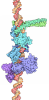
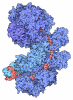
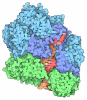
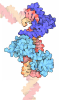
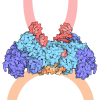
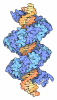
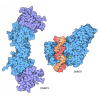
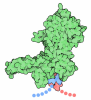
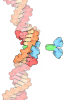
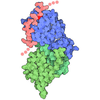
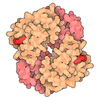
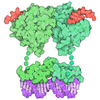
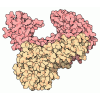
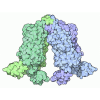
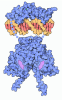
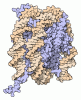
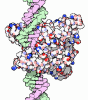
| Title | Human PARP1 N-terminal domains bound to nicked DNA | |||||||||||||||||||||||||||
 Components Components |
| |||||||||||||||||||||||||||
 Keywords Keywords | DNA BINDING PROTEIN / PARP1 / Zinc-finger domains / nicked DNA | |||||||||||||||||||||||||||
| Function / homology |  Function and homology information Function and homology informationNAD+-histone H2BS6 serine ADP-ribosyltransferase activity / NAD+-histone H3S10 serine ADP-ribosyltransferase activity / NAD+-histone H2BE35 glutamate ADP-ribosyltransferase activity / positive regulation of myofibroblast differentiation / negative regulation of ATP biosynthetic process / NAD+-protein-tyrosine ADP-ribosyltransferase activity / NAD+-protein-histidine ADP-ribosyltransferase activity / non-sequence-specific DNA binding, bending / regulation of base-excision repair / mitochondrial DNA metabolic process ...NAD+-histone H2BS6 serine ADP-ribosyltransferase activity / NAD+-histone H3S10 serine ADP-ribosyltransferase activity / NAD+-histone H2BE35 glutamate ADP-ribosyltransferase activity / positive regulation of myofibroblast differentiation / negative regulation of ATP biosynthetic process / NAD+-protein-tyrosine ADP-ribosyltransferase activity / NAD+-protein-histidine ADP-ribosyltransferase activity / non-sequence-specific DNA binding, bending / regulation of base-excision repair / mitochondrial DNA metabolic process / regulation of circadian sleep/wake cycle, non-REM sleep / vRNA Synthesis / carbohydrate biosynthetic process / NAD+-protein-serine ADP-ribosyltransferase activity / NAD DNA ADP-ribosyltransferase activity / single-strand break-containing DNA binding / mitochondrial DNA repair / DNA ADP-ribosylation / regulation of oxidative stress-induced neuron intrinsic apoptotic signaling pathway / signal transduction involved in regulation of gene expression / ATP generation from poly-ADP-D-ribose / replication fork reversal / positive regulation of necroptotic process / establishment of protein localization to chromatin / positive regulation of intracellular estrogen receptor signaling pathway / transcription regulator activator activity / response to aldosterone / HDR through MMEJ (alt-NHEJ) / single strand break repair / positive regulation of DNA-templated transcription, elongation / NAD+ ADP-ribosyltransferase / protein auto-ADP-ribosylation / negative regulation of telomere maintenance via telomere lengthening / cellular response to zinc ion / NAD+-protein-aspartate ADP-ribosyltransferase activity / protein poly-ADP-ribosylation / NAD+-protein-glutamate ADP-ribosyltransferase activity / negative regulation of cGAS/STING signaling pathway / positive regulation of cardiac muscle hypertrophy / negative regulation of transcription elongation by RNA polymerase II / decidualization / NAD+-protein mono-ADP-ribosyltransferase activity / positive regulation of mitochondrial depolarization / protein autoprocessing / macrophage differentiation / R-SMAD binding / negative regulation of adipose tissue development / nuclear replication fork / Transferases; Glycosyltransferases; Pentosyltransferases / positive regulation of SMAD protein signal transduction / POLB-Dependent Long Patch Base Excision Repair / NAD+ poly-ADP-ribosyltransferase activity / transforming growth factor beta receptor signaling pathway / SUMOylation of DNA damage response and repair proteins / positive regulation of double-strand break repair via homologous recombination / nucleosome binding / protein localization to chromatin / nucleotidyltransferase activity / response to gamma radiation / negative regulation of innate immune response / telomere maintenance / nuclear estrogen receptor binding / protein modification process / site of DNA damage / mitochondrion organization / cellular response to nerve growth factor stimulus / Downregulation of SMAD2/3:SMAD4 transcriptional activity / positive regulation of protein localization to nucleus / protein-DNA complex / fibrillar center / transcription by RNA polymerase II / DNA Damage Recognition in GG-NER / NAD binding / cellular response to amyloid-beta / enzyme activator activity / histone deacetylase binding / Dual Incision in GG-NER / Formation of Incision Complex in GG-NER / cellular response to UV / double-strand break repair / cellular response to insulin stimulus / nuclear envelope / regulation of protein localization / site of double-strand break / transcription regulator complex / cellular response to oxidative stress / damaged DNA binding / response to ethanol / RNA polymerase II-specific DNA-binding transcription factor binding / nuclear body / positive regulation of canonical NF-kappaB signal transduction / chromosome, telomeric region / innate immune response / negative regulation of DNA-templated transcription / ubiquitin protein ligase binding / DNA repair / apoptotic process / chromatin binding / DNA damage response / nucleolus Similarity search - Function | |||||||||||||||||||||||||||
| Biological species |  Homo sapiens (human) Homo sapiens (human) | |||||||||||||||||||||||||||
| Method | ELECTRON MICROSCOPY / single particle reconstruction / cryo EM / Resolution: 3.6 Å | |||||||||||||||||||||||||||
 Authors Authors | Sverzhinsky, A. / Pascal, J.M. | |||||||||||||||||||||||||||
| Funding support |  Canada, Canada,  United States, 2items United States, 2items
| |||||||||||||||||||||||||||
 Citation Citation | Journal: Nat Commun / Year: 2026 Title: PARP1-HPF1 structure and dynamics on nicked DNA suggest a mechanism for acute and localized ADP-ribosylation. Authors: Aleksandr Sverzhinsky / Huijun Xue / Marie-France Langelier / Marcelo V Muniz Corrêa / Joshua Del Mundo / Scott Classen / Michal Hammel / Eli Rothenberg / John M Pascal / Abstract: PARP1 detection of DNA strand breaks allosterically leads to PARP1 synthesis of poly(ADP-ribose) modifications that signal DNA damage. HPF1 engages activated PARP1 to control modification site ...PARP1 detection of DNA strand breaks allosterically leads to PARP1 synthesis of poly(ADP-ribose) modifications that signal DNA damage. HPF1 engages activated PARP1 to control modification site selection. Understanding of the mechanism of DNA break detection and catalytic activation is incomplete, due largely to limited structural information for full-length PARP1. Here, single-particle cryo-EM provides views of the full complement of PARP1 domains engaging a DNA single-strand break in the presence of HPF1 and a fragment of binding partner Timeless. Cryo-EM, single-molecule DNA dynamics, and small-angle X-ray scattering analysis indicate that PARP1 remains dynamic even when the multi-domain structure is organized on a DNA break, with the minimal catalytic region displaying high mobility relative to domains engaging damage. We propose that the organization of PARP1 domains on a DNA break releases a tethered, constitutively active catalytic region to modify molecules in a radius surrounding the DNA break site. | |||||||||||||||||||||||||||
| History |
|
- Structure visualization
| Structure viewer | Molecule: MolmilJmol/JSmol |
|---|
- Downloads & links
-Download
| PDBx/mmCIF format | 9mi8.cif.gz | 233.3 KB | Display | PDBx/mmCIF format |
|---|---|---|---|---|
| PDB format | pdb9mi8.ent.gz | 178 KB | Display | PDB format |
| PDBx/mmJSON format | 9mi8.json.gz | Tree view | PDBx/mmJSON format | |
| Others |  Other downloads Other downloads |
-Validation report
| Arichive directory | https://data.pdbj.org/pub/pdb/validation_reports/mi/9mi8ftp://data.pdbj.org/pub/pdb/validation_reports/mi/9mi8 | HTTPS FTP |
|---|
-Related structure data
| Related structure data |  48285MC  9mjaC M: map data used to model this data C: citing same article ( |
|---|---|
| Similar structure data |

-Links
 PDBj
PDBj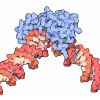
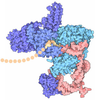
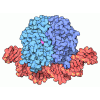
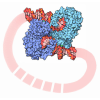

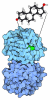
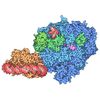

- Assembly
| Deposited unit | 
|
|---|---|
| 1 |
|
-Components
| #1: Protein | Mass: 115433.406 Da / Num. of mol.: 1 Source method: isolated from a genetically manipulated source Source: (gene. exp.) Homo sapiens (human) / Gene: PARP1, ADPRT, PPOL / Production host:   Escherichia coli (E. coli) Escherichia coli (E. coli)References: UniProt: P09874, NAD+ ADP-ribosyltransferase, Transferases; Glycosyltransferases; Pentosyltransferases | ||||
|---|---|---|---|---|---|
| #2: DNA chain | Mass: 14850.459 Da / Num. of mol.: 1 / Source method: obtained synthetically / Source: (synth.) Homo sapiens (human) | ||||
| #3: Chemical |   Mass: 65.409 Da / Num. of mol.: 3 / Source method: obtained synthetically / Formula: Zn Mass: 65.409 Da / Num. of mol.: 3 / Source method: obtained synthetically / Formula: ZnHas ligand of interest | N | Has protein modification | N | |
-Experimental details
-Experiment
| Experiment | Method: ELECTRON MICROSCOPY |
|---|---|
| EM experiment | Aggregation state: PARTICLE / 3D reconstruction method: single particle reconstruction |
- Sample preparation
| Component | Name: Full-length human PARP1 bound to nicked DNA and in complex with HPF1 and Timeless fragment Type: COMPLEX / Entity ID: #1-#2 / Source: RECOMBINANT |
|---|---|
| Molecular weight | Value: 0.18 MDa / Experimental value: YES |
| Source (natural) | Organism: Homo sapiens (human) |
| Source (recombinant) | Organism: Escherichia coli (E. coli) |
| Buffer solution | pH: 8 |
| Specimen | Embedding applied: NO / Shadowing applied: NO / Staining applied: NO / Vitrification applied: YES |
| Vitrification | Cryogen name: ETHANE |
- Electron microscopy imaging
| Experimental equipment |  Model: Titan Krios / Image courtesy: FEI Company |
|---|---|
| Microscopy | Model: TFS KRIOS |
| Electron gun | Electron source:  FIELD EMISSION GUN / Accelerating voltage: 300 kV / Illumination mode: FLOOD BEAM FIELD EMISSION GUN / Accelerating voltage: 300 kV / Illumination mode: FLOOD BEAM |
| Electron lens | Mode: BRIGHT FIELD / Nominal defocus max: 2500 nm / Nominal defocus min: 700 nm |
| Image recording | Electron dose: 43 e/Å2 / Film or detector model: FEI FALCON IV (4k x 4k) / Num. of real images: 9648 |
- Processing
| CTF correction | Type: PHASE FLIPPING AND AMPLITUDE CORRECTION |
|---|---|
| 3D reconstruction | Resolution: 3.6 Å / Resolution method: FSC 0.143 CUT-OFF / Num. of particles: 87400 / Symmetry type: POINT |
