 ムービー
ムービー コントローラー


+ データを開く

- 基本情報
基本情報
| 登録情報 |  | |||||||||
|---|---|---|---|---|---|---|---|---|---|---|
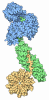
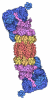
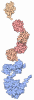
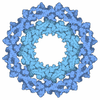
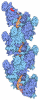
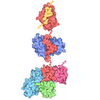
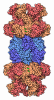
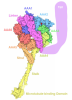
| タイトル | Composite map: Ternary complex of the human 20S proteasome in complex with Importin-9 and two homodimers of Akirin-2 | |||||||||
 マップデータ マップデータ | Composite map | |||||||||
 試料 試料 |
| |||||||||
 キーワード キーワード | 20S proteasome / 20S / proteasome / nuclear iport / akirin / akirin2 / importin 9 / importin / PROTEIN TRANSPORT | |||||||||
| 機能・相同性 |  機能・相同性情報 機能・相同性情報proteasome localization / regulation of muscle cell differentiation / positive regulation of B cell activation / histone chaperone activity / nuclear protein quality control by the ubiquitin-proteasome system / positive regulation of adaptive immune response / purine ribonucleoside triphosphate binding / embryo development ending in birth or egg hatching / Antigen processing: Ub, ATP-independent proteasomal degradation / positive regulation of innate immune response ...proteasome localization / regulation of muscle cell differentiation / positive regulation of B cell activation / histone chaperone activity / nuclear protein quality control by the ubiquitin-proteasome system / positive regulation of adaptive immune response / purine ribonucleoside triphosphate binding / embryo development ending in birth or egg hatching / Antigen processing: Ub, ATP-independent proteasomal degradation / positive regulation of innate immune response / sperm glycocalyx / nuclear import signal receptor activity / Regulation of ornithine decarboxylase (ODC) / Proteasome assembly / proteasome core complex / perinuclear theca / Cross-presentation of soluble exogenous antigens (endosomes) / Somitogenesis / myofibril / sperm head-tail coupling apparatus / immune system process / NF-kappaB binding / proteasome core complex, alpha-subunit complex / transcription repressor complex / ciliary tip / : / proteasome complex / Regulation of activated PAK-2p34 by proteasome mediated degradation / sarcomere / Autodegradation of Cdh1 by Cdh1:APC/C / APC/C:Cdc20 mediated degradation of Securin / Asymmetric localization of PCP proteins / transcription coregulator activity / Ubiquitin-dependent degradation of Cyclin D / SCF-beta-TrCP mediated degradation of Emi1 / NIK-->noncanonical NF-kB signaling / TNFR2 non-canonical NF-kB pathway / AUF1 (hnRNP D0) binds and destabilizes mRNA / centriole / sperm end piece / P-body / negative regulation of inflammatory response to antigenic stimulus / Assembly of the pre-replicative complex / Vpu mediated degradation of CD4 / Cdc20:Phospho-APC/C mediated degradation of Cyclin A / lipopolysaccharide binding / Degradation of DVL / Dectin-1 mediated noncanonical NF-kB signaling / Degradation of CRY and PER proteins / Degradation of AXIN / Hh mutants are degraded by ERAD / Activation of NF-kappaB in B cells / G2/M Checkpoints / Hedgehog ligand biogenesis / Degradation of GLI1 by the proteasome / Defective CFTR causes cystic fibrosis / Autodegradation of the E3 ubiquitin ligase COP1 / Regulation of RUNX3 expression and activity / GSK3B and BTRC:CUL1-mediated-degradation of NFE2L2 / Negative regulation of NOTCH4 signaling / Hedgehog 'on' state / APC/C:Cdh1 mediated degradation of Cdc20 and other APC/C:Cdh1 targeted proteins in late mitosis/early G1 / Vif-mediated degradation of APOBEC3G / FBXL7 down-regulates AURKA during mitotic entry and in early mitosis / cerebral cortex development / Ubiquitin-Mediated Degradation of Phosphorylated Cdc25A / Degradation of GLI2 by the proteasome / GLI3 is processed to GLI3R by the proteasome / MAPK6/MAPK4 signaling / Degradation of CDH1 / positive regulation of interleukin-6 production / Degradation of beta-catenin by the destruction complex / Oxygen-dependent proline hydroxylation of Hypoxia-inducible Factor Alpha / ABC-family protein mediated transport / CDK-mediated phosphorylation and removal of Cdc6 / CLEC7A (Dectin-1) signaling / SCF(Skp2)-mediated degradation of p27/p21 / FCERI mediated NF-kB activation / response to virus / small GTPase binding / Regulation of expression of SLITs and ROBOs / nuclear matrix / Regulation of PTEN stability and activity / Interleukin-1 signaling / Orc1 removal from chromatin / protein import into nucleus / Regulation of RAS by GAPs / Regulation of RUNX2 expression and activity / The role of GTSE1 in G2/M progression after G2 checkpoint / Separation of Sister Chromatids / UCH proteinases / KEAP1-NFE2L2 pathway / Downstream TCR signaling / nuclear envelope / Antigen processing: Ubiquitination & Proteasome degradation / sperm principal piece / RUNX1 regulates transcription of genes involved in differentiation of HSCs / ER-Phagosome pathway / Neddylation / regulation of inflammatory response 類似検索 - 分子機能 | |||||||||
| 生物種 |  Homo sapiens (ヒト) Homo sapiens (ヒト) | |||||||||
| 手法 | 単粒子再構成法 / クライオ電子顕微鏡法 / 解像度: 3.3 Å | |||||||||
 データ登録者 データ登録者 | Brunner HL / Grundmann L / David H | |||||||||
| 資金援助 | European Union,  オーストリア, 2件 オーストリア, 2件
| |||||||||
 引用 引用 | ジャーナル: Nat Commun / 年: 2026 タイトル: A multivalent adaptor mechanism drives the nuclear import of proteasomes. 著者: Hanna L Brunner / Robert W Kalis / Lorenz Grundmann / Zuzana Hodáková / Zuzana Koskova / Irina Grishkovskaya / Melanie de Almeida / Matthias Hinterndorfer / Hannah Knaudt / Simon Höfflin / ...著者: Hanna L Brunner / Robert W Kalis / Lorenz Grundmann / Zuzana Hodáková / Zuzana Koskova / Irina Grishkovskaya / Melanie de Almeida / Matthias Hinterndorfer / Hannah Knaudt / Simon Höfflin / Florian Andersch / Harald Kotisch / Achim Dickmanns / Sara Cuylen-Haering / Johannes Zuber / David Haselbach /   要旨: Nuclear protein homeostasis, including transcription factor turnover, critically depends on the nuclear proteasomes that must be imported after cell division. This dynamic process requires AKIRIN2, a ...Nuclear protein homeostasis, including transcription factor turnover, critically depends on the nuclear proteasomes that must be imported after cell division. This dynamic process requires AKIRIN2, a small unstructured protein whose mechanistic role has remained elusive despite its essential function. Using an integrated approach combining protein-wide saturation mutagenesis screens, cryo-EM, and biochemical reconstitution, we characterize AKIRIN2 as a scaffold protein that coordinates the assembly of an importin cluster around the proteasome. AKIRIN2 binds in multiple copies to the 20S proteasome and simultaneously interacts with importin IPO9 and the KPNA2/KPNB1 heterodimer. In the nucleus, RanGTP triggers importin dissociation, releasing the proteasome, while AKIRIN2 undergoes ubiquitin-independent degradation. Our findings reveal how AKIRIN2's multivalency facilitates the recruitment of multiple importins to the proteasome, a critical adaptation for transporting this large macromolecular complex into the nucleus and maintaining the nuclear proteome. | |||||||||
| 履歴 |
|
- 構造の表示
構造の表示
| 添付画像 |
|---|

- ダウンロードとリンク
-EMDBアーカイブ
| マップデータ | emd_53265.map.gz | 1.2 MB | EMDBマップデータ形式 | |
|---|---|---|---|---|
| ヘッダ (付随情報) | emd-53265-v30.xmlemd-53265.xml | 30.7 KB 30.7 KB | 表示 表示 | EMDBヘッダ |
| 画像 |  emd_53265.png emd_53265.png | 65.3 KB | ||
| Filedesc metadata | emd-53265.cif.gz | 8.7 KB | ||
| アーカイブディレクトリ |  http://ftp.pdbj.org/pub/emdb/structures/EMD-53265ftp://ftp.pdbj.org/pub/emdb/structures/EMD-53265 http://ftp.pdbj.org/pub/emdb/structures/EMD-53265ftp://ftp.pdbj.org/pub/emdb/structures/EMD-53265 | HTTPS FTP |
-関連構造データ


-リンク
| EMDBのページ | EMDB (EBI/PDBe) / EMDataResource |
|---|---|
| 「今月の分子」の関連する項目 |
-マップ
| ファイル | ダウンロード / ファイル: emd_53265.map.gz / 形式: CCP4 / 大きさ: 103 MB / タイプ: IMAGE STORED AS FLOATING POINT NUMBER (4 BYTES) | ||||||||||||||||||||||||||||||||||||
|---|---|---|---|---|---|---|---|---|---|---|---|---|---|---|---|---|---|---|---|---|---|---|---|---|---|---|---|---|---|---|---|---|---|---|---|---|---|
| 注釈 | Composite map | ||||||||||||||||||||||||||||||||||||
| 投影像・断面図 | 画像のコントロール
画像は Spider により作成 | ||||||||||||||||||||||||||||||||||||
| ボクセルのサイズ | X=Y=Z: 1.43 Å | ||||||||||||||||||||||||||||||||||||
| 密度 |
| ||||||||||||||||||||||||||||||||||||
| 対称性 | 空間群: 1 | ||||||||||||||||||||||||||||||||||||
| 詳細 | EMDB XML:
|
 Z (Sec.)
 Y (Row.)
 X (Col.)


-添付データ
- 試料の構成要素
+全体 : Ternary complex of the human 20S proteasome in complex with two d...
+超分子 #1: Ternary complex of the human 20S proteasome in complex with two d...
+分子 #1: Importin-9

 Escherichia coli (大腸菌)
+分子 #2: Akirin-2
+分子 #3: Proteasome subunit alpha type-3

 Spodoptera frugiperda (ツマジロクサヨトウ)
+分子 #4: Proteasome subunit alpha type-6
+分子 #5: Proteasome subunit alpha type-2
+分子 #6: Proteasome subunit alpha type-4
+分子 #7: Proteasome subunit alpha type-7
+分子 #8: Proteasome subunit alpha type-5
+分子 #9: Proteasome subunit alpha type-1
-実験情報
-構造解析
| 手法 | クライオ電子顕微鏡法 |
|---|---|
 解析 解析 | 単粒子再構成法 |
| 試料の集合状態 | particle |
-試料調製
| 緩衝液 | pH: 7.5 |
|---|---|
| グリッド | モデル: Quantifoil R3.5/1 / 材質: COPPER / メッシュ: 200 / 支持フィルム - #0 - Film type ID: 1 / 支持フィルム - #0 - 材質: CARBON / 支持フィルム - #0 - トポロジー: HOLEY / 支持フィルム - #1 - Film type ID: 2 / 支持フィルム - #1 - 材質: CARBON / 支持フィルム - #1 - トポロジー: CONTINUOUS / 支持フィルム - #1 - Film thickness: 2 / 前処理 - タイプ: GLOW DISCHARGE |
| 凍結 | 凍結剤: ETHANE |
- 電子顕微鏡法
| 顕微鏡 | TFS KRIOS |
|---|---|
| 撮影 | フィルム・検出器のモデル: GATAN K3 BIOQUANTUM (6k x 4k) 平均電子線量: 44.4 e/Å2 |
| 電子線 | 加速電圧: 300 kV / 電子線源:  FIELD EMISSION GUN FIELD EMISSION GUN |
| 電子光学系 | 照射モード: FLOOD BEAM / 撮影モード: BRIGHT FIELD 最大 デフォーカス(公称値): 1.9000000000000001 µm 最小 デフォーカス(公称値): 1.0 µm |
| 実験機器 |  モデル: Titan Krios / 画像提供: FEI Company |
