DNA clamp unloader activity / positive regulation of cell cycle G2/M phase transition / positive regulation of DNA-directed DNA polymerase activity / Rad17 RFC-like complex / Elg1 RFC-like complex / DNA replication factor C complex / Ctf18 RFC-like complex / nuclear DNA replication / dinucleotide insertion or deletion binding / PCNA-p21 complex ...DNA clamp unloader activity / positive regulation of cell cycle G2/M phase transition / positive regulation of DNA-directed DNA polymerase activity / Rad17 RFC-like complex / Elg1 RFC-like complex / DNA replication factor C complex / Ctf18 RFC-like complex / nuclear DNA replication / dinucleotide insertion or deletion binding / PCNA-p21 complex / mitotic telomere maintenance via semi-conservative replication / purine-specific mismatch base pair DNA N-glycosylase activity / DNA clamp loader activity / nuclear lamina / Polymerase switching / Processive synthesis on the lagging strand / PCNA complex / DNA replication checkpoint signaling / Removal of the Flap Intermediate / Telomere C-strand (Lagging Strand) Synthesis / MutLalpha complex binding / Mismatch repair (MMR) directed by MSH2:MSH3 (MutSbeta) / Mismatch repair (MMR) directed by MSH2:MSH6 (MutSalpha) / Transcription of E2F targets under negative control by DREAM complex / Polymerase switching on the C-strand of the telomere / replisome / mitotic DNA replication / response to L-glutamate / Processive synthesis on the C-strand of the telomere / Removal of the Flap Intermediate from the C-strand / negative regulation of intrinsic apoptotic signaling pathway in response to DNA damage by p53 class mediator / response to dexamethasone / DNA strand elongation involved in DNA replication / histone acetyltransferase binding / DNA synthesis involved in DNA repair / leading strand elongation / DNA polymerase processivity factor activity / G1/S-Specific Transcription / HDR through Single Strand Annealing (SSA) / SUMOylation of DNA replication proteins / nuclear replication fork / Impaired BRCA2 binding to RAD51 / PCNA-Dependent Long Patch Base Excision Repair / response to cadmium ion / DNA repair-dependent chromatin remodeling / Presynaptic phase of homologous DNA pairing and strand exchange / liver regeneration / ATP-dependent activity, acting on DNA / estrous cycle / Activation of ATR in response to replication stress / mismatch repair / cyclin-dependent protein kinase holoenzyme complex / DNA polymerase binding / epithelial cell differentiation / translesion synthesis / TP53 Regulates Transcription of Genes Involved in G2 Cell Cycle Arrest / positive regulation of DNA replication / replication fork / positive regulation of DNA repair / replication fork processing / nuclear estrogen receptor binding / Translesion synthesis by REV1 / Translesion synthesis by POLK / Translesion synthesis by POLI / Gap-filling DNA repair synthesis and ligation in GG-NER / Termination of translesion DNA synthesis / Translesion Synthesis by POLH / receptor tyrosine kinase binding / Recognition of DNA damage by PCNA-containing replication complex / DNA-templated DNA replication / G2/M DNA damage checkpoint / cellular response to hydrogen peroxide / HDR through Homologous Recombination (HRR) / cell population proliferation / Dual Incision in GG-NER / heart development / cellular response to UV / Dual incision in TC-NER / Gap-filling DNA repair synthesis and ligation in TC-NER / response to estradiol / E3 ubiquitin ligases ubiquitinate target proteins / chromatin organization / Processing of DNA double-strand break ends / Regulation of TP53 Activity through Phosphorylation / damaged DNA binding / DNA replication / chromosome, telomeric region / DNA repair / centrosome / chromatin binding / DNA damage response / chromatin / protein-containing complex binding / enzyme binding / ATP hydrolysis activity / DNA binding / extracellular exosome / nucleoplasm / ATP binding / identical protein binding Similarity search - Function
Replication factor C subunit 3, C-terminal domain / RCF1/5-like, AAA+ ATPase lid domain / Replication factor C, C-terminal / Replication factor C C-terminal domain / : / DNA polymerase III, delta subunit / : / DNA polymerase III, clamp loader complex, gamma/delta/delta subunit, C-terminal / Proliferating cell nuclear antigen signature 2. / Proliferating cell nuclear antigen, PCNA, C-terminal ...Replication factor C subunit 3, C-terminal domain / RCF1/5-like, AAA+ ATPase lid domain / Replication factor C, C-terminal / Replication factor C C-terminal domain / : / DNA polymerase III, delta subunit / : / DNA polymerase III, clamp loader complex, gamma/delta/delta subunit, C-terminal / Proliferating cell nuclear antigen signature 2. / Proliferating cell nuclear antigen, PCNA, C-terminal / Proliferating cell nuclear antigen, C-terminal domain / Proliferating cell nuclear antigen, PCNA, conserved site / Proliferating cell nuclear antigen signature 1. / Proliferating cell nuclear antigen, PCNA / Proliferating cell nuclear antigen, PCNA, N-terminal / Proliferating cell nuclear antigen, N-terminal domain / : / ATPase family associated with various cellular activities (AAA) / ATPase, AAA-type, core / ATPases associated with a variety of cellular activities / AAA+ ATPase domain / P-loop containing nucleoside triphosphate hydrolase Similarity search - Domain/homology
DNA sliding clamp PCNA / Replication factor C subunit 4 / Replication factor C subunit 2 / Replication factor C subunit 5 / Replication factor C subunit 3 / ATPase family AAA domain-containing protein 5 Similarity search - Component
Biological species
Homo sapiens (human)
Method
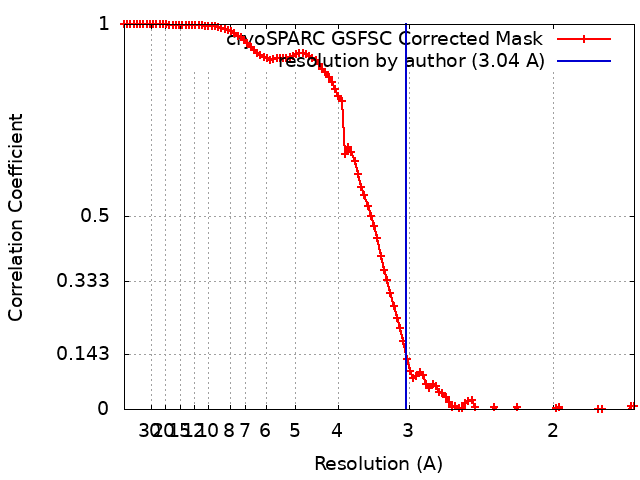
single particle reconstruction / cryo EM / Resolution: 3.04 Å
National Institutes of Health/National Institute of General Medical Sciences (NIH/NIGMS)
GM131754
United States
National Institutes of Health/National Institute of General Medical Sciences (NIH/NIGMS)
GM115809
United States
Howard Hughes Medical Institute (HHMI)
United States
Citation
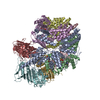
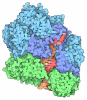
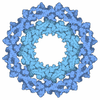
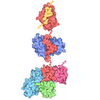
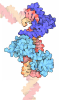
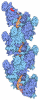
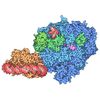
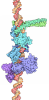
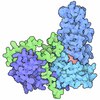
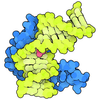
Journal: Nat Struct Mol Biol / Year: 2024 Title: The human ATAD5 has evolved unique structural elements to function exclusively as a PCNA unloader. Authors: Feng Wang / Qing He / Nina Y Yao / Michael E O'Donnell / Huilin Li / Abstract: Humans have three different proliferating cell nuclear antigen (PCNA) clamp-loading complexes: RFC and CTF18-RFC load PCNA onto DNA, but ATAD5-RFC can only unload PCNA from DNA. The underlying ...Humans have three different proliferating cell nuclear antigen (PCNA) clamp-loading complexes: RFC and CTF18-RFC load PCNA onto DNA, but ATAD5-RFC can only unload PCNA from DNA. The underlying structural basis of ATAD5-RFC unloading is unknown. We show here that ATAD5 has two unique locking loops that appear to tie the complex into a rigid structure, and together with a domain that plugs the DNA-binding chamber, prevent conformation changes required for DNA binding, likely explaining why ATAD5-RFC is exclusively a PCNA unloader. These features are conserved in the yeast PCNA unloader Elg1-RFC. We observe intermediates in which PCNA bound to ATAD5-RFC exists as a closed planar ring, a cracked spiral or a gapped spiral. Surprisingly, ATAD5-RFC can open a PCNA gap between PCNA protomers 2 and 3, different from the PCNA protomers 1 and 3 gap observed in all previously characterized clamp loaders.
In the structure databanks used in Yorodumi, some data are registered as the other names, "COVID-19 virus" and "2019-nCoV". Here are the details of the virus and the list of structure data.
Jan 31, 2019. EMDB accession codes are about to change! (news from PDBe EMDB page)
EMDB accession codes are about to change! (news from PDBe EMDB page)
The allocation of 4 digits for EMDB accession codes will soon come to an end. Whilst these codes will remain in use, new EMDB accession codes will include an additional digit and will expand incrementally as the available range of codes is exhausted. The current 4-digit format prefixed with “EMD-” (i.e. EMD-XXXX) will advance to a 5-digit format (i.e. EMD-XXXXX), and so on. It is currently estimated that the 4-digit codes will be depleted around Spring 2019, at which point the 5-digit format will come into force.
The EM Navigator/Yorodumi systems omit the EMD- prefix.
Related info.:Q: What is EMD? / ID/Accession-code notation in Yorodumi/EM Navigator
Yorodumi is a browser for structure data from EMDB, PDB, SASBDB, etc.
This page is also the successor to EM Navigator detail page, and also detail information page/front-end page for Omokage search.
The word "yorodu" (or yorozu) is an old Japanese word meaning "ten thousand". "mi" (miru) is to see.
Related info.:EMDB / PDB / SASBDB / Comparison of 3 databanks / Yorodumi Search / Aug 31, 2016. New EM Navigator & Yorodumi / Yorodumi Papers / Jmol/JSmol / Function and homology information / Changes in new EM Navigator and Yorodumi
 Movie
Movie Controller

 Yorodumi
 Open data
 Basic information
 Map data
 Sample
 Keywords
 Function and homology information
 Homo sapiens (human)
 Authors
 United States, 3 items
  Citation
 Structure visualization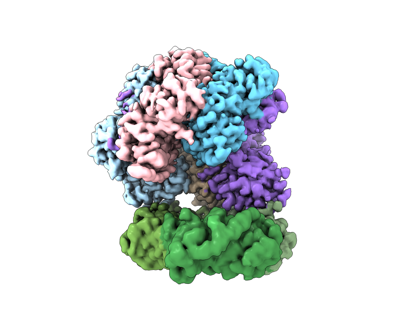
 Downloads & links
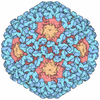
 emd_42295.png
 https://data.pdbj.org/pub/emdb/structures/EMD-42295


 Z (Sec.)
 Y (Row.)
 X (Col.)




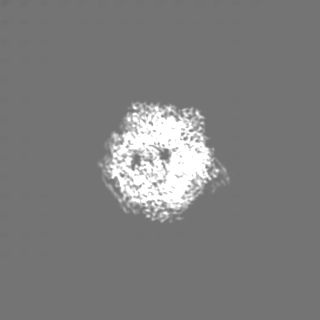
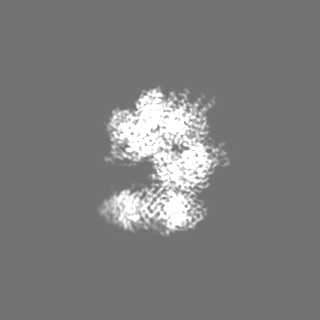
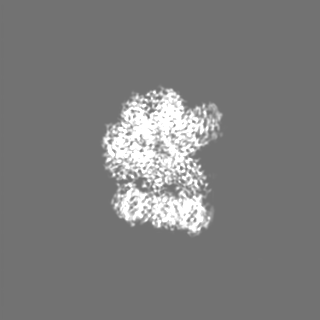
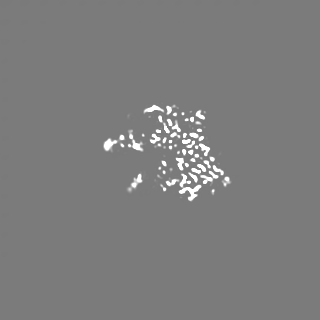







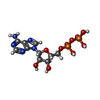
 Sample components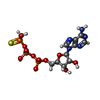
 Processing
 Electron microscopy
 FIELD EMISSION GUN