negative regulation of phosphatase activity / positive regulation of sodium:proton antiporter activity / positive regulation of mitochondrial membrane permeability / regulation of the force of heart contraction by cardiac conduction / Sodium/Proton exchangers / cation-transporting ATPase complex / membrane docking / negative regulation of protein autophosphorylation / Hyaluronan degradation / positive regulation of protein transport ...negative regulation of phosphatase activity / positive regulation of sodium:proton antiporter activity / positive regulation of mitochondrial membrane permeability / regulation of the force of heart contraction by cardiac conduction / Sodium/Proton exchangers / cation-transporting ATPase complex / membrane docking / negative regulation of protein autophosphorylation / Hyaluronan degradation / positive regulation of protein transport / cellular response to electrical stimulus / positive regulation of phospholipid biosynthetic process / transporter complex / regulation of cardiac muscle cell membrane potential / regulation of pH / positive regulation of action potential / positive regulation of glycoprotein biosynthetic process / hyaluronan catabolic process / maintenance of cell polarity / positive regulation of calcineurin-NFAT signaling cascade / sodium:proton antiporter activity / membrane organization / cellular response to cold / sodium ion export across plasma membrane / microtubule bundle formation / protein phosphatase 2B binding / regulation of stress fiber assembly / intracellular sodium ion homeostasis / negative regulation of calcineurin-NFAT signaling cascade / negative regulation of protein import into nucleus / response to acidic pH / sodium ion import across plasma membrane / regulation of focal adhesion assembly / regulation of cardiac muscle contraction by calcium ion signaling / cellular response to antibiotic / cardiac muscle cell contraction / positive regulation of cardiac muscle hypertrophy / small GTPase-mediated signal transduction / positive regulation of the force of heart contraction / endoplasmic reticulum-Golgi intermediate compartment / negative regulation of protein phosphorylation / protein kinase inhibitor activity / response to muscle stretch / protein complex oligomerization / potassium channel regulator activity / intercalated disc / positive regulation of protein targeting to membrane / potassium ion transport / protein export from nucleus / transport vesicle / negative regulation of protein kinase activity / cellular response to acidic pH / cytoplasmic microtubule organization / phosphatidylinositol-4,5-bisphosphate binding / negative regulation of protein ubiquitination / proton transmembrane transport / cellular response to epinephrine stimulus / T-tubule / regulation of intracellular pH / sodium ion transmembrane transport / cellular response to mechanical stimulus / phospholipid binding / kinase binding / calcium-dependent protein binding / microtubule cytoskeleton / cellular response to insulin stimulus / cell migration / positive regulation of cell growth / lamellipodium / cell differentiation / cellular response to hypoxia / microtubule binding / basolateral plasma membrane / molecular adaptor activity / membrane fusion / protein-macromolecule adaptor activity / protein stabilization / apical plasma membrane / positive regulation of apoptotic process / membrane raft / Golgi membrane / focal adhesion / calcium ion binding / negative regulation of apoptotic process / perinuclear region of cytoplasm / cell surface / endoplasmic reticulum / positive regulation of transcription by RNA polymerase II / extracellular exosome / membrane / identical protein binding / nucleus / plasma membrane / cytoplasm Similarity search - Function
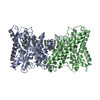
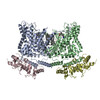
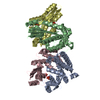
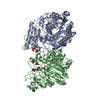
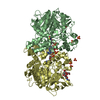
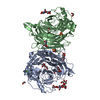
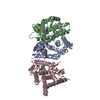
Journal: Nat Commun / Year: 2021 Title: Structure and mechanism of the human NHE1-CHP1 complex. Authors: Yanli Dong / Yiwei Gao / Alina Ilie / DuSik Kim / Annie Boucher / Bin Li / Xuejun C Zhang / John Orlowski / Yan Zhao / Abstract: Sodium/proton exchanger 1 (NHE1) is an electroneutral secondary active transporter present on the plasma membrane of most mammalian cells and plays critical roles in regulating intracellular pH and ...Sodium/proton exchanger 1 (NHE1) is an electroneutral secondary active transporter present on the plasma membrane of most mammalian cells and plays critical roles in regulating intracellular pH and volume homeostasis. Calcineurin B-homologous protein 1 (CHP1) is an obligate binding partner that promotes NHE1 biosynthetic maturation, cell surface expression and pH-sensitivity. Dysfunctions of either protein are associated with neurological disorders. Here, we elucidate structures of the human NHE1-CHP1 complex in both inward- and inhibitor (cariporide)-bound outward-facing conformations. We find that NHE1 assembles as a symmetrical homodimer, with each subunit undergoing an elevator-like conformational change during cation exchange. The cryo-EM map reveals the binding site for the NHE1 inhibitor cariporide, illustrating how inhibitors block transport activity. The CHP1 molecule differentially associates with these two conformational states of each NHE1 monomer, and this association difference probably underlies the regulation of NHE1 pH-sensitivity by CHP1.
History
Deposition
Jan 3, 2021
-
Header (metadata) release
Jun 23, 2021
-
Map release
Jun 23, 2021
-
Update
Mar 27, 2024
-
Current status
Mar 27, 2024
Processing site: PDBj / Status: Released
-
Structure visualization
Movie
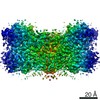
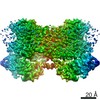
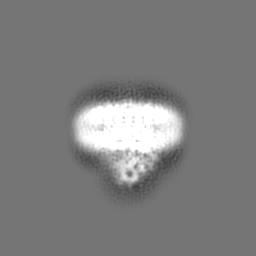
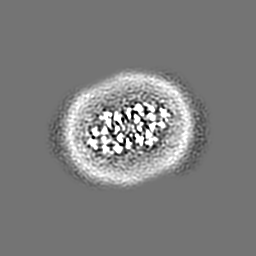
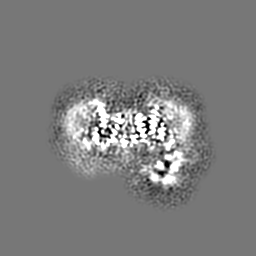
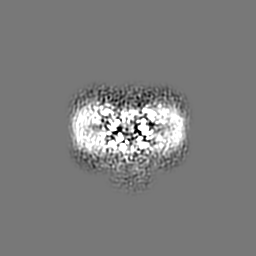
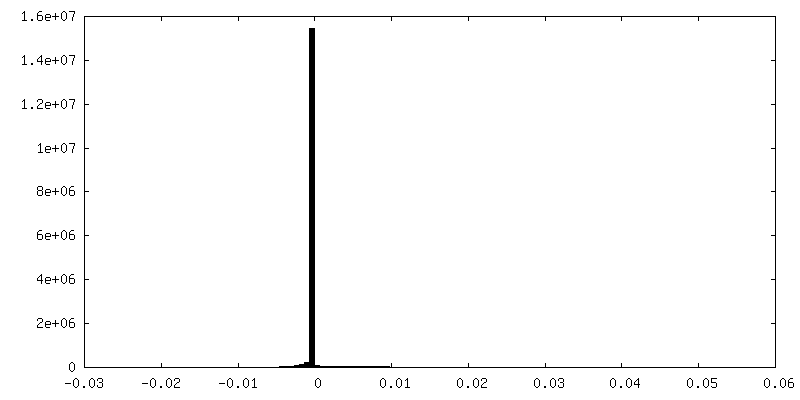
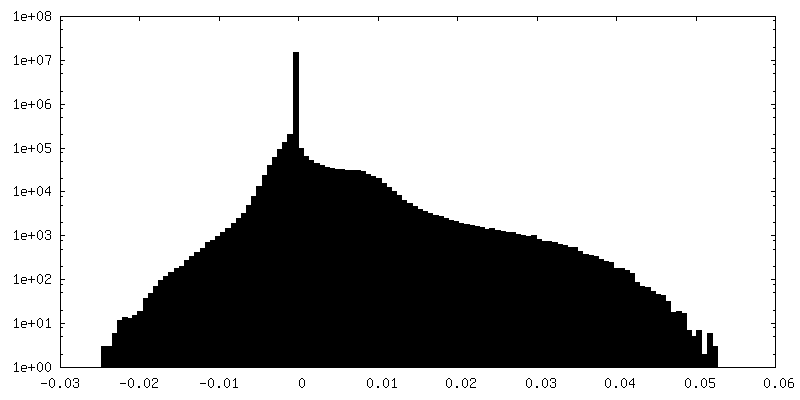
Surface view with section colored by density value
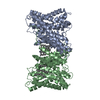
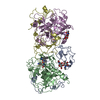
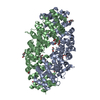
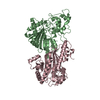
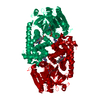
Supramolecule #1: Human NHE1-CHP1 complex under pH 6.5
Supramolecule
Name: Human NHE1-CHP1 complex under pH 6.5 / type: complex / ID: 1 / Parent: 0 / Macromolecule list: #1-#2 Details: CHP1 in this map was locally refined using symmetry expansion to improve resolution.
In the structure databanks used in Yorodumi, some data are registered as the other names, "COVID-19 virus" and "2019-nCoV". Here are the details of the virus and the list of structure data.
Jan 31, 2019. EMDB accession codes are about to change! (news from PDBe EMDB page)
EMDB accession codes are about to change! (news from PDBe EMDB page)
The allocation of 4 digits for EMDB accession codes will soon come to an end. Whilst these codes will remain in use, new EMDB accession codes will include an additional digit and will expand incrementally as the available range of codes is exhausted. The current 4-digit format prefixed with “EMD-” (i.e. EMD-XXXX) will advance to a 5-digit format (i.e. EMD-XXXXX), and so on. It is currently estimated that the 4-digit codes will be depleted around Spring 2019, at which point the 5-digit format will come into force.
The EM Navigator/Yorodumi systems omit the EMD- prefix.
Related info.:Q: What is EMD? / ID/Accession-code notation in Yorodumi/EM Navigator
Yorodumi is a browser for structure data from EMDB, PDB, SASBDB, etc.
This page is also the successor to EM Navigator detail page, and also detail information page/front-end page for Omokage search.
The word "yorodu" (or yorozu) is an old Japanese word meaning "ten thousand". "mi" (miru) is to see.
Related info.:EMDB / PDB / SASBDB / Comparison of 3 databanks / Yorodumi Search / Aug 31, 2016. New EM Navigator & Yorodumi / Yorodumi Papers / Jmol/JSmol / Function and homology information / Changes in new EM Navigator and Yorodumi
 Movie
Movie Controller


 Open data
 Basic information
 Map data
 Sample
 Keywords
 Function and homology information
 Homo sapiens (human)
 Authors
 Citation

 Structure visualization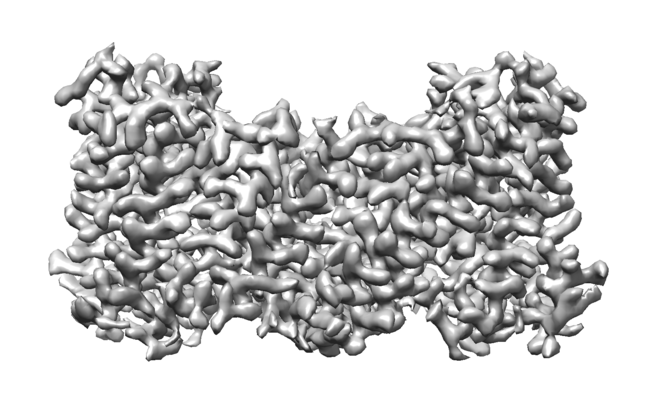
 Downloads & links
 emd_30847.png
 https://data.pdbj.org/pub/emdb/structures/EMD-30847
 Z (Sec.)
 Y (Row.)
 X (Col.)


 Sample components
 Processing
 Electron microscopy
 FIELD EMISSION GUN