negative regulation of cardiac muscle tissue regeneration / negative regulation of DNA biosynthetic process / cellular response to cell-matrix adhesion / TFAP2 (AP-2) family regulates transcription of cell cycle factors / FOXO-mediated transcription of cell cycle genes / tissue regeneration / dinucleotide insertion or deletion binding / regulation of cell cycle G1/S phase transition / PCNA-p21 complex / mitotic telomere maintenance via semi-conservative replication ...negative regulation of cardiac muscle tissue regeneration / negative regulation of DNA biosynthetic process / cellular response to cell-matrix adhesion / TFAP2 (AP-2) family regulates transcription of cell cycle factors / FOXO-mediated transcription of cell cycle genes / tissue regeneration / dinucleotide insertion or deletion binding / regulation of cell cycle G1/S phase transition / PCNA-p21 complex / mitotic telomere maintenance via semi-conservative replication / import into nucleus / Transcriptional regulation by RUNX2 / purine-specific mismatch base pair DNA N-glycosylase activity / nuclear lamina / Polymerase switching / cyclin-dependent protein serine/threonine kinase inhibitor activity / Processive synthesis on the lagging strand / PCNA complex / replisome / Removal of the Flap Intermediate / MutLalpha complex binding / Telomere C-strand (Lagging Strand) Synthesis / Mismatch repair (MMR) directed by MSH2:MSH3 (MutSbeta) / Mismatch repair (MMR) directed by MSH2:MSH6 (MutSalpha) / Transcription of E2F targets under negative control by DREAM complex / Transcriptional activation of cell cycle inhibitor p21 / Polymerase switching on the C-strand of the telomere / AKT phosphorylates targets in the cytosol / mitotic DNA replication / response to L-glutamate / Processive synthesis on the C-strand of the telomere / RUNX3 regulates CDKN1A transcription / stress-induced premature senescence / Removal of the Flap Intermediate from the C-strand / regulation of G2/M transition of mitotic cell cycle / molecular function inhibitor activity / cellular response to UV-B / negative regulation of G1/S transition of mitotic cell cycle / STAT5 activation downstream of FLT3 ITD mutants / response to dexamethasone / p53-Dependent G1 DNA Damage Response / histone acetyltransferase binding / leading strand elongation / DNA polymerase processivity factor activity / G1/S-Specific Transcription / Constitutive Signaling by AKT1 E17K in Cancer / mitotic G2 DNA damage checkpoint signaling / Defective binding of RB1 mutants to E2F1,(E2F2, E2F3) / negative regulation of protein phosphorylation / positive regulation of protein kinase activity / protein kinase inhibitor activity / replicative senescence / nuclear replication fork / SUMOylation of DNA replication proteins / negative regulation of vascular associated smooth muscle cell proliferation / PCNA-Dependent Long Patch Base Excision Repair / DNA repair-dependent chromatin remodeling / replication fork processing / response to cadmium ion / TP53 Regulates Transcription of Genes Involved in G1 Cell Cycle Arrest / Regulation of MITF-M-dependent genes involved in cell cycle and proliferation / estrous cycle / Cyclin E associated events during G1/S transition / mismatch repair / cyclin-dependent protein kinase holoenzyme complex / Cyclin A:Cdk2-associated events at S phase entry / regulation of G1/S transition of mitotic cell cycle / mitotic G1 DNA damage checkpoint signaling / DNA polymerase binding / epithelial cell differentiation / translesion synthesis / Signaling by FLT3 fusion proteins / intrinsic apoptotic signaling pathway / liver regeneration / TP53 Regulates Transcription of Genes Involved in G2 Cell Cycle Arrest / cyclin binding / positive regulation of DNA replication / nuclear estrogen receptor binding / cellular response to amino acid starvation / molecular function activator activity / positive regulation of DNA repair / DNA damage response, signal transduction by p53 class mediator / cellular response to ionizing radiation / wound healing / Translesion synthesis by REV1 / Translesion synthesis by POLK / protein serine/threonine kinase binding / Translesion synthesis by POLI / Gap-filling DNA repair synthesis and ligation in GG-NER / replication fork / G1/S transition of mitotic cell cycle / positive regulation of fibroblast proliferation / protein sequestering activity / Termination of translesion DNA synthesis / negative regulation of cell growth / Translesion Synthesis by POLH / receptor tyrosine kinase binding / Recognition of DNA damage by PCNA-containing replication complex / positive regulation of protein phosphorylation / DNA Damage/Telomere Stress Induced Senescence Similarity search - Function
In the structure databanks used in Yorodumi, some data are registered as the other names, "COVID-19 virus" and "2019-nCoV". Here are the details of the virus and the list of structure data.
Jan 31, 2019. EMDB accession codes are about to change! (news from PDBe EMDB page)
EMDB accession codes are about to change! (news from PDBe EMDB page)
The allocation of 4 digits for EMDB accession codes will soon come to an end. Whilst these codes will remain in use, new EMDB accession codes will include an additional digit and will expand incrementally as the available range of codes is exhausted. The current 4-digit format prefixed with “EMD-” (i.e. EMD-XXXX) will advance to a 5-digit format (i.e. EMD-XXXXX), and so on. It is currently estimated that the 4-digit codes will be depleted around Spring 2019, at which point the 5-digit format will come into force.
The EM Navigator/Yorodumi systems omit the EMD- prefix.
Related info.:Q: What is EMD? / ID/Accession-code notation in Yorodumi/EM Navigator
Yorodumi is a browser for structure data from EMDB, PDB, SASBDB, etc.
This page is also the successor to EM Navigator detail page, and also detail information page/front-end page for Omokage search.
The word "yorodu" (or yorozu) is an old Japanese word meaning "ten thousand". "mi" (miru) is to see.
Related info.:EMDB / PDB / SASBDB / Comparison of 3 databanks / Yorodumi Search / Aug 31, 2016. New EM Navigator & Yorodumi / Yorodumi Papers / Jmol/JSmol / Function and homology information / Changes in new EM Navigator and Yorodumi
 Movie
Movie Controller


 Open data
 Basic information
 Components
 Keywords
 Function and homology information
 Homo sapiens (human)
 X-RAY DIFFRACTION /
  Authors
 Citation
 Structure visualization
 Downloads & links
 Other downloads
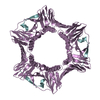
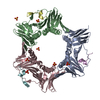
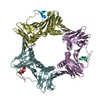

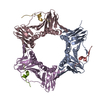


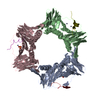
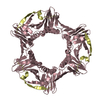
 PDBj
PDBj
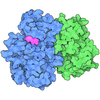
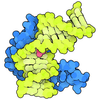


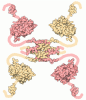
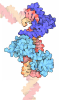

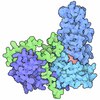

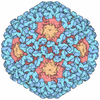
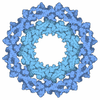
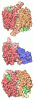
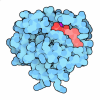
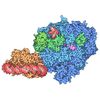
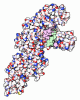
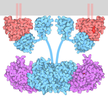
 Assembly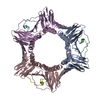
 Mass: 18.015 Da / Num. of mol.: 295 / Source method: isolated from a natural source / Formula: H2O
 Sample preparation
 / Beamline: X25
 Processing