 ムービー
ムービー コントローラー


+ データを開く

- 基本情報
基本情報
| 登録情報 | データベース: PDB / ID: 7plo | ||||||||||||
|---|---|---|---|---|---|---|---|---|---|---|---|---|---|
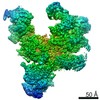
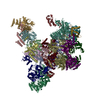
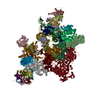
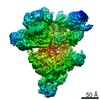
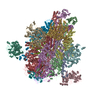
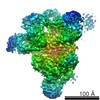
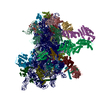
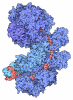
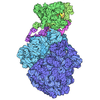
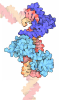
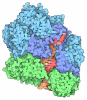
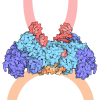
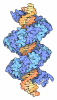
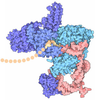
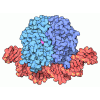
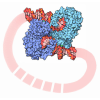
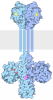
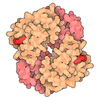
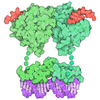
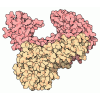
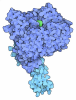
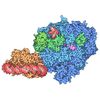
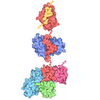
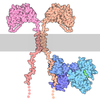
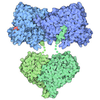
| タイトル | H. sapiens replisome-CUL2/LRR1 complex | ||||||||||||
 要素 要素 |
| ||||||||||||
 キーワード キーワード | REPLICATION / Genome stability / DNA replication / Ubiquitination / termination / replisome / cryo-EM / CMG / Cul2LRR1 / DNA / polymerase / helicase | ||||||||||||
| 機能・相同性 |  機能・相同性情報 機能・相同性情報cellular response to bleomycin / DNA secondary structure binding / regulation of nuclear cell cycle DNA replication / detection of abiotic stimulus / replication fork protection complex / replication fork arrest / Switching of origins to a post-replicative state / cell cycle phase transition / Unwinding of DNA / DNA replication initiation ...cellular response to bleomycin / DNA secondary structure binding / regulation of nuclear cell cycle DNA replication / detection of abiotic stimulus / replication fork protection complex / replication fork arrest / Switching of origins to a post-replicative state / cell cycle phase transition / Unwinding of DNA / DNA replication initiation / epsilon DNA polymerase complex / DNA strand elongation involved in mitotic DNA replication / GINS complex / mitotic DNA replication preinitiation complex assembly / regulation of phosphorylation / nuclear origin of replication recognition complex / alpha DNA polymerase:primase complex / anaphase-promoting complex binding / cellular response to cisplatin / nucleotide-excision repair, DNA gap filling / mitotic DNA replication / Regulation of MITF-M-dependent genes involved in DNA replication, damage repair and senescence / negative regulation of beige fat cell differentiation / cellular response to hydroxyurea / DNA replication checkpoint signaling / CMG complex / cullin-RING-type E3 NEDD8 transferase / NEDD8 transferase activity / DNA replication proofreading / DNA replication preinitiation complex / single-stranded DNA 3'-5' DNA exonuclease activity / cullin-RING ubiquitin ligase complex / Cul7-RING ubiquitin ligase complex / mitotic DNA replication checkpoint signaling / cellular response to chemical stress / Loss of Function of FBXW7 in Cancer and NOTCH1 Signaling / double-strand break repair via break-induced replication / MCM complex / target-directed miRNA degradation / mitotic DNA replication initiation / elongin complex / positive regulation of protein autoubiquitination / RNA polymerase II transcription initiation surveillance / protein neddylation / NEDD8 ligase activity / mitotic intra-S DNA damage checkpoint signaling / regulation of DNA-templated DNA replication initiation / protein K27-linked ubiquitination / negative regulation of response to oxidative stress / VCB complex / 加水分解酵素; エステル加水分解酵素; 5'-リン酸モノエステル産生エンドデオキシリボヌクレアーゼ / Cul5-RING ubiquitin ligase complex / inner cell mass cell proliferation / ubiquitin-ubiquitin ligase activity / ubiquitin-dependent protein catabolic process via the C-end degron rule pathway / DNA strand elongation involved in DNA replication / SCF ubiquitin ligase complex / Apoptotic cleavage of cellular proteins / Cul2-RING ubiquitin ligase complex / branching morphogenesis of an epithelial tube / Cul3-RING ubiquitin ligase complex / negative regulation of type I interferon production / positive regulation of double-strand break repair / leading strand elongation / SCF-dependent proteasomal ubiquitin-dependent protein catabolic process / G1/S-Specific Transcription / Cul4A-RING E3 ubiquitin ligase complex / Cul4-RING E3 ubiquitin ligase complex / Prolactin receptor signaling / negative regulation of mitophagy / mitotic G2 DNA damage checkpoint signaling / DNA synthesis involved in DNA repair / Cul4B-RING E3 ubiquitin ligase complex / ubiquitin ligase complex scaffold activity / nuclear replication fork / replication fork processing / DNA replication origin binding / Pausing and recovery of Tat-mediated HIV elongation / Tat-mediated HIV elongation arrest and recovery / cochlea development / HIV elongation arrest and recovery / Pausing and recovery of HIV elongation / PCNA-Dependent Long Patch Base Excision Repair / Activation of the pre-replicative complex / cullin family protein binding / DNA replication initiation / error-prone translesion synthesis / embryonic organ development / protein monoubiquitination / Tat-mediated elongation of the HIV-1 transcript / Activation of ATR in response to replication stress / Formation of HIV-1 elongation complex containing HIV-1 Tat / response to UV / Formation of HIV elongation complex in the absence of HIV Tat / positive regulation of double-strand break repair via homologous recombination / site of DNA damage / RNA Polymerase II Transcription Elongation / base-excision repair, gap-filling / Formation of RNA Pol II elongation complex / signal transduction in response to DNA damage 類似検索 - 分子機能 | ||||||||||||
| 生物種 |  Homo sapiens (ヒト) Homo sapiens (ヒト) | ||||||||||||
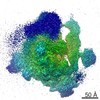
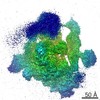
| 手法 | 電子顕微鏡法 / 単粒子再構成法 / クライオ電子顕微鏡法 / 解像度: 2.8 Å | ||||||||||||
 データ登録者 データ登録者 | Jones, M.J. / Yeeles, J.T.P. / Deegan, T.D. / Jenkyn-Bedford, M. | ||||||||||||
| 資金援助 |  英国, 3件 英国, 3件
| ||||||||||||
 引用 引用 | ジャーナル: Nature / 年: 2021 タイトル: A conserved mechanism for regulating replisome disassembly in eukaryotes. 著者: Michael Jenkyn-Bedford / Morgan L Jones / Yasemin Baris / Karim P M Labib / Giuseppe Cannone / Joseph T P Yeeles / Tom D Deegan / 要旨: Replisome disassembly is the final step of eukaryotic DNA replication and is triggered by ubiquitylation of the CDC45-MCM-GINS (CMG) replicative helicase. Despite being driven by evolutionarily ...Replisome disassembly is the final step of eukaryotic DNA replication and is triggered by ubiquitylation of the CDC45-MCM-GINS (CMG) replicative helicase. Despite being driven by evolutionarily diverse E3 ubiquitin ligases in different eukaryotes (SCF in budding yeast, CUL2 in metazoa), replisome disassembly is governed by a common regulatory principle, in which ubiquitylation of CMG is suppressed before replication termination, to prevent replication fork collapse. Recent evidence suggests that this suppression is mediated by replication fork DNA. However, it is unknown how SCF and CUL2 discriminate terminated from elongating replisomes, to selectively ubiquitylate CMG only after termination. Here we used cryo-electron microscopy to solve high-resolution structures of budding yeast and human replisome-E3 ligase assemblies. Our structures show that the leucine-rich repeat domains of Dia2 and LRR1 are structurally distinct, but bind to a common site on CMG, including the MCM3 and MCM5 zinc-finger domains. The LRR-MCM interaction is essential for replisome disassembly and, crucially, is occluded by the excluded DNA strand at replication forks, establishing the structural basis for the suppression of CMG ubiquitylation before termination. Our results elucidate a conserved mechanism for the regulation of replisome disassembly in eukaryotes, and reveal a previously unanticipated role for DNA in preserving replisome integrity. | ||||||||||||
| 履歴 |
|
- 構造の表示
構造の表示
| ムービー |
ムービービューア |
|---|---|
| 構造ビューア | 分子: MolmilJmol/JSmol |
- ダウンロードとリンク
-ダウンロード
| PDBx/mmCIF形式 | 7plo.cif.gz | 3.4 MB | 表示 | PDBx/mmCIF形式 |
|---|---|---|---|---|
| PDB形式 | pdb7plo.ent.gz | 表示 | PDB形式 | |
| PDBx/mmJSON形式 | 7plo.json.gz | ツリー表示 | PDBx/mmJSON形式 | |
| その他 |  その他のダウンロード その他のダウンロード |
-検証レポート
| アーカイブディレクトリ | https://data.pdbj.org/pub/pdb/validation_reports/pl/7ploftp://data.pdbj.org/pub/pdb/validation_reports/pl/7plo | HTTPS FTP |
|---|
-関連構造データ




-リンク
 PDBj
PDBj





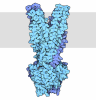
- 集合体
集合体
| 登録構造単位 | 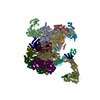
|
|---|---|
| 1 |
|
-要素
-DNA replication licensing factor ... , 6種, 6分子 234567
| #1: タンパク質 | 分子量: 102034.102 Da / 分子数: 1 / 由来タイプ: 組換発現 / 由来: (組換発現) Homo sapiens (ヒト) / 遺伝子: MCM2, BM28, CCNL1, CDCL1, KIAA0030 / 発現宿主:  Trichoplusia ni (イラクサキンウワバ) / 参照: UniProt: P49736, DNA helicase Trichoplusia ni (イラクサキンウワバ) / 参照: UniProt: P49736, DNA helicase |
|---|---|
| #2: タンパク質 | 分子量: 91110.852 Da / 分子数: 1 / 由来タイプ: 組換発現 / 由来: (組換発現) Homo sapiens (ヒト) / 遺伝子: MCM3 / 発現宿主: Trichoplusia ni (イラクサキンウワバ) / 参照: UniProt: P25205, DNA helicase |
| #3: タンパク質 | 分子量: 96684.852 Da / 分子数: 1 / 由来タイプ: 組換発現 / 由来: (組換発現) Homo sapiens (ヒト) / 遺伝子: MCM4, CDC21 / 発現宿主: Trichoplusia ni (イラクサキンウワバ) / 参照: UniProt: P33991, DNA helicase |
| #4: タンパク質 | 分子量: 82406.633 Da / 分子数: 1 / 由来タイプ: 組換発現 / 由来: (組換発現) Homo sapiens (ヒト) / 遺伝子: MCM5, CDC46 / 発現宿主: Trichoplusia ni (イラクサキンウワバ) / 参照: UniProt: P33992, DNA helicase |
| #5: タンパク質 | 分子量: 93010.273 Da / 分子数: 1 / 由来タイプ: 組換発現 / 由来: (組換発現) Homo sapiens (ヒト) / 遺伝子: MCM6 / 発現宿主: Trichoplusia ni (イラクサキンウワバ) / 参照: UniProt: Q14566, DNA helicase |
| #6: タンパク質 | 分子量: 81411.875 Da / 分子数: 1 / 由来タイプ: 組換発現 / 由来: (組換発現) Homo sapiens (ヒト) / 遺伝子: MCM7, CDC47, MCM2 / 発現宿主: Trichoplusia ni (イラクサキンウワバ) / 参照: UniProt: P33993, DNA helicase |
-DNA polymerase epsilon ... , 2種, 2分子 AB
| #7: タンパク質 | 分子量: 59600.887 Da / 分子数: 1 / 由来タイプ: 組換発現 / 由来: (組換発現) Homo sapiens (ヒト) / 遺伝子: POLE2, DPE2 / 発現宿主: Trichoplusia ni (イラクサキンウワバ) / 参照: UniProt: P56282 |
|---|---|
| #8: タンパク質 | 分子量: 261855.266 Da / 分子数: 1 / 由来タイプ: 組換発現 / 由来: (組換発現) Homo sapiens (ヒト) / 遺伝子: POLE, POLE1 / 発現宿主: Trichoplusia ni (イラクサキンウワバ)参照: UniProt: Q07864, DNA-directed DNA polymerase, 加水分解酵素; エステル加水分解酵素; 5'-リン酸モノエステル産生エンドデオキシリボヌクレアーゼ |
-タンパク質 , 10種, 12分子 CHIJKLOPQRST
| #9: タンパク質 | 分子量: 66016.891 Da / 分子数: 1 / 由来タイプ: 組換発現 / 由来: (組換発現) Homo sapiens (ヒト) / 遺伝子: CDC45, CDC45L, CDC45L2, UNQ374/PRO710 / 発現宿主: Trichoplusia ni (イラクサキンウワバ) / 参照: UniProt: O75419 | ||||||||||||||||
|---|---|---|---|---|---|---|---|---|---|---|---|---|---|---|---|---|---|
| #14: タンパク質 | 分子量: 130098.148 Da / 分子数: 3 / 由来タイプ: 組換発現 / 由来: (組換発現) Homo sapiens (ヒト) / 遺伝子: WDHD1, AND1 / 発現宿主: Trichoplusia ni (イラクサキンウワバ) / 参照: UniProt: O75717#15: タンパク質 | | 分子量: 138903.031 Da / 分子数: 1 / 由来タイプ: 組換発現 / 由来: (組換発現) Homo sapiens (ヒト) / 遺伝子: TIMELESS, TIM, TIM1, TIMELESS1 / 発現宿主: Trichoplusia ni (イラクサキンウワバ) / 参照: UniProt: Q9UNS1#16: タンパク質 | | 分子量: 34600.223 Da / 分子数: 1 / 由来タイプ: 組換発現 / 由来: (組換発現) Homo sapiens (ヒト) / 遺伝子: TIPIN / 発現宿主: Trichoplusia ni (イラクサキンウワバ) / 参照: UniProt: Q9BVW5#19: タンパク質 | | 分子量: 46789.648 Da / 分子数: 1 / 由来タイプ: 組換発現 / 由来: (組換発現) Homo sapiens (ヒト) / 遺伝子: LRR1, PPIL5 / 発現宿主: Trichoplusia ni (イラクサキンウワバ) / 参照: UniProt: Q96L50#20: タンパク質 | | 分子量: 13147.781 Da / 分子数: 1 / 由来タイプ: 組換発現 / 由来: (組換発現) Homo sapiens (ヒト) / 遺伝子: ELOB, TCEB2 / 発現宿主: Trichoplusia ni (イラクサキンウワバ) / 参照: UniProt: Q15370#21: タンパク質 | | 分子量: 155184.703 Da / 分子数: 1 / 由来タイプ: 組換発現 / 由来: (組換発現) Homo sapiens (ヒト) / 遺伝子: CLSPN / 発現宿主: Trichoplusia ni (イラクサキンウワバ) / 参照: UniProt: Q9HAW4#22: タンパク質 | | 分子量: 12485.135 Da / 分子数: 1 / 由来タイプ: 組換発現 / 由来: (組換発現) Homo sapiens (ヒト) / 遺伝子: ELOC, TCEB1 / 発現宿主: Trichoplusia ni (イラクサキンウワバ) / 参照: UniProt: Q15369#23: タンパク質 | | 分子量: 87098.930 Da / 分子数: 1 / 由来タイプ: 組換発現 / 由来: (組換発現) Homo sapiens (ヒト) / 遺伝子: CUL2 / 発現宿主: Trichoplusia ni (イラクサキンウワバ) / 参照: UniProt: Q13617#24: タンパク質 | | 分子量: 12289.977 Da / 分子数: 1 / 由来タイプ: 組換発現 / 由来: (組換発現) Homo sapiens (ヒト) / 遺伝子: RBX1, RNF75, ROC1 / 発現宿主: Trichoplusia ni (イラクサキンウワバ)参照: UniProt: P62877, RING-type E3 ubiquitin transferase, cullin-RING-type E3 NEDD8 transferase |
-DNA replication complex GINS protein ... , 4種, 4分子 DEFG
| #10: タンパク質 | 分子量: 23022.469 Da / 分子数: 1 / 由来タイプ: 組換発現 / 由来: (組換発現) Homo sapiens (ヒト) / 遺伝子: GINS1, KIAA0186, PSF1 / 発現宿主: Trichoplusia ni (イラクサキンウワバ) / 参照: UniProt: Q14691 |
|---|---|
| #11: タンパク質 | 分子量: 21453.713 Da / 分子数: 1 / 由来タイプ: 組換発現 / 由来: (組換発現) Homo sapiens (ヒト) / 遺伝子: GINS2, PSF2, CGI-122, DC5, HSPC037 / 発現宿主: Trichoplusia ni (イラクサキンウワバ) / 参照: UniProt: Q9Y248 |
| #12: タンパク質 | 分子量: 24562.611 Da / 分子数: 1 / 由来タイプ: 組換発現 / 由来: (組換発現) Homo sapiens (ヒト) / 遺伝子: GINS3, PSF3 / 発現宿主: Trichoplusia ni (イラクサキンウワバ) / 参照: UniProt: Q9BRX5 |
| #13: タンパク質 | 分子量: 30114.236 Da / 分子数: 1 / 由来タイプ: 組換発現 / 由来: (組換発現) Homo sapiens (ヒト) / 遺伝子: GINS4, SLD5 / 発現宿主: Trichoplusia ni (イラクサキンウワバ) / 参照: UniProt: Q9BRT9 |
-DNA鎖 , 2種, 2分子 MN
| #17: DNA鎖 | 分子量: 26396.836 Da / 分子数: 1 / 由来タイプ: 合成 / 由来: (合成) Homo sapiens (ヒト) |
|---|---|
| #18: DNA鎖 | 分子量: 12279.929 Da / 分子数: 1 / 由来タイプ: 合成 / 由来: (合成) Homo sapiens (ヒト) |
-非ポリマー , 4種, 15分子 

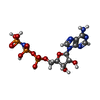
| #25: 化合物 | ChemComp-ZN /  分子量: 65.409 Da / 分子数: 8 / 由来タイプ: 合成 / 式: Zn / タイプ: SUBJECT OF INVESTIGATION 分子量: 65.409 Da / 分子数: 8 / 由来タイプ: 合成 / 式: Zn / タイプ: SUBJECT OF INVESTIGATION#26: 化合物 |  分子量: 24.305 Da / 分子数: 3 / 由来タイプ: 合成 / 式: Mg / タイプ: SUBJECT OF INVESTIGATION 分子量: 24.305 Da / 分子数: 3 / 由来タイプ: 合成 / 式: Mg / タイプ: SUBJECT OF INVESTIGATION#27: 化合物 | 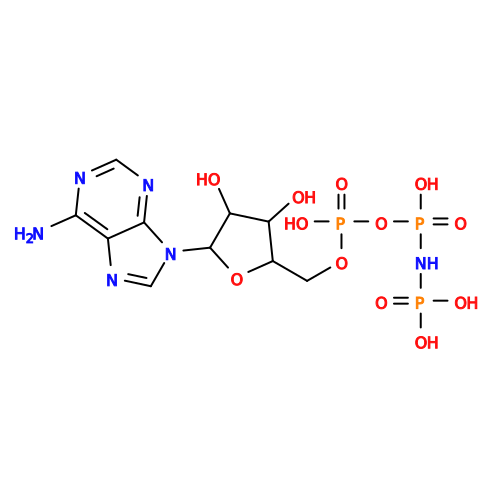 分子量: 506.196 Da / 分子数: 3 / 由来タイプ: 合成 / 式: C10H17N6O12P3 分子量: 506.196 Da / 分子数: 3 / 由来タイプ: 合成 / 式: C10H17N6O12P3コメント: AMP-PNP, エネルギー貯蔵分子類似体*YM #28: 化合物 | ChemComp-SO4 / |  分子量: 96.063 Da / 分子数: 1 / 由来タイプ: 合成 / 式: SO4 / タイプ: SUBJECT OF INVESTIGATION 分子量: 96.063 Da / 分子数: 1 / 由来タイプ: 合成 / 式: SO4 / タイプ: SUBJECT OF INVESTIGATION |
|---|
-詳細
| 研究の焦点であるリガンドがあるか | Y |
|---|
-実験情報
-実験
| 実験 | 手法: 電子顕微鏡法 |
|---|---|
| EM実験 | 試料の集合状態: PARTICLE / 3次元再構成法: 単粒子再構成法 |
- 試料調製
試料調製
| 構成要素 | 名称: Human replisome engaged with CUL2-LRR1 / タイプ: COMPLEX / Entity ID: #21, #1-#20, #22-#24 / 由来: MULTIPLE SOURCES |
|---|---|
| 分子量 | 実験値: NO |
| 由来(天然) | 生物種: Homo sapiens (ヒト) |
| 由来(組換発現) | 生物種: Trichoplusia ni (イラクサキンウワバ) |
| 緩衝液 | pH: 7.6 |
| 試料 | 包埋: NO / シャドウイング: NO / 染色: NO / 凍結: YES |
| 試料支持 | グリッドの材料: COPPER / グリッドのサイズ: 400 divisions/in. / グリッドのタイプ: Quantifoil R2/2 |
| 急速凍結 | 凍結剤: ETHANE |
- 電子顕微鏡撮影
| 実験機器 |  モデル: Titan Krios / 画像提供: FEI Company |
|---|---|
| 顕微鏡 | モデル: FEI TITAN KRIOS |
| 電子銃 | 電子線源:  FIELD EMISSION GUN / 加速電圧: 300 kV / 照射モード: FLOOD BEAM FIELD EMISSION GUN / 加速電圧: 300 kV / 照射モード: FLOOD BEAM |
| 電子レンズ | モード: BRIGHT FIELD / 最大 デフォーカス(公称値): 2800 nm / 最小 デフォーカス(公称値): 800 nm / Cs: 0.1 mm / C2レンズ絞り径: 2.7 µm |
| 試料ホルダ | 試料ホルダーモデル: FEI TITAN KRIOS AUTOGRID HOLDER |
| 撮影 | 平均露光時間: 4 sec. / 電子線照射量: 38.8 e/Å2 フィルム・検出器のモデル: GATAN K3 BIOQUANTUM (6k x 4k) 実像数: 16721 |
| 電子光学装置 | エネルギーフィルター名称: GIF Bioquantum / エネルギーフィルタースリット幅: 20 eV |
- 解析
解析
| EMソフトウェア |
| ||||||||||||||||||||||||
|---|---|---|---|---|---|---|---|---|---|---|---|---|---|---|---|---|---|---|---|---|---|---|---|---|---|
| CTF補正 | タイプ: PHASE FLIPPING AND AMPLITUDE CORRECTION | ||||||||||||||||||||||||
| 粒子像の選択 | 選択した粒子像数: 2412000 | ||||||||||||||||||||||||
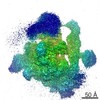
| 3次元再構成 | 解像度: 2.8 Å / 解像度の算出法: FSC 0.143 CUT-OFF / 粒子像の数: 232000 / アルゴリズム: FOURIER SPACE / クラス平均像の数: 1 / 対称性のタイプ: POINT |
