 Movie
Movie Controller


+ Open data

- Basic information
| Entry | Database: PDB / ID: 5zcs | |||||||||||||||
|---|---|---|---|---|---|---|---|---|---|---|---|---|---|---|---|---|
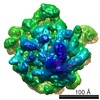
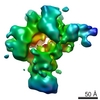
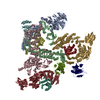
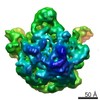
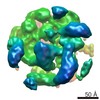
| Title | 4.9 Angstrom Cryo-EM structure of human mTOR complex 2 | |||||||||||||||
 Components Components |
| |||||||||||||||
 Keywords Keywords | GENE REGULATION / Cryo-EM structure human mTORC2 | |||||||||||||||
| Function / homology |  Function and homology information Function and homology informationcardiac cell development / positive regulation of SCF-dependent proteasomal ubiquitin-dependent catabolic process / RNA polymerase III type 2 promoter sequence-specific DNA binding / T-helper 1 cell lineage commitment / RNA polymerase III type 1 promoter sequence-specific DNA binding / positive regulation of cytoplasmic translational initiation / regulation of locomotor rhythm / positive regulation of pentose-phosphate shunt / positive regulation of wound healing, spreading of epidermal cells / regulation of phosphatidylinositol 3-kinase/protein kinase B signal transduction ...cardiac cell development / positive regulation of SCF-dependent proteasomal ubiquitin-dependent catabolic process / RNA polymerase III type 2 promoter sequence-specific DNA binding / T-helper 1 cell lineage commitment / RNA polymerase III type 1 promoter sequence-specific DNA binding / positive regulation of cytoplasmic translational initiation / regulation of locomotor rhythm / positive regulation of pentose-phosphate shunt / positive regulation of wound healing, spreading of epidermal cells / regulation of phosphatidylinositol 3-kinase/protein kinase B signal transduction / TORC2 complex / cellular response to leucine starvation / TFIIIC-class transcription factor complex binding / regulation of lysosome organization / TORC1 complex / regulation of cellular response to oxidative stress / negative regulation of lysosome organization / regulation of osteoclast differentiation / RNA polymerase III type 3 promoter sequence-specific DNA binding / positive regulation of keratinocyte migration / positive regulation of transcription of nucleolar large rRNA by RNA polymerase I / negative regulation of Ras protein signal transduction / Energy dependent regulation of mTOR by LKB1-AMPK / cellular response to nutrient / cellular response to L-leucine / regulation of autophagosome assembly / phosphatidic acid binding / Amino acids regulate mTORC1 / embryo development ending in birth or egg hatching / Dengue virus modulates apoptosis / cellular response to methionine / phosphatidylinositol-3,4-bisphosphate binding / TORC2 signaling / TORC1 signaling / cellular response to osmotic stress / MTOR signalling / inositol hexakisphosphate binding / anoikis / negative regulation of protein localization to nucleus / positive regulation of ubiquitin-dependent protein catabolic process / regulation of cell size / phosphatidylinositol-3,5-bisphosphate binding / lipid biosynthetic process / Macroautophagy / Constitutive Signaling by AKT1 E17K in Cancer / behavioral response to pain / positive regulation of transcription by RNA polymerase III / positive regulation of protein kinase activity / phosphatidylinositol-3,4,5-trisphosphate binding / response to amino acid / neuronal action potential / TOR signaling / mTORC1-mediated signalling / HSF1-dependent transactivation / positive regulation of translational initiation / CD28 dependent PI3K/Akt signaling / enzyme-substrate adaptor activity / positive regulation of lipid biosynthetic process / positive regulation of epithelial to mesenchymal transition / negative regulation of macroautophagy / T cell costimulation / vascular endothelial cell response to laminar fluid shear stress / cellular response to nutrient levels / regulation of cellular response to heat / 'de novo' pyrimidine nucleobase biosynthetic process / regulation of macroautophagy / cytoskeleton organization / negative regulation of insulin receptor signaling pathway / positive regulation of endothelial cell proliferation / phagocytic vesicle / phosphatidylinositol-4,5-bisphosphate binding / substantia nigra development / positive regulation of TOR signaling / positive regulation of glycolytic process / negative regulation of autophagy / protein serine/threonine kinase activator activity / cellular response to amino acid starvation / regulation of actin cytoskeleton organization / cellular response to amino acid stimulus / Regulation of PTEN gene transcription / cellular response to starvation / regulation of signal transduction by p53 class mediator / phosphatidylinositol 3-kinase/protein kinase B signal transduction / VEGFR2 mediated vascular permeability / non-specific protein-tyrosine kinase / TP53 Regulates Metabolic Genes / endomembrane system / regulation of cell growth / non-membrane spanning protein tyrosine kinase activity / positive regulation of translation / phosphoprotein binding / response to nutrient levels / PML body / regulation of circadian rhythm / small GTPase binding / actin cytoskeleton organization / cellular response to insulin stimulus / Regulation of TP53 Degradation / PIP3 activates AKT signaling / late endosome Similarity search - Function | |||||||||||||||
| Biological species |  Homo sapiens (human) Homo sapiens (human) | |||||||||||||||
| Method | ELECTRON MICROSCOPY / single particle reconstruction / cryo EM / Resolution: 4.9 Å | |||||||||||||||
 Authors Authors | Chen, X. / Liu, M. / Tian, Y. / Wang, H. / Wang, J. / Xu, Y. | |||||||||||||||
| Funding support |  China, 4items China, 4items
| |||||||||||||||
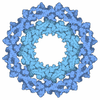
 Citation Citation | Journal: Cell Res / Year: 2018 Title: Cryo-EM structure of human mTOR complex 2. Authors: Xizi Chen / Mengjie Liu / Yuan Tian / Jiabei Li / Yilun Qi / Dan Zhao / Zihan Wu / Min Huang / Catherine C L Wong / Hong-Wei Wang / Jiawei Wang / Huirong Yang / Yanhui Xu / Abstract: Mechanistic target of rapamycin (mTOR) complex 2 (mTORC2) plays an essential role in regulating cell proliferation through phosphorylating AGC protein kinase family members, including AKT, PKC and ...Mechanistic target of rapamycin (mTOR) complex 2 (mTORC2) plays an essential role in regulating cell proliferation through phosphorylating AGC protein kinase family members, including AKT, PKC and SGK1. The functional core complex consists of mTOR, mLST8, and two mTORC2-specific components, Rictor and mSin1. Here we investigated the intermolecular interactions within mTORC2 complex and determined its cryo-electron microscopy structure at 4.9 Å resolution. The structure reveals a hollow rhombohedral fold with a 2-fold symmetry. The dimerized mTOR serves as a scaffold for the complex assembly. The N-terminal half of Rictor is composed of helical repeat clusters and binds to mTOR through multiple contacts. mSin1 is located close to the FRB domain and catalytic cavity of mTOR. Rictor and mSin1 together generate steric hindrance to inhibit binding of FKBP12-rapamycin to mTOR, revealing the mechanism for rapamycin insensitivity of mTORC2. The mTOR dimer in mTORC2 shows more compact conformation than that of mTORC1 (rapamycin sensitive), which might result from the interaction between mTOR and Rictor-mSin1. Structural comparison shows that binding of Rictor and Raptor (mTORC1-specific component) to mTOR is mutually exclusive. Our study provides a basis for understanding the assembly of mTORC2 and a framework to further characterize the regulatory mechanism of mTORC2 pathway. | |||||||||||||||
| History |
|
- Structure visualization
| Movie |
Movie viewer |
|---|---|
| Structure viewer | Molecule: MolmilJmol/JSmol |
- Downloads & links
-Download
| PDBx/mmCIF format | 5zcs.cif.gz | 1.1 MB | Display | PDBx/mmCIF format |
|---|---|---|---|---|
| PDB format | pdb5zcs.ent.gz | 906.2 KB | Display | PDB format |
| PDBx/mmJSON format | 5zcs.json.gz | Tree view | PDBx/mmJSON format | |
| Others |  Other downloads Other downloads |
-Validation report
| Arichive directory | https://data.pdbj.org/pub/pdb/validation_reports/zc/5zcsftp://data.pdbj.org/pub/pdb/validation_reports/zc/5zcs | HTTPS FTP |
|---|
-Related structure data
| Related structure data | 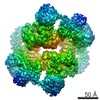 6913MC M: map data used to model this data C: citing same article ( |
|---|---|
| Similar structure data |
-Links
 PDBj
PDBj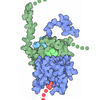
- Assembly
| Deposited unit | 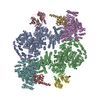
|
|---|---|
| 1 |
|
-Components
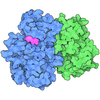
| #1: Protein | Mass: 289257.969 Da / Num. of mol.: 2 Source method: isolated from a genetically manipulated source Source: (gene. exp.) Homo sapiens (human) / Gene: MTOR, FRAP, FRAP1, FRAP2, RAFT1, RAPT1 / Cell line (production host): 293F / Production host: Homo sapiens (human)References: UniProt: P42345, non-specific serine/threonine protein kinase #2: Protein | Mass: 35910.090 Da / Num. of mol.: 2 Source method: isolated from a genetically manipulated source Source: (gene. exp.) Homo sapiens (human) / Gene: MLST8, GBL, LST8 / Cell line (production host): 293F / Production host: Homo sapiens (human) / References: UniProt: Q9BVC4#3: Protein | Mass: 175142.500 Da / Num. of mol.: 2 Source method: isolated from a genetically manipulated source Source: (gene. exp.) Homo sapiens (human) / Gene: RICTOR, KIAA1999 / Cell line (production host): 293F / Production host: Homo sapiens (human) / References: UniProt: Q6R327#4: Protein | Mass: 55158.477 Da / Num. of mol.: 2 Source method: isolated from a genetically manipulated source Source: (gene. exp.) Homo sapiens (human) / Gene: MAPKAP1, MIP1, SIN1 / Cell line (production host): 293F / Production host: Homo sapiens (human) / References: UniProt: Q9BPZ7Sequence details | 1. FOR ENTITY 3 (CHAINS E/F), ENTIRE SEQUENCE HAS BEEN USED IN THE EXPERIMENT. HOWEVER, C-TERMINAL ...1. FOR ENTITY 3 (CHAINS E/F), ENTIRE SEQUENCE HAS BEEN USED IN THE EXPERIMENT | |
|---|
-Experimental details
-Experiment
| Experiment | Method: ELECTRON MICROSCOPY |
|---|---|
| EM experiment | Aggregation state: PARTICLE / 3D reconstruction method: single particle reconstruction |
- Sample preparation
| Component | Name: human mTOR Complex 2 / Type: COMPLEX / Entity ID: all / Source: RECOMBINANT |
|---|---|
| Molecular weight | Value: 1400 kDa/nm / Experimental value: YES |
| Source (natural) | Organism: Homo sapiens (human) |
| Source (recombinant) | Organism: Homo sapiens (human) / Cell: 293F |
| Buffer solution | pH: 7.4 |
| Specimen | Conc.: 1.5 mg/ml / Embedding applied: NO / Shadowing applied: NO / Staining applied: NO / Vitrification applied: YES |
| Specimen support | Grid material: GOLD / Grid mesh size: 300 divisions/in. / Grid type: Quantifoil R1.2/1.3 |
| Vitrification | Instrument: FEI VITROBOT MARK IV / Cryogen name: ETHANE / Humidity: 100 % / Chamber temperature: 282 K |
- Electron microscopy imaging
| Experimental equipment |  Model: Titan Krios / Image courtesy: FEI Company |
|---|---|
| Microscopy | Model: FEI TITAN KRIOS |
| Electron gun | Electron source:  FIELD EMISSION GUN / Accelerating voltage: 300 kV / Illumination mode: FLOOD BEAM FIELD EMISSION GUN / Accelerating voltage: 300 kV / Illumination mode: FLOOD BEAM |
| Electron lens | Mode: BRIGHT FIELD / Cs: 2.7 mm / C2 aperture diameter: 100 µm |
| Specimen holder | Cryogen: NITROGEN / Specimen holder model: FEI TITAN KRIOS AUTOGRID HOLDER |
| Image recording | Average exposure time: 8 sec. / Electron dose: 50 e/Å2 / Detector mode: COUNTING / Film or detector model: GATAN K2 SUMMIT (4k x 4k) |
| Image scans | Movie frames/image: 32 / Used frames/image: 1-32 |
- Processing
| Software | Name: PHENIX / Version: 1.13_2998: / Classification: refinement | ||||||||||||||||||||||||||||
|---|---|---|---|---|---|---|---|---|---|---|---|---|---|---|---|---|---|---|---|---|---|---|---|---|---|---|---|---|---|
| EM software |
| ||||||||||||||||||||||||||||
| CTF correction | Type: NONE | ||||||||||||||||||||||||||||
| Symmetry | Point symmetry: C2 (2 fold cyclic) | ||||||||||||||||||||||||||||
| 3D reconstruction | Resolution: 4.9 Å / Resolution method: FSC 0.143 CUT-OFF / Num. of particles: 195353 / Symmetry type: POINT | ||||||||||||||||||||||||||||
| Atomic model building | Protocol: OTHER / Space: REAL | ||||||||||||||||||||||||||||
| Refine LS restraints |
|
