[English] 日本語
Yorodumi Papers
- Database of articles cited by EMDB/PDB/SASBDB data -

+
Search query

Keywords
Structure methods
Author
Journal
IF

-
Structure paper

TitlePIP2 Binding at Allosteric Site Blocks Activation in Human Rod CNG Channels.
Journal, issue, pagesbioRxiv, Year 2025
Publish dateDec 21, 2025
AuthorsTaehyun Park / Crina M Nimigean /
PubMed AbstractPhosphatidylinositol-4,5-bisphosphate (PIP2) is a ubiquitous signaling lipid that regulates multiple ion channels. In human cyclic nucleotide-gated (CNG) channels, including the rod photoreceptor ...Phosphatidylinositol-4,5-bisphosphate (PIP2) is a ubiquitous signaling lipid that regulates multiple ion channels. In human cyclic nucleotide-gated (CNG) channels, including the rod photoreceptor channel, PIP2 has been reported to exert inhibitory effects, but the underlying mechanism has remained unclear. Because this inhibition lowers the apparent cGMP sensitivity of rod CNG channels, it can play a key role in controlling the light sensitivity and dynamic range of rod photoreceptors. Here we report how PIP2 modulates the function of human CNGA1 channels, the major subunit of human rod photoreceptor CNG channels. Ensemble ion flux assays with liposome-reconstituted purified CNGA1 channels demonstrated robust inhibition by PIP2 via a reduction in apparent cGMP sensitivity, and single-channel recordings revealed PIP2 reduces the channel's open probability without altering unitary conductance. To uncover the structural basis, we determined cryo-EM structures of CNGA1 in lipid nanodiscs under multiple ligand conditions. In PIP2-free conditions, closed, intermediate, and open conformations were observed, whereas in the presence of PIP2, the open state was absent. Density consistent with bound PIP2 was detected at inter-protomer grooves between the voltage-sensing and pore domains indicating that PIP2 binding stabilizes non-conductive conformations by sterically preventing C-linker elevation and outward movement of helix S6, conformational changes needed for pore dilation. Collectively, our results establish a structural mechanism for PIP2-mediated inhibition of rod CNG channels, define a mechanistic framework for phosphoinositide control of ligand-gated channels across the CNG superfamily, and provide an inhibitory allosteric binding site for future drug targeting in this channel family.
External linksbioRxiv / PubMed:41473327 / PubMed Central
MethodsEM (single particle)
Resolution2.07 - 2.64 Å
Structure data

EMDB-74534, PDB-9zpv:
CNGA1 channel closed state in nanodisc cGMP-free
Method: EM (single particle) / Resolution: 2.07 Å

EMDB-74535, PDB-9zpw:
CNGA1 channel intermediate state in nanodisc cGMP-bound
Method: EM (single particle) / Resolution: 2.47 Å

EMDB-74536, PDB-9zpx:
CNGA1 channel open state in nanodisc cGMP-bound
Method: EM (single particle) / Resolution: 2.64 Å

EMDB-74537, PDB-9zpy:
CNGA1 channel closed state in nanodisc with brain PIP2 cGMP-free
Method: EM (single particle) / Resolution: 2.48 Å

EMDB-74538, PDB-9zpz:
CNGA1 channel intermediate state in nanodisc with brain PIP2 cGMP-bound
Method: EM (single particle) / Resolution: 2.64 Å

EMDB-74539, PDB-9zq0:
CNGA1 channel closed state in nanodisc with diC8-PIP2 cGMP-free
Method: EM (single particle) / Resolution: 2.11 Å

EMDB-74540, PDB-9zq1:
CNGA1 channel intermediate state in nanodisc with diC8-PIP2 cGMP-bound
Method: EM (single particle) / Resolution: 2.22 Å

Chemicals

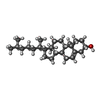
ChemComp-CLR:
CHOLESTEROL

ChemComp-PCW:
1,2-DIOLEOYL-SN-GLYCERO-3-PHOSPHOCHOLINE / DOPC, phospholipid*YM

ChemComp-K:
Unknown entry

ChemComp-PCG:
CYCLIC GUANOSINE MONOPHOSPHATE

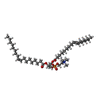
ChemComp-PT5:
[(2R)-1-octadecanoyloxy-3-[oxidanyl-[(1R,2R,3S,4R,5R,6S)-2,3,6-tris(oxidanyl)-4,5-diphosphonooxy-cyclohexyl]oxy-phospho / phospholipid*YM

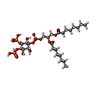
ChemComp-PIO:
[(2R)-2-octanoyloxy-3-[oxidanyl-[(1R,2R,3S,4R,5R,6S)-2,3,6-tris(oxidanyl)-4,5-diphosphonooxy-cyclohexyl]oxy-phosphoryl]oxy-propyl] octanoate

Source
  • homo sapiens (human)
KeywordsTRANSPORT PROTEIN / Cyclic nucleotide-gated channel / Rod photoreceptor / CNGA1 / Ion channel

+
About Yorodumi Papers

-
News

-
Feb 9, 2022. New format data for meta-information of EMDB entries

New format data for meta-information of EMDB entries

  • Version 3 of the EMDB header file is now the official format.
  • The previous official version 1.9 will be removed from the archive.

Related info.:EMDB header

External links:wwPDB to switch to version 3 of the EMDB data model

-
Aug 12, 2020. Covid-19 info

Covid-19 info

URL: https://pdbj.org/emnavi/covid19.php

New page: Covid-19 featured information page in EM Navigator.

Related info.:Covid-19 info / Mar 5, 2020. Novel coronavirus structure data

+
Mar 5, 2020. Novel coronavirus structure data

Novel coronavirus structure data

Related info.:Yorodumi Speices / Aug 12, 2020. Covid-19 info

External links:COVID-19 featured content - PDBj / Molecule of the Month (242):Coronavirus Proteases

+
Jan 31, 2019. EMDB accession codes are about to change! (news from PDBe EMDB page)

EMDB accession codes are about to change! (news from PDBe EMDB page)

  • The allocation of 4 digits for EMDB accession codes will soon come to an end. Whilst these codes will remain in use, new EMDB accession codes will include an additional digit and will expand incrementally as the available range of codes is exhausted. The current 4-digit format prefixed with “EMD-” (i.e. EMD-XXXX) will advance to a 5-digit format (i.e. EMD-XXXXX), and so on. It is currently estimated that the 4-digit codes will be depleted around Spring 2019, at which point the 5-digit format will come into force.
  • The EM Navigator/Yorodumi systems omit the EMD- prefix.

Related info.:Q: What is EMD? / ID/Accession-code notation in Yorodumi/EM Navigator

External links:EMDB Accession Codes are Changing Soon! / Contact to PDBj

+
Jul 12, 2017. Major update of PDB

Major update of PDB

  • wwPDB released updated PDB data conforming to the new PDBx/mmCIF dictionary.
  • This is a major update changing the version number from 4 to 5, and with Remediation, in which all the entries are updated.
  • In this update, many items about electron microscopy experimental information are reorganized (e.g. em_software).
  • Now, EM Navigator and Yorodumi are based on the updated data.

External links:wwPDB Remediation / Enriched Model Files Conforming to OneDep Data Standards Now Available in the PDB FTP Archive

-
Yorodumi Papers

Database of articles cited by EMDB/PDB/SASBDB data

  • Database of articles cited by EMDB, PDB, and SASBDB entries
  • Using PubMed data

Related info.:EMDB / PDB / SASBDB / Yorodumi / EMN Papers / Changes in new EM Navigator and Yorodumi

Read more