 Movie
Movie Controller

[English] 日本語
 Yorodumi
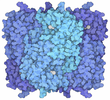
- EMDB-74540: CNGA1 channel intermediate state in nanodisc with diC8-PIP2 cGMP-bound -
+ Open data

- Basic information
| Entry |  | |||||||||
|---|---|---|---|---|---|---|---|---|---|---|
| Title | CNGA1 channel intermediate state in nanodisc with diC8-PIP2 cGMP-bound | |||||||||
 Map data Map data | ||||||||||
 Sample Sample |
| |||||||||
 Keywords Keywords | Cyclic nucleotide-gated channel / Rod photoreceptor / CNGA1 / Ion channel / TRANSPORT PROTEIN | |||||||||
| Function / homology |  Function and homology information Function and homology informationintracellular cyclic nucleotide activated cation channel complex / intracellularly cGMP-activated cation channel activity / rod photoreceptor outer segment / intracellularly cAMP-activated cation channel activity / sensory perception of chemical stimulus / photoreceptor outer segment membrane / sodium channel activity / sodium ion transport / cGMP binding / monoatomic cation transmembrane transport ...intracellular cyclic nucleotide activated cation channel complex / intracellularly cGMP-activated cation channel activity / rod photoreceptor outer segment / intracellularly cAMP-activated cation channel activity / sensory perception of chemical stimulus / photoreceptor outer segment membrane / sodium channel activity / sodium ion transport / cGMP binding / monoatomic cation transmembrane transport / cAMP binding / visual perception / calcium channel activity / Activation of the phototransduction cascade / calcium ion transport / Inactivation, recovery and regulation of the phototransduction cascade / plasma membrane Similarity search - Function | |||||||||
| Biological species |  Homo sapiens (human) Homo sapiens (human) | |||||||||
| Method | single particle reconstruction / cryo EM / Resolution: 2.22 Å | |||||||||
 Authors Authors | Park T / Nimigean CM | |||||||||
| Funding support |  United States, 1 items United States, 1 items
| |||||||||
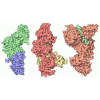
 Citation Citation | Journal: bioRxiv / Year: 2025 Title: PIP2 Binding at Allosteric Site Blocks Activation in Human Rod CNG Channels. Authors: Taehyun Park / Crina M Nimigean / Abstract: Phosphatidylinositol-4,5-bisphosphate (PIP2) is a ubiquitous signaling lipid that regulates multiple ion channels. In human cyclic nucleotide-gated (CNG) channels, including the rod photoreceptor ...Phosphatidylinositol-4,5-bisphosphate (PIP2) is a ubiquitous signaling lipid that regulates multiple ion channels. In human cyclic nucleotide-gated (CNG) channels, including the rod photoreceptor channel, PIP2 has been reported to exert inhibitory effects, but the underlying mechanism has remained unclear. Because this inhibition lowers the apparent cGMP sensitivity of rod CNG channels, it can play a key role in controlling the light sensitivity and dynamic range of rod photoreceptors. Here we report how PIP2 modulates the function of human CNGA1 channels, the major subunit of human rod photoreceptor CNG channels. Ensemble ion flux assays with liposome-reconstituted purified CNGA1 channels demonstrated robust inhibition by PIP2 via a reduction in apparent cGMP sensitivity, and single-channel recordings revealed PIP2 reduces the channel's open probability without altering unitary conductance. To uncover the structural basis, we determined cryo-EM structures of CNGA1 in lipid nanodiscs under multiple ligand conditions. In PIP2-free conditions, closed, intermediate, and open conformations were observed, whereas in the presence of PIP2, the open state was absent. Density consistent with bound PIP2 was detected at inter-protomer grooves between the voltage-sensing and pore domains indicating that PIP2 binding stabilizes non-conductive conformations by sterically preventing C-linker elevation and outward movement of helix S6, conformational changes needed for pore dilation. Collectively, our results establish a structural mechanism for PIP2-mediated inhibition of rod CNG channels, define a mechanistic framework for phosphoinositide control of ligand-gated channels across the CNG superfamily, and provide an inhibitory allosteric binding site for future drug targeting in this channel family. | |||||||||
| History |
|
- Structure visualization
| Supplemental images |
|---|

- Downloads & links
-EMDB archive
| Map data | emd_74540.map.gz | 125.6 MB | EMDB map data format | |
|---|---|---|---|---|
| Header (meta data) | emd-74540-v30.xmlemd-74540.xml | 17.9 KB 17.9 KB | Display Display | EMDB header |
| Images |  emd_74540.png emd_74540.png | 59.5 KB | ||
| Filedesc metadata | emd-74540.cif.gz | 6.3 KB | ||
| Others | emd_74540_half_map_1.map.gzemd_74540_half_map_2.map.gz | 126.3 MB 126.3 MB | ||
| Archive directory |  http://ftp.pdbj.org/pub/emdb/structures/EMD-74540ftp://ftp.pdbj.org/pub/emdb/structures/EMD-74540 http://ftp.pdbj.org/pub/emdb/structures/EMD-74540ftp://ftp.pdbj.org/pub/emdb/structures/EMD-74540 | HTTPS FTP |
-Related structure data
| Related structure data |  9zq1MC  9zpvC  9zpwC  9zpxC  9zpyC  9zpzC  9zq0C M: atomic model generated by this map C: citing same article ( |
|---|---|
| Similar structure data |


-Links
| EMDB pages | EMDB (EBI/PDBe) / EMDataResource |
|---|---|
| Related items in Molecule of the Month |
-Map
| File | Download / File: emd_74540.map.gz / Format: CCP4 / Size: 166.4 MB / Type: IMAGE STORED AS FLOATING POINT NUMBER (4 BYTES) | ||||||||||||||||||||
|---|---|---|---|---|---|---|---|---|---|---|---|---|---|---|---|---|---|---|---|---|---|
| Voxel size | X=Y=Z: 0.9 Å | ||||||||||||||||||||
| Density |
| ||||||||||||||||||||
| Symmetry | Space group: 1 | ||||||||||||||||||||
| Details | EMDB XML:
|
-Supplemental data
-Half map: #2
| File | emd_74540_half_map_1.map | ||||||||||||
|---|---|---|---|---|---|---|---|---|---|---|---|---|---|
| Projections & Slices |
| ||||||||||||
| Density Histograms |
 Z
Z Y
Y X
X


-Half map: #1
| File | emd_74540_half_map_2.map | ||||||||||||
|---|---|---|---|---|---|---|---|---|---|---|---|---|---|
| Projections & Slices |
| ||||||||||||
| Density Histograms |


- Sample components
-Entire : homotetramer complex of Cyclic nucleotide-gated channel alpha-1
| Entire | Name: homotetramer complex of Cyclic nucleotide-gated channel alpha-1 |
|---|---|
| Components |
|
-Supramolecule #1: homotetramer complex of Cyclic nucleotide-gated channel alpha-1
| Supramolecule | Name: homotetramer complex of Cyclic nucleotide-gated channel alpha-1 type: complex / ID: 1 / Parent: 0 / Macromolecule list: #1 |
|---|---|
| Source (natural) | Organism: Homo sapiens (human) |
| Molecular weight | Theoretical: 316.5 KDa |
-Macromolecule #1: Cyclic nucleotide-gated channel alpha-1
| Macromolecule | Name: Cyclic nucleotide-gated channel alpha-1 / type: protein_or_peptide / ID: 1 / Number of copies: 4 / Enantiomer: LEVO |
|---|---|
| Source (natural) | Organism: Homo sapiens (human) |
| Molecular weight | Theoretical: 64.519238 KDa |
| Recombinant expression | Organism: Homo sapiens (human) |
| Sequence | String: DYKDDDDKGG SASKDKKEEE KKEVVVIDPS GNTYYNWLFC ITLPVMYNWT MVIARACFDE LQSDYLEYWL ILDYVSDIVY LIDMFVRTR TGYLEQGLLV KEELKLINKY KSNLQFKLDV LSLIPTDLLY FKLGWNYPEI RLNRLLRFSR MFEFFQRTET R TNYPNIFR ...String: DYKDDDDKGG SASKDKKEEE KKEVVVIDPS GNTYYNWLFC ITLPVMYNWT MVIARACFDE LQSDYLEYWL ILDYVSDIVY LIDMFVRTR TGYLEQGLLV KEELKLINKY KSNLQFKLDV LSLIPTDLLY FKLGWNYPEI RLNRLLRFSR MFEFFQRTET R TNYPNIFR ISNLVMYIVI IIHWNACVFY SISKAIGFGN DTWVYPDIND PEFGRLARKY VYSLYWSTLT LTTIGETPPP VR DSEYVFV VVDFLIGVLI FATIVGNIGS MISNMNAARA EFQARIDAIK QYMHFRNVSK DMEKRVIKWF DYLWTNKKTV DEK EVLKYL PDKLRAEIAI NVHLDTLKKV RIFADCEAGL LVELVLKLQP QVYSPGDYIC KKGDIGREMY IIKEGKLAVV ADDG VTQFV VLSDGSYFGE ISILNIKGSK AGNRRTANIK SIGYSDLFCL SKDDLMEALT EYPDAKTMLE EKGKQILMKD GLLDL NIAN AGSDPKDLEE KVTRMEGSVD LLQTRFARIL AEYESMQQKL KQRLTKVEKF LKPLIDTEFS SIEGPGAESG PIDST UniProtKB: Cyclic nucleotide-gated channel alpha-1 |
-Macromolecule #2: CYCLIC GUANOSINE MONOPHOSPHATE
| Macromolecule | Name: CYCLIC GUANOSINE MONOPHOSPHATE / type: ligand / ID: 2 / Number of copies: 4 / Formula: PCG |
|---|---|
| Molecular weight | Theoretical: 345.205 Da |
| Chemical component information |  ChemComp-PCG: |
-Macromolecule #3: CHOLESTEROL
| Macromolecule | Name: CHOLESTEROL / type: ligand / ID: 3 / Number of copies: 4 / Formula: CLR |
|---|---|
| Molecular weight | Theoretical: 386.654 Da |
| Chemical component information | 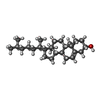 ChemComp-CLR: |
-Macromolecule #4: 1,2-DIOLEOYL-SN-GLYCERO-3-PHOSPHOCHOLINE
| Macromolecule | Name: 1,2-DIOLEOYL-SN-GLYCERO-3-PHOSPHOCHOLINE / type: ligand / ID: 4 / Number of copies: 28 / Formula: PCW |
|---|---|
| Molecular weight | Theoretical: 787.121 Da |
| Chemical component information | 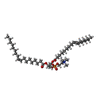 ChemComp-PCW: |
-Macromolecule #5: [(2R)-2-octanoyloxy-3-[oxidanyl-[(1R,2R,3S,4R,5R,6S)-2,3,6-tris(o...
| Macromolecule | Name: [(2R)-2-octanoyloxy-3-[oxidanyl-[(1R,2R,3S,4R,5R,6S)-2,3,6-tris(oxidanyl)-4,5-diphosphonooxy-cyclohexyl]oxy-phosphoryl]oxy-propyl] octanoate type: ligand / ID: 5 / Number of copies: 4 / Formula: PIO |
|---|---|
| Molecular weight | Theoretical: 746.566 Da |
| Chemical component information | 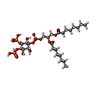 ChemComp-PIO: |
-Macromolecule #6: POTASSIUM ION
| Macromolecule | Name: POTASSIUM ION / type: ligand / ID: 6 / Number of copies: 5 / Formula: K |
|---|---|
| Molecular weight | Theoretical: 39.098 Da |
-Experimental details
-Structure determination
| Method | cryo EM |
|---|---|
 Processing Processing | single particle reconstruction |
| Aggregation state | particle |
-Sample preparation
| Buffer | pH: 7.4 Component:
Details: 25 mM HEPES, 150 mM KCl, pH 7.4 | |||||||||
|---|---|---|---|---|---|---|---|---|---|---|
| Grid | Model: Quantifoil R1.2/1.3 / Material: GOLD | |||||||||
| Vitrification | Cryogen name: ETHANE / Chamber humidity: 100 % / Chamber temperature: 295 K / Instrument: FEI VITROBOT MARK IV |
- Electron microscopy
| Microscope | TFS KRIOS |
|---|---|
| Image recording | Film or detector model: GATAN K3 (6k x 4k) / Average electron dose: 48.48 e/Å2 |
| Electron beam | Acceleration voltage: 300 kV / Electron source:  FIELD EMISSION GUN FIELD EMISSION GUN |
| Electron optics | Illumination mode: FLOOD BEAM / Imaging mode: BRIGHT FIELD / Nominal defocus max: 2.4 µm / Nominal defocus min: 0.6 µm |
| Experimental equipment |  Model: Titan Krios / Image courtesy: FEI Company |
