 Movie
Movie Controller


+ Open data

- Basic information
| Entry | Database: PDB / ID: 9zpy | |||||||||||||||||||||
|---|---|---|---|---|---|---|---|---|---|---|---|---|---|---|---|---|---|---|---|---|---|---|
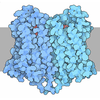
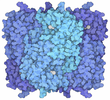
| Title | CNGA1 channel closed state in nanodisc with brain PIP2 cGMP-free | |||||||||||||||||||||
 Components Components | Cyclic nucleotide-gated channel alpha-1 | |||||||||||||||||||||
 Keywords Keywords | TRANSPORT PROTEIN / Cyclic nucleotide-gated channel / Rod photoreceptor / CNGA1 / Ion channel | |||||||||||||||||||||
| Function / homology |  Function and homology information Function and homology informationintracellular cyclic nucleotide activated cation channel complex / intracellularly cGMP-activated cation channel activity / rod photoreceptor outer segment / intracellularly cAMP-activated cation channel activity / sensory perception of chemical stimulus / photoreceptor outer segment membrane / sodium channel activity / sodium ion transport / cGMP binding / monoatomic cation transmembrane transport ...intracellular cyclic nucleotide activated cation channel complex / intracellularly cGMP-activated cation channel activity / rod photoreceptor outer segment / intracellularly cAMP-activated cation channel activity / sensory perception of chemical stimulus / photoreceptor outer segment membrane / sodium channel activity / sodium ion transport / cGMP binding / monoatomic cation transmembrane transport / cAMP binding / visual perception / calcium channel activity / Activation of the phototransduction cascade / calcium ion transport / Inactivation, recovery and regulation of the phototransduction cascade / plasma membrane Similarity search - Function | |||||||||||||||||||||
| Biological species |  Homo sapiens (human) Homo sapiens (human) | |||||||||||||||||||||
| Method | ELECTRON MICROSCOPY / single particle reconstruction / cryo EM / Resolution: 2.48 Å | |||||||||||||||||||||
 Authors Authors | Park, T. / Nimigean, C.M. | |||||||||||||||||||||
| Funding support |  United States, 1items United States, 1items
| |||||||||||||||||||||
 Citation Citation | Journal: bioRxiv / Year: 2025 Title: PIP2 Binding at Allosteric Site Blocks Activation in Human Rod CNG Channels. Authors: Taehyun Park / Crina M Nimigean / Abstract: Phosphatidylinositol-4,5-bisphosphate (PIP2) is a ubiquitous signaling lipid that regulates multiple ion channels. In human cyclic nucleotide-gated (CNG) channels, including the rod photoreceptor ...Phosphatidylinositol-4,5-bisphosphate (PIP2) is a ubiquitous signaling lipid that regulates multiple ion channels. In human cyclic nucleotide-gated (CNG) channels, including the rod photoreceptor channel, PIP2 has been reported to exert inhibitory effects, but the underlying mechanism has remained unclear. Because this inhibition lowers the apparent cGMP sensitivity of rod CNG channels, it can play a key role in controlling the light sensitivity and dynamic range of rod photoreceptors. Here we report how PIP2 modulates the function of human CNGA1 channels, the major subunit of human rod photoreceptor CNG channels. Ensemble ion flux assays with liposome-reconstituted purified CNGA1 channels demonstrated robust inhibition by PIP2 via a reduction in apparent cGMP sensitivity, and single-channel recordings revealed PIP2 reduces the channel's open probability without altering unitary conductance. To uncover the structural basis, we determined cryo-EM structures of CNGA1 in lipid nanodiscs under multiple ligand conditions. In PIP2-free conditions, closed, intermediate, and open conformations were observed, whereas in the presence of PIP2, the open state was absent. Density consistent with bound PIP2 was detected at inter-protomer grooves between the voltage-sensing and pore domains indicating that PIP2 binding stabilizes non-conductive conformations by sterically preventing C-linker elevation and outward movement of helix S6, conformational changes needed for pore dilation. Collectively, our results establish a structural mechanism for PIP2-mediated inhibition of rod CNG channels, define a mechanistic framework for phosphoinositide control of ligand-gated channels across the CNG superfamily, and provide an inhibitory allosteric binding site for future drug targeting in this channel family. | |||||||||||||||||||||
| History |
|
- Structure visualization
| Structure viewer | Molecule: MolmilJmol/JSmol |
|---|
- Downloads & links
-Download
| PDBx/mmCIF format | 9zpy.cif.gz | 403 KB | Display | PDBx/mmCIF format |
|---|---|---|---|---|
| PDB format | pdb9zpy.ent.gz | 331 KB | Display | PDB format |
| PDBx/mmJSON format | 9zpy.json.gz | Tree view | PDBx/mmJSON format | |
| Others |  Other downloads Other downloads |
-Validation report
| Arichive directory | https://data.pdbj.org/pub/pdb/validation_reports/zp/9zpyftp://data.pdbj.org/pub/pdb/validation_reports/zp/9zpy | HTTPS FTP |
|---|
-Related structure data
| Related structure data |  74537MC  9zpvC  9zpwC  9zpxC  9zpzC  9zq0C  9zq1C M: map data used to model this data C: citing same article ( |
|---|---|
| Similar structure data |


-Links
 PDBj
PDBj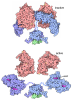
- Assembly
| Deposited unit | 
|
|---|---|
| 1 |
|
-Components
| #1: Protein | Mass: 64519.238 Da / Num. of mol.: 4 Source method: isolated from a genetically manipulated source Source: (gene. exp.) Homo sapiens (human) / Gene: CNGA1, CNCG, CNCG1 / Cell line (production host): HEK293F / Production host: Homo sapiens (human) / References: UniProt: P29973#2: Chemical | ChemComp-CLR / 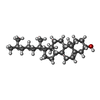 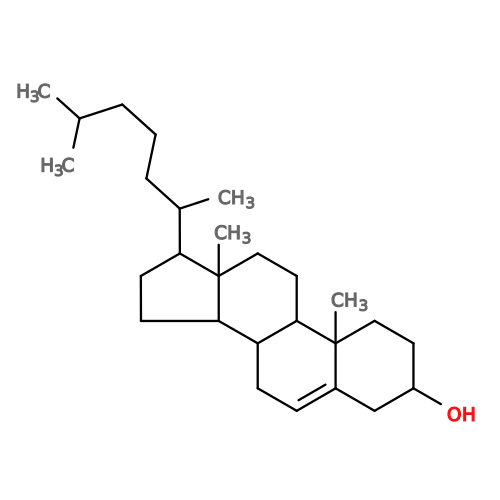 Mass: 386.654 Da / Num. of mol.: 4 / Source method: obtained synthetically / Formula: C27H46O / Feature type: SUBJECT OF INVESTIGATION Mass: 386.654 Da / Num. of mol.: 4 / Source method: obtained synthetically / Formula: C27H46O / Feature type: SUBJECT OF INVESTIGATION#3: Chemical | ChemComp-PCW /  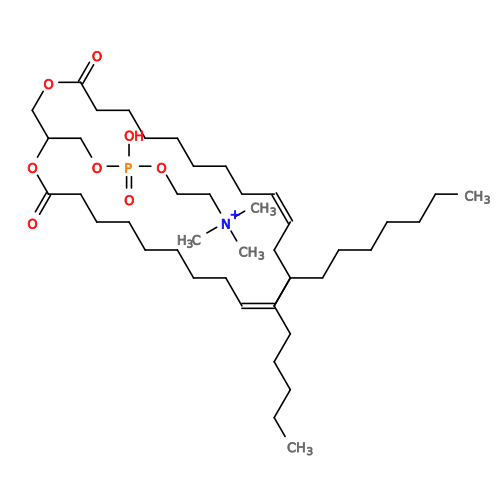 Mass: 787.121 Da / Num. of mol.: 28 / Source method: obtained synthetically / Formula: C44H85NO8P / Feature type: SUBJECT OF INVESTIGATION / Comment: DOPC, phospholipid*YM Mass: 787.121 Da / Num. of mol.: 28 / Source method: obtained synthetically / Formula: C44H85NO8P / Feature type: SUBJECT OF INVESTIGATION / Comment: DOPC, phospholipid*YM#4: Chemical | ChemComp-K /   Mass: 39.098 Da / Num. of mol.: 5 / Source method: obtained synthetically / Formula: K / Feature type: SUBJECT OF INVESTIGATION Mass: 39.098 Da / Num. of mol.: 5 / Source method: obtained synthetically / Formula: K / Feature type: SUBJECT OF INVESTIGATION#5: Chemical |   Mass: 1047.088 Da / Num. of mol.: 2 / Source method: obtained synthetically / Formula: C47H85O19P3 / Feature type: SUBJECT OF INVESTIGATION / Comment: phospholipid*YM Mass: 1047.088 Da / Num. of mol.: 2 / Source method: obtained synthetically / Formula: C47H85O19P3 / Feature type: SUBJECT OF INVESTIGATION / Comment: phospholipid*YMHas ligand of interest | Y | Has protein modification | N | |
|---|
-Experimental details
-Experiment
| Experiment | Method: ELECTRON MICROSCOPY |
|---|---|
| EM experiment | Aggregation state: PARTICLE / 3D reconstruction method: single particle reconstruction |
- Sample preparation
| Component | Name: homotetramer complex of Cyclic nucleotide-gated channel alpha-1 Type: COMPLEX / Entity ID: #1 / Source: RECOMBINANT |
|---|---|
| Molecular weight | Value: 0.3165 MDa / Experimental value: NO |
| Source (natural) | Organism: Homo sapiens (human) |
| Source (recombinant) | Organism: Homo sapiens (human) |
| Buffer solution | pH: 7.4 |
| Specimen | Embedding applied: NO / Shadowing applied: NO / Staining applied: NO / Vitrification applied: YES |
| Specimen support | Grid material: GOLD / Grid type: Quantifoil R1.2/1.3 |
| Vitrification | Instrument: FEI VITROBOT MARK IV / Cryogen name: ETHANE / Humidity: 100 % / Chamber temperature: 295 K |
- Electron microscopy imaging
| Experimental equipment |  Model: Titan Krios / Image courtesy: FEI Company |
|---|---|
| Microscopy | Model: TFS KRIOS |
| Electron gun | Electron source:  FIELD EMISSION GUN / Accelerating voltage: 300 kV / Illumination mode: FLOOD BEAM FIELD EMISSION GUN / Accelerating voltage: 300 kV / Illumination mode: FLOOD BEAM |
| Electron lens | Mode: BRIGHT FIELD / Nominal defocus max: 2600 nm / Nominal defocus min: 600 nm |
| Image recording | Electron dose: 48.56 e/Å2 / Film or detector model: GATAN K3 (6k x 4k) |
- Processing
| EM software |
| ||||||||||||||||||||||||
|---|---|---|---|---|---|---|---|---|---|---|---|---|---|---|---|---|---|---|---|---|---|---|---|---|---|
| CTF correction | Type: PHASE FLIPPING AND AMPLITUDE CORRECTION | ||||||||||||||||||||||||
| 3D reconstruction | Resolution: 2.48 Å / Resolution method: FSC 0.143 CUT-OFF / Num. of particles: 195750 / Symmetry type: POINT | ||||||||||||||||||||||||
| Refinement | Highest resolution: 2.48 Å Stereochemistry target values: REAL-SPACE (WEIGHTED MAP SUM AT ATOM CENTERS) | ||||||||||||||||||||||||
| Refine LS restraints |
|
