 Movie
Movie Controller
 Structure viewers
 About Yorodumi Papers


+Search query
-Structure paper
| Title | Structural insights into the substrate uptake and inhibition of the human creatine transporter (hCRT). |
|---|---|
| Journal, issue, pages | Proc Natl Acad Sci U S A, Vol. 122, Issue 36, Page e2426135122, Year 2025 |
| Publish date | Sep 9, 2025 |
 Authors Authors | Xinyi Yuan / Jian Yin / Chang Liu / Xudong Chen / Meiying Chen / Yixue Wang / Zi Yang / Yue Wang / Li Jiang / Niyun Zhou / Xiaojuan Wang / Botong Liu / Zhaoqi Ma / Kaiyan Wang / Hongen Li / Sensen Zhang / Yongfeng Shang / Maojun Yang /  |
| PubMed Abstract | Creatine plays a vital role in cellular energy production and adenosine triphosphate (ATP) homeostasis and has also been identified as a neurotransmitter in the mammalian brain. Creatine is ...Creatine plays a vital role in cellular energy production and adenosine triphosphate (ATP) homeostasis and has also been identified as a neurotransmitter in the mammalian brain. Creatine is transported into cells by the human creatine transporter (hCRT) (SLC6A8), an Na/Cl-dependent symporter encoded on the X chromosome. Mutations in hCRT cause cerebral creatine deficiency syndrome 1, a neurological disorder marked by intellectual disability, speech delay, and seizures. Beyond its role in the brain and muscle, hCRT is highly expressed in metabolically active tumors. Many cancer cells, including colorectal cancer and glioblastoma, upregulate hCRT to sustain intracellular creatine levels and buffer ATP under energy stress. Pharmacological blockade of hCRT by RGX202 has been shown to impair tumor growth by disrupting energy homeostasis. Here, we report the high-resolution cryo-Electron Microscopy (cryo-EM) structures of human hCRT in three states: apo, creatine-bound, and RGX202-bound. hCRT adopts a canonical LeuT-fold with 12 transmembrane helices and two pseudosymmetric inverted repeats. Creatine is coordinated in the central substrate-binding site through interactions with transmembrane helices TM1, TM3, TM6, and TM8, while the inhibitor RGX202 occupies the same binding pocket, engaging in overlapping contacts that competitively block creatine access. Our structural and mechanistic findings clarify substrate recognition and inhibitory binding of hCRT, providing a molecular rationale for targeting hCRT in both inherited metabolic diseases and cancer therapy. |
 External links External links | Proc Natl Acad Sci U S A / PubMed:40892912 / PubMed Central |
| Methods | EM (single particle) |
| Resolution | 2.75 - 3.28 Å |
| Structure data | EMDB-64853, PDB-9v8w: EMDB-64854, PDB-9v8x: EMDB-64855, PDB-9v8y: |
| Chemicals |  ChemComp-NA:  ChemComp-CL:  PDB-1d9s:  ChemComp-HOH: 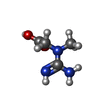 ChemComp-CRN: |
| Source |
|
 Keywords Keywords | MEMBRANE PROTEIN / membrane protein S6A8 / membrane protein S6A8 with Crea / membrane protein S6A8 apo |


 homo sapiens (human)