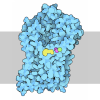
Journal: Proc Natl Acad Sci U S A / Year: 2025 Title: Structural insights into the substrate uptake and inhibition of the human creatine transporter (hCRT). Authors: Xinyi Yuan / Jian Yin / Chang Liu / Xudong Chen / Meiying Chen / Yixue Wang / Zi Yang / Yue Wang / Li Jiang / Niyun Zhou / Xiaojuan Wang / Botong Liu / Zhaoqi Ma / Kaiyan Wang / Hongen Li / ...Authors: Xinyi Yuan / Jian Yin / Chang Liu / Xudong Chen / Meiying Chen / Yixue Wang / Zi Yang / Yue Wang / Li Jiang / Niyun Zhou / Xiaojuan Wang / Botong Liu / Zhaoqi Ma / Kaiyan Wang / Hongen Li / Sensen Zhang / Yongfeng Shang / Maojun Yang / Abstract: Creatine plays a vital role in cellular energy production and adenosine triphosphate (ATP) homeostasis and has also been identified as a neurotransmitter in the mammalian brain. Creatine is ...Creatine plays a vital role in cellular energy production and adenosine triphosphate (ATP) homeostasis and has also been identified as a neurotransmitter in the mammalian brain. Creatine is transported into cells by the human creatine transporter (hCRT) (SLC6A8), an Na/Cl-dependent symporter encoded on the X chromosome. Mutations in hCRT cause cerebral creatine deficiency syndrome 1, a neurological disorder marked by intellectual disability, speech delay, and seizures. Beyond its role in the brain and muscle, hCRT is highly expressed in metabolically active tumors. Many cancer cells, including colorectal cancer and glioblastoma, upregulate hCRT to sustain intracellular creatine levels and buffer ATP under energy stress. Pharmacological blockade of hCRT by RGX202 has been shown to impair tumor growth by disrupting energy homeostasis. Here, we report the high-resolution cryo-Electron Microscopy (cryo-EM) structures of human hCRT in three states: apo, creatine-bound, and RGX202-bound. hCRT adopts a canonical LeuT-fold with 12 transmembrane helices and two pseudosymmetric inverted repeats. Creatine is coordinated in the central substrate-binding site through interactions with transmembrane helices TM1, TM3, TM6, and TM8, while the inhibitor RGX202 occupies the same binding pocket, engaging in overlapping contacts that competitively block creatine access. Our structural and mechanistic findings clarify substrate recognition and inhibitory binding of hCRT, providing a molecular rationale for targeting hCRT in both inherited metabolic diseases and cancer therapy.
In the structure databanks used in Yorodumi, some data are registered as the other names, "COVID-19 virus" and "2019-nCoV". Here are the details of the virus and the list of structure data.
Jan 31, 2019. EMDB accession codes are about to change! (news from PDBe EMDB page)
EMDB accession codes are about to change! (news from PDBe EMDB page)
The allocation of 4 digits for EMDB accession codes will soon come to an end. Whilst these codes will remain in use, new EMDB accession codes will include an additional digit and will expand incrementally as the available range of codes is exhausted. The current 4-digit format prefixed with “EMD-” (i.e. EMD-XXXX) will advance to a 5-digit format (i.e. EMD-XXXXX), and so on. It is currently estimated that the 4-digit codes will be depleted around Spring 2019, at which point the 5-digit format will come into force.
The EM Navigator/Yorodumi systems omit the EMD- prefix.
Related info.:Q: What is EMD? / ID/Accession-code notation in Yorodumi/EM Navigator
Yorodumi is a browser for structure data from EMDB, PDB, SASBDB, etc.
This page is also the successor to EM Navigator detail page, and also detail information page/front-end page for Omokage search.
The word "yorodu" (or yorozu) is an old Japanese word meaning "ten thousand". "mi" (miru) is to see.
Related info.:EMDB / PDB / SASBDB / Comparison of 3 databanks / Yorodumi Search / Aug 31, 2016. New EM Navigator & Yorodumi / Yorodumi Papers / Jmol/JSmol / Function and homology information / Changes in new EM Navigator and Yorodumi
 Movie
Movie Controller


 Open data
 Basic information
 Map data
 Sample
 Keywords
 Function and homology information
 Homo sapiens (human)
 Authors
 China, 1 items
  Citation
 Structure visualization
 Downloads & links
 emd_64853.png
 http://ftp.pdbj.org/pub/emdb/structures/EMD-64853


 Z (Sec.)
 Y (Row.)
 X (Col.)




 Sample components
 Processing
 Electron microscopy
 FIELD EMISSION GUN
