[English] 日本語
Yorodumi
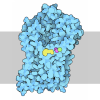
- EMDB-64854: membrane protein S6A8 with Crea -

+
Open data


ID or keywords:

Loading...

-
Basic information

Entry
Database: EMDB / ID: EMD-64854
Titlemembrane protein S6A8 with Crea
Map data
Sample
  • Organelle or cellular component: membrane protein S6A8
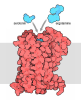
    • Protein or peptide: Sodium- and chloride-dependent creatine transporter 1
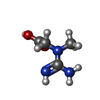
  • Ligand: N-[(E)-AMINO(IMINO)METHYL]-N-METHYLGLYCINE
  • Ligand: SODIUM ION
  • Ligand: CHLORIDE ION
  • Ligand: water
Keywordsmembrane protein S6A8 with Crea / MEMBRANE PROTEIN
Function / homology
Function and homology information


creatine transmembrane transporter activity / creatine:sodium symporter activity / creatine transmembrane transport / creatine metabolic process / Creatine metabolism / gamma-aminobutyric acid:sodium:chloride symporter activity / neurotransmitter transport / amino acid transport / muscle contraction / sodium ion transmembrane transport ...creatine transmembrane transporter activity / creatine:sodium symporter activity / creatine transmembrane transport / creatine metabolic process / Creatine metabolism / gamma-aminobutyric acid:sodium:chloride symporter activity / neurotransmitter transport / amino acid transport / muscle contraction / sodium ion transmembrane transport / apical plasma membrane / membrane / plasma membrane
Similarity search - Function
Sodium:neurotransmitter symporter, creatine / Sodium:neurotransmitter symporter family signature 2. / Sodium:neurotransmitter symporter family signature 1. / Sodium:neurotransmitter symporter / Sodium:neurotransmitter symporter superfamily / Sodium:neurotransmitter symporter family / Sodium:neurotransmitter symporter family profile.
Similarity search - Domain/homology
Sodium- and chloride-dependent creatine transporter 1
Similarity search - Component
Biological speciesHomo sapiens (human)
Methodsingle particle reconstruction / cryo EM / Resolution: 2.85 Å
AuthorsZhang SS
Funding support China, 1 items
OrganizationGrant numberCountry
National Science Foundation (NSF, China)21532004, 31570733 China
CitationJournal: Proc Natl Acad Sci U S A / Year: 2025
Title: Structural insights into the substrate uptake and inhibition of the human creatine transporter (hCRT).
Authors: Xinyi Yuan / Jian Yin / Chang Liu / Xudong Chen / Meiying Chen / Yixue Wang / Zi Yang / Yue Wang / Li Jiang / Niyun Zhou / Xiaojuan Wang / Botong Liu / Zhaoqi Ma / Kaiyan Wang / Hongen Li / ...Authors: Xinyi Yuan / Jian Yin / Chang Liu / Xudong Chen / Meiying Chen / Yixue Wang / Zi Yang / Yue Wang / Li Jiang / Niyun Zhou / Xiaojuan Wang / Botong Liu / Zhaoqi Ma / Kaiyan Wang / Hongen Li / Sensen Zhang / Yongfeng Shang / Maojun Yang /
Abstract: Creatine plays a vital role in cellular energy production and adenosine triphosphate (ATP) homeostasis and has also been identified as a neurotransmitter in the mammalian brain. Creatine is ...Creatine plays a vital role in cellular energy production and adenosine triphosphate (ATP) homeostasis and has also been identified as a neurotransmitter in the mammalian brain. Creatine is transported into cells by the human creatine transporter (hCRT) (SLC6A8), an Na/Cl-dependent symporter encoded on the X chromosome. Mutations in hCRT cause cerebral creatine deficiency syndrome 1, a neurological disorder marked by intellectual disability, speech delay, and seizures. Beyond its role in the brain and muscle, hCRT is highly expressed in metabolically active tumors. Many cancer cells, including colorectal cancer and glioblastoma, upregulate hCRT to sustain intracellular creatine levels and buffer ATP under energy stress. Pharmacological blockade of hCRT by RGX202 has been shown to impair tumor growth by disrupting energy homeostasis. Here, we report the high-resolution cryo-Electron Microscopy (cryo-EM) structures of human hCRT in three states: apo, creatine-bound, and RGX202-bound. hCRT adopts a canonical LeuT-fold with 12 transmembrane helices and two pseudosymmetric inverted repeats. Creatine is coordinated in the central substrate-binding site through interactions with transmembrane helices TM1, TM3, TM6, and TM8, while the inhibitor RGX202 occupies the same binding pocket, engaging in overlapping contacts that competitively block creatine access. Our structural and mechanistic findings clarify substrate recognition and inhibitory binding of hCRT, providing a molecular rationale for targeting hCRT in both inherited metabolic diseases and cancer therapy.
History
DepositionMay 30, 2025-
Header (metadata) releaseApr 15, 2026-
Map releaseApr 15, 2026-
UpdateApr 15, 2026-
Current statusApr 15, 2026Processing site: PDBc / Status: Released

-
Structure visualization

Supplemental images

Downloads & links

-
Map

FileDownload / File: emd_64854.map.gz / Format: CCP4 / Size: 64 MB / Type: IMAGE STORED AS FLOATING POINT NUMBER (4 BYTES)
Projections & slices

Image control

Size
Brightness
Contrast
Others
AxesZ (Sec.)Y (Row.)X (Col.)
0.84 Å/pix.
x 256 pix.
= 215.885 Å
0.84 Å/pix.
x 256 pix.
= 215.885 Å
0.84 Å/pix.
x 256 pix.
= 215.885 Å

Surface

Projections

Slices (1/3)

Slices (1/2)

Slices (2/3)

Images are generated by Spider.

Voxel sizeX=Y=Z: 0.8433 Å
Density
Contour LevelBy AUTHOR: 0.333
Minimum - Maximum-2.7628984 - 4.087002
Average (Standard dev.)-0.00027547768 (±0.087837815)
SymmetrySpace group: 1
Details

EMDB XML:

Map geometry
Axis orderXYZ
Origin000
Dimensions256256256
Spacing256256256
CellA=B=C: 215.8848 Å
α=β=γ: 90.0 °

-
Supplemental data

-
Half map: #1

Fileemd_64854_half_map_1.map
Projections & Slices
AxesZYX

Projections

Slices (1/2)
Density Histograms

-
Half map: #2

Fileemd_64854_half_map_2.map
Projections & Slices
AxesZYX

Projections

Slices (1/2)
Density Histograms

-
Sample components

-
Entire : membrane protein S6A8

EntireName: membrane protein S6A8
Components
  • Organelle or cellular component: membrane protein S6A8
    • Protein or peptide: Sodium- and chloride-dependent creatine transporter 1
  • Ligand: N-[(E)-AMINO(IMINO)METHYL]-N-METHYLGLYCINE
  • Ligand: SODIUM ION
  • Ligand: CHLORIDE ION
  • Ligand: water

-
Supramolecule #1: membrane protein S6A8

SupramoleculeName: membrane protein S6A8 / type: organelle_or_cellular_component / ID: 1 / Parent: 0 / Macromolecule list: #1
Source (natural)Organism: Homo sapiens (human)

-
Macromolecule #1: Sodium- and chloride-dependent creatine transporter 1

MacromoleculeName: Sodium- and chloride-dependent creatine transporter 1 / type: protein_or_peptide / ID: 1 / Number of copies: 1 / Enantiomer: LEVO
Source (natural)Organism: Homo sapiens (human)
Molecular weightTheoretical: 70.568336 KDa
Recombinant expressionOrganism: Homo sapiens (human)
SequenceString: MAKKSAENGI YSVSGDEKKG PLIAPGPDGA PAKGDGPVGL GTPGGRLAVP PRETWTRQMD FIMSCVGFAV GLGNVWRFPY LCYKNGGGV FLIPYVLIAL VGGIPIFFLE ISLGQFMKAG SINVWNICPL FKGLGYASMV IVFYCNTYYI MVLAWGFYYL V KSFTTTLP ...String:
MAKKSAENGI YSVSGDEKKG PLIAPGPDGA PAKGDGPVGL GTPGGRLAVP PRETWTRQMD FIMSCVGFAV GLGNVWRFPY LCYKNGGGV FLIPYVLIAL VGGIPIFFLE ISLGQFMKAG SINVWNICPL FKGLGYASMV IVFYCNTYYI MVLAWGFYYL V KSFTTTLP WATCGHTWNT PDCVEIFRHE DCANASLANL TCDQLADRRS PVIEFWENKV LRLSGGLEVP GALNWEVTLC LL ACWVLVY FCVWKGVKST GKIVYFTATF PYVVLVVLLV RGVLLPGALD GIIYYLKPDW SKLGSPQVWI DAGTQIFFSY AIG LGALTA LGSYNRFNNN CYKDAIILAL INSGTSFFAG FVVFSILGFM AAEQGVHISK VAESGPGLAF IAYPRAVTLM PVAP LWAAL FFFMLLLLGL DSQFVGVEGF ITGLLDLLPA SYYFRFQREI SVALCCALCF VIDLSMVTDG GMYVFQLFDY YSASG TTLL WQAFWECVVV AWVYGADRFM DDIACMIGYR PCPWMKWCWS FFTPLVCMGI FIFNVVYYEP LVYNNTYVYP WWGEAM GWA FALSSMLCVP LHLLGCLLRA KGTMAERWQH LTQPIWGLHH LEYRAQDADV RGLTTLTPVS ESSKVVVVES VM

UniProtKB: Sodium- and chloride-dependent creatine transporter 1

-
Macromolecule #2: N-[(E)-AMINO(IMINO)METHYL]-N-METHYLGLYCINE

MacromoleculeName: N-[(E)-AMINO(IMINO)METHYL]-N-METHYLGLYCINE / type: ligand / ID: 2 / Number of copies: 1 / Formula: CRN
Molecular weightTheoretical: 131.133 Da
Chemical component information

ChemComp-CRN:
N-[(E)-AMINO(IMINO)METHYL]-N-METHYLGLYCINE

-
Macromolecule #3: SODIUM ION

MacromoleculeName: SODIUM ION / type: ligand / ID: 3 / Number of copies: 2
Molecular weightTheoretical: 22.99 Da

-
Macromolecule #4: CHLORIDE ION

MacromoleculeName: CHLORIDE ION / type: ligand / ID: 4 / Number of copies: 1 / Formula: CL
Molecular weightTheoretical: 35.453 Da

-
Macromolecule #5: water

MacromoleculeName: water / type: ligand / ID: 5 / Number of copies: 10 / Formula: HOH
Molecular weightTheoretical: 18.015 Da
Chemical component information

ChemComp-HOH:
WATER

-
Experimental details

-
Structure determination

Methodcryo EM
Processingsingle particle reconstruction
Aggregation stateparticle

-
Sample preparation

BufferpH: 7.4
VitrificationCryogen name: ETHANE

-
Electron microscopy

MicroscopeTFS KRIOS
Image recordingFilm or detector model: GATAN K3 BIOCONTINUUM (6k x 4k) / Average electron dose: 50.0 e/Å2
Electron beamAcceleration voltage: 300 kV / Electron source: FIELD EMISSION GUN
Electron opticsIllumination mode: FLOOD BEAM / Imaging mode: BRIGHT FIELD / Nominal defocus max: 2.5 µm / Nominal defocus min: 1.2 µm
Experimental equipment
Model: Titan Krios / Image courtesy: FEI Company

+
Image processing

CTF correctionType: PHASE FLIPPING AND AMPLITUDE CORRECTION
Startup modelType of model: INSILICO MODEL
Final reconstructionResolution.type: BY AUTHOR / Resolution: 2.85 Å / Resolution method: FSC 0.143 CUT-OFF / Number images used: 237000
Initial angle assignmentType: ANGULAR RECONSTITUTION
Final angle assignmentType: RANDOM ASSIGNMENT

+
About Yorodumi

-
News

-
Feb 9, 2022. New format data for meta-information of EMDB entries

New format data for meta-information of EMDB entries

  • Version 3 of the EMDB header file is now the official format.
  • The previous official version 1.9 will be removed from the archive.

Related info.:EMDB header

External links:wwPDB to switch to version 3 of the EMDB data model

-
Aug 12, 2020. Covid-19 info

Covid-19 info

URL: https://pdbj.org/emnavi/covid19.php

New page: Covid-19 featured information page in EM Navigator.

Related info.:Covid-19 info / Mar 5, 2020. Novel coronavirus structure data

+
Mar 5, 2020. Novel coronavirus structure data

Novel coronavirus structure data

Related info.:Yorodumi Speices / Aug 12, 2020. Covid-19 info

External links:COVID-19 featured content - PDBj / Molecule of the Month (242):Coronavirus Proteases

+
Jan 31, 2019. EMDB accession codes are about to change! (news from PDBe EMDB page)

EMDB accession codes are about to change! (news from PDBe EMDB page)

  • The allocation of 4 digits for EMDB accession codes will soon come to an end. Whilst these codes will remain in use, new EMDB accession codes will include an additional digit and will expand incrementally as the available range of codes is exhausted. The current 4-digit format prefixed with “EMD-” (i.e. EMD-XXXX) will advance to a 5-digit format (i.e. EMD-XXXXX), and so on. It is currently estimated that the 4-digit codes will be depleted around Spring 2019, at which point the 5-digit format will come into force.
  • The EM Navigator/Yorodumi systems omit the EMD- prefix.

Related info.:Q: What is EMD? / ID/Accession-code notation in Yorodumi/EM Navigator

External links:EMDB Accession Codes are Changing Soon! / Contact to PDBj

+
Jul 12, 2017. Major update of PDB

Major update of PDB

  • wwPDB released updated PDB data conforming to the new PDBx/mmCIF dictionary.
  • This is a major update changing the version number from 4 to 5, and with Remediation, in which all the entries are updated.
  • In this update, many items about electron microscopy experimental information are reorganized (e.g. em_software).
  • Now, EM Navigator and Yorodumi are based on the updated data.

External links:wwPDB Remediation / Enriched Model Files Conforming to OneDep Data Standards Now Available in the PDB FTP Archive

-
Yorodumi

Thousand views of thousand structures

  • Yorodumi is a browser for structure data from EMDB, PDB, SASBDB, etc.
  • This page is also the successor to EM Navigator detail page, and also detail information page/front-end page for Omokage search.
  • The word "yorodu" (or yorozu) is an old Japanese word meaning "ten thousand". "mi" (miru) is to see.

Related info.:EMDB / PDB / SASBDB / Comparison of 3 databanks / Yorodumi Search / Aug 31, 2016. New EM Navigator & Yorodumi / Yorodumi Papers / Jmol/JSmol / Function and homology information / Changes in new EM Navigator and Yorodumi

Read more