[English] 日本語
Yorodumi Papers
- Database of articles cited by EMDB/PDB/SASBDB data -

+
Search query

Keywords
Structure methods
Author
Journal
IF

-
Structure paper

TitleInsights into the Activation Mechanism of HCA1, HCA2, and HCA3.
Journal, issue, pagesJ Med Chem, Vol. 68, Issue 4, Page 4527-4539, Year 2025
Publish dateFeb 27, 2025
AuthorsJiening Wang / Yuxia Qian / Zhen Han / Yize Wang / Yanru Liu / Jie Li / Qingmiao Duanmu / Sheng Ye / Anna Qiao / Shan Wu /
PubMed AbstractHydroxy-carboxylic acid receptors HCA1, HCA2, and HCA3 can be activated by important intermediates of energy metabolism. Despite the research focusing on HCA2, its clinical application has been ...Hydroxy-carboxylic acid receptors HCA1, HCA2, and HCA3 can be activated by important intermediates of energy metabolism. Despite the research focusing on HCA2, its clinical application has been limited by adverse effects. Therefore, the role of HCA1 as a promising target for the treatment of lipolysis warrants further exploration. As HCAs exhibit high similarity when activated with diverse selective agonists, a conserved yet unique activation mechanism for HCAs remains undisclosed. Herein, we unveil the cryo-electron microscopy structures of the 3,5-DHBA-HCA1-Gi signaling complex, the acifran- and MK6892-bound HCA2-Gi signaling complexes, and the acifran-HCA3-Gi signaling complex. Comparative analysis across HCAs reveals key residues in HCA1 contributing to the stabilization of the ligand-binding pocket. Furthermore, chimeric complexes and mutational analyses identify residues that are pivotal for HCA2 and HCA3 selectivity. Our findings elucidate critical structural insights into the mechanisms of ligand recognition and activation within HCA1 and broaden our comprehension of ligand specificity binding across the HCA family.
External linksJ Med Chem / PubMed:39936872 / PubMed Central
MethodsEM (single particle)
Resolution2.7 - 3.01 Å
Structure data

EMDB-62557, PDB-9kt6:
HCA3-Gi complex with acifran
Method: EM (single particle) / Resolution: 3.01 Å

EMDB-62558, PDB-9kt7:
Cryo-EM structure of HCA2-Gi complex with MK6892
Method: EM (single particle) / Resolution: 2.8 Å

EMDB-62559, PDB-9kt8:
Cryo-EM structure of HCA2-Gi complex with acifran
Method: EM (single particle) / Resolution: 2.73 Å

EMDB-62560, PDB-9kt9:
Cryo-EM structure of HCA1-Gi complex with 3,5-DHBA
Method: EM (single particle) / Resolution: 2.7 Å

Chemicals

ChemComp-P9X:
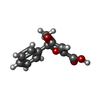
(5~{S})-5-methyl-4-oxidanylidene-5-phenyl-furan-2-carboxylic acid / agonist*YM

ChemComp-FI7:
2-[[2,2-dimethyl-3-[3-(5-oxidanylpyridin-2-yl)-1,2,4-oxadiazol-5-yl]propanoyl]amino]cyclohexene-1-carboxylic acid

ChemComp-34D:
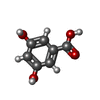
3,5-DIHYDROXYBENZOATE

Source
  • homo sapiens (human)
KeywordsSIGNALING PROTEIN / cryo-EM; G-protein-coupled receptors; Hydroxycarboxylic acid receptors / SIGNALING PROTEIN/IMMUNE SYSTEM / SIGNALING PROTEIN-IMMUNE SYSTEM complex / G-protein-coupled receptors; Hydroxycarboxylic acid receptors / cryo-EM; SIGNALING PROTEIN

+
About Yorodumi Papers

-
News

-
Feb 9, 2022. New format data for meta-information of EMDB entries

New format data for meta-information of EMDB entries

  • Version 3 of the EMDB header file is now the official format.
  • The previous official version 1.9 will be removed from the archive.

Related info.:EMDB header

External links:wwPDB to switch to version 3 of the EMDB data model

-
Aug 12, 2020. Covid-19 info

Covid-19 info

URL: https://pdbj.org/emnavi/covid19.php

New page: Covid-19 featured information page in EM Navigator.

Related info.:Covid-19 info / Mar 5, 2020. Novel coronavirus structure data

+
Mar 5, 2020. Novel coronavirus structure data

Novel coronavirus structure data

Related info.:Yorodumi Speices / Aug 12, 2020. Covid-19 info

External links:COVID-19 featured content - PDBj / Molecule of the Month (242):Coronavirus Proteases

+
Jan 31, 2019. EMDB accession codes are about to change! (news from PDBe EMDB page)

EMDB accession codes are about to change! (news from PDBe EMDB page)

  • The allocation of 4 digits for EMDB accession codes will soon come to an end. Whilst these codes will remain in use, new EMDB accession codes will include an additional digit and will expand incrementally as the available range of codes is exhausted. The current 4-digit format prefixed with “EMD-” (i.e. EMD-XXXX) will advance to a 5-digit format (i.e. EMD-XXXXX), and so on. It is currently estimated that the 4-digit codes will be depleted around Spring 2019, at which point the 5-digit format will come into force.
  • The EM Navigator/Yorodumi systems omit the EMD- prefix.

Related info.:Q: What is EMD? / ID/Accession-code notation in Yorodumi/EM Navigator

External links:EMDB Accession Codes are Changing Soon! / Contact to PDBj

+
Jul 12, 2017. Major update of PDB

Major update of PDB

  • wwPDB released updated PDB data conforming to the new PDBx/mmCIF dictionary.
  • This is a major update changing the version number from 4 to 5, and with Remediation, in which all the entries are updated.
  • In this update, many items about electron microscopy experimental information are reorganized (e.g. em_software).
  • Now, EM Navigator and Yorodumi are based on the updated data.

External links:wwPDB Remediation / Enriched Model Files Conforming to OneDep Data Standards Now Available in the PDB FTP Archive

-
Yorodumi Papers

Database of articles cited by EMDB/PDB/SASBDB data

  • Database of articles cited by EMDB, PDB, and SASBDB entries
  • Using PubMed data

Related info.:EMDB / PDB / SASBDB / Yorodumi / EMN Papers / Changes in new EM Navigator and Yorodumi

Read more