[English] 日本語
Yorodumi Papers
- Database of articles cited by EMDB/PDB/SASBDB data -

+
Search query

Keywords
Structure methods
Author
Journal
IF

-
Structure paper

TitleImpacts of D-aspartate on the Aggregation Kinetics and Structural Polymorphism of Amyloid β Peptide 1-42.
Journal, issue, pagesJ Mol Biol, Vol. 437, Issue 12, Page 169092, Year 2025
Publish dateMar 14, 2025
AuthorsLi-Ching Hsiao / Chih-Hsuan Lee / Karine Mazmanian / Masaya Yoshida / Genta Ito / Takuya Murata / Naoko Utsunomiya-Tate / Takeharu Haino / Shih-Ichi Tate / Shang-Te Danny Hsu /
PubMed AbstractIsomerization of L-Aspartate (L-Asp) into D-aspartate (D-Asp) occurs naturally in proteins at a rate that is much faster than that of other amino acid types. Accumulation of D-Asp is age-dependent, ...Isomerization of L-Aspartate (L-Asp) into D-aspartate (D-Asp) occurs naturally in proteins at a rate that is much faster than that of other amino acid types. Accumulation of D-Asp is age-dependent, which could alter protein structures and, therefore, functions. Site-specific introduction of D-Asp can accelerate aggregation kinetics of a variety of proteins associated with misfolding diseases. Here, we showed by thioflavin T fluorescence that the isomerization of L-Asp at different positions of amyloid β peptide 1-42 (Aβ42) generates opposing effects on its aggregation kinetics. We further determined the atomic structures of Aβ42 amyloid fibrils harboring a single D-Asp at position 23 and two D-Asp at positions 7 and 23 by cryo-electron microscopy helical reconstruction - cross-validated by cryo-electron tomography and atomic force microscopy - to reveal how D-Asp contributes to the formation of a unique triple stranded amyloid fibril structure stabilized by two threads of well-ordered water molecules. These findings provide crucial insights into how the conversion from L- to D-Asp influences the aggregation propensity and amyloid polymorphism of Aβ42.
External linksJ Mol Biol / PubMed:40090459
MethodsEM (helical sym.)
Resolution2.5 - 3.0 Å
Structure data

EMDB-61302, PDB-9jaz:
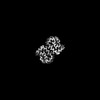
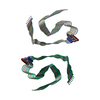
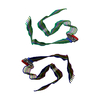
Cryo-EM structure of the class I amyloid-beta 42 fibril containing a D-Asp at position 23
Method: EM (helical sym.) / Resolution: 3.0 Å

EMDB-61303, PDB-9jb0:
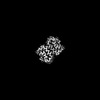
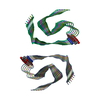
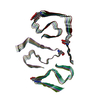
Cryo-EM structure of the class II amyloid-beta 42 fibril containing a D-Asp at position 23
Method: EM (helical sym.) / Resolution: 2.9 Å

EMDB-61304, PDB-9jb1:
Cryo-EM structure of the type I amyloid-beta 42 fibril containing a D-Asp at positions 7 and 23
Method: EM (helical sym.) / Resolution: 2.5 Å

EMDB-61305, PDB-9jb2:
Cryo-EM structure of the type II amyloid-beta 42 fibril containing a D-Asp at positions 7 and 23
Method: EM (helical sym.) / Resolution: 2.9 Å

Source
  • homo sapiens (human)
KeywordsPROTEIN FIBRIL / aggregation

+
About Yorodumi Papers

-
News

-
Feb 9, 2022. New format data for meta-information of EMDB entries

New format data for meta-information of EMDB entries

  • Version 3 of the EMDB header file is now the official format.
  • The previous official version 1.9 will be removed from the archive.

Related info.:EMDB header

External links:wwPDB to switch to version 3 of the EMDB data model

-
Aug 12, 2020. Covid-19 info

Covid-19 info

URL: https://pdbj.org/emnavi/covid19.php

New page: Covid-19 featured information page in EM Navigator.

Related info.:Covid-19 info / Mar 5, 2020. Novel coronavirus structure data

+
Mar 5, 2020. Novel coronavirus structure data

Novel coronavirus structure data

Related info.:Yorodumi Speices / Aug 12, 2020. Covid-19 info

External links:COVID-19 featured content - PDBj / Molecule of the Month (242):Coronavirus Proteases

+
Jan 31, 2019. EMDB accession codes are about to change! (news from PDBe EMDB page)

EMDB accession codes are about to change! (news from PDBe EMDB page)

  • The allocation of 4 digits for EMDB accession codes will soon come to an end. Whilst these codes will remain in use, new EMDB accession codes will include an additional digit and will expand incrementally as the available range of codes is exhausted. The current 4-digit format prefixed with “EMD-” (i.e. EMD-XXXX) will advance to a 5-digit format (i.e. EMD-XXXXX), and so on. It is currently estimated that the 4-digit codes will be depleted around Spring 2019, at which point the 5-digit format will come into force.
  • The EM Navigator/Yorodumi systems omit the EMD- prefix.

Related info.:Q: What is EMD? / ID/Accession-code notation in Yorodumi/EM Navigator

External links:EMDB Accession Codes are Changing Soon! / Contact to PDBj

+
Jul 12, 2017. Major update of PDB

Major update of PDB

  • wwPDB released updated PDB data conforming to the new PDBx/mmCIF dictionary.
  • This is a major update changing the version number from 4 to 5, and with Remediation, in which all the entries are updated.
  • In this update, many items about electron microscopy experimental information are reorganized (e.g. em_software).
  • Now, EM Navigator and Yorodumi are based on the updated data.

External links:wwPDB Remediation / Enriched Model Files Conforming to OneDep Data Standards Now Available in the PDB FTP Archive

-
Yorodumi Papers

Database of articles cited by EMDB/PDB/SASBDB data

  • Database of articles cited by EMDB, PDB, and SASBDB entries
  • Using PubMed data

Related info.:EMDB / PDB / SASBDB / Yorodumi / EMN Papers / Changes in new EM Navigator and Yorodumi

Read more