[English] 日本語
Yorodumi Papers
- Database of articles cited by EMDB/PDB/SASBDB data -

+
Search query

Keywords
Structure methods
Author
Journal
IF

-
Structure paper

TitleFilamentation activates bacterial Avs5 antiviral protein.
Journal, issue, pagesNat Commun, Vol. 16, Issue 1, Page 2408, Year 2025
Publish dateMar 11, 2025
AuthorsYiqun Wang / Yuqing Tian / Xu Yang / Feng Yu / Jianting Zheng /
PubMed AbstractBacterial antiviral STANDs (Avs) are evolutionarily related to the nucleotide-binding oligomerization domain (NOD)-like receptors widely distributed in immune systems across animals and plants. ...Bacterial antiviral STANDs (Avs) are evolutionarily related to the nucleotide-binding oligomerization domain (NOD)-like receptors widely distributed in immune systems across animals and plants. EfAvs5, a type 5 Avs from Escherichia fergusonii, contains an N-terminal SIR2 effector domain, a NOD, and a C-terminal sensor domain, conferring protection against diverse phage invasions. Despite the established roles of SIR2 and STAND in prokaryotic and eukaryotic immunity, the mechanism underlying their collaboration remains unclear. Here we present cryo-EM structures of EfAvs5 filaments, elucidating the mechanisms of dimerization, filamentation, filament bundling, ATP binding, and NAD hydrolysis, all of which are crucial for anti-phage defense. The SIR2 and NOD domains engage in intra- and inter-dimer interaction to form an individual filament, while the outward C-terminal sensor domains contribute to bundle formation. Filamentation potentially stabilizes the dimeric SIR2 configuration, thereby activating the NADase activity of EfAvs5. Furthermore, we identify the nucleotide kinase gp1.7 of phage T7 as an activator of EfAvs5, demonstrating its ability to induce filamentation and NADase activity. Together, we uncover the filament assembly of Avs5 as a unique mechanism to switch enzyme activities and perform anti-phage defenses.
External linksNat Commun / PubMed:40069208 / PubMed Central
MethodsEM (single particle) / EM (helical sym.)
Resolution3.4 - 6.14 Å
Structure data

EMDB-61299, PDB-9jap:
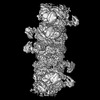
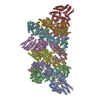
Helical structure of EfAvs5(SIR2-STAND)
Method: EM (single particle) / Resolution: 3.4 Å

EMDB-62759: Focused map of EfAvs5 adjacent filament 2
Method: EM (helical sym.) / Resolution: 4.32 Å

EMDB-62760: Focused map of EfAvs5 adjacent filament 3
Method: EM (helical sym.) / Resolution: 6.14 Å

EMDB-62762: Focused map of EfAvs5 adjacent filament 4
Method: EM (helical sym.) / Resolution: 5.86 Å

EMDB-62763: Bundled helical structure of EfAvs5(SIR2-STAND)
Method: EM (helical sym.) / Resolution: 4.3 Å

Chemicals

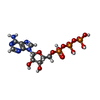
ChemComp-ATP:
ADENOSINE-5'-TRIPHOSPHATE / ATP, energy-carrying molecule*YM

ChemComp-MG:
Unknown entry

Source
  • escherichia fergusonii (bacteria)
KeywordsIMMUNE SYSTEM / anti-phage / sir2 / STAND

+
About Yorodumi Papers

-
News

-
Feb 9, 2022. New format data for meta-information of EMDB entries

New format data for meta-information of EMDB entries

  • Version 3 of the EMDB header file is now the official format.
  • The previous official version 1.9 will be removed from the archive.

Related info.:EMDB header

External links:wwPDB to switch to version 3 of the EMDB data model

-
Aug 12, 2020. Covid-19 info

Covid-19 info

URL: https://pdbj.org/emnavi/covid19.php

New page: Covid-19 featured information page in EM Navigator.

Related info.:Covid-19 info / Mar 5, 2020. Novel coronavirus structure data

+
Mar 5, 2020. Novel coronavirus structure data

Novel coronavirus structure data

Related info.:Yorodumi Speices / Aug 12, 2020. Covid-19 info

External links:COVID-19 featured content - PDBj / Molecule of the Month (242):Coronavirus Proteases

+
Jan 31, 2019. EMDB accession codes are about to change! (news from PDBe EMDB page)

EMDB accession codes are about to change! (news from PDBe EMDB page)

  • The allocation of 4 digits for EMDB accession codes will soon come to an end. Whilst these codes will remain in use, new EMDB accession codes will include an additional digit and will expand incrementally as the available range of codes is exhausted. The current 4-digit format prefixed with “EMD-” (i.e. EMD-XXXX) will advance to a 5-digit format (i.e. EMD-XXXXX), and so on. It is currently estimated that the 4-digit codes will be depleted around Spring 2019, at which point the 5-digit format will come into force.
  • The EM Navigator/Yorodumi systems omit the EMD- prefix.

Related info.:Q: What is EMD? / ID/Accession-code notation in Yorodumi/EM Navigator

External links:EMDB Accession Codes are Changing Soon! / Contact to PDBj

+
Jul 12, 2017. Major update of PDB

Major update of PDB

  • wwPDB released updated PDB data conforming to the new PDBx/mmCIF dictionary.
  • This is a major update changing the version number from 4 to 5, and with Remediation, in which all the entries are updated.
  • In this update, many items about electron microscopy experimental information are reorganized (e.g. em_software).
  • Now, EM Navigator and Yorodumi are based on the updated data.

External links:wwPDB Remediation / Enriched Model Files Conforming to OneDep Data Standards Now Available in the PDB FTP Archive

-
Yorodumi Papers

Database of articles cited by EMDB/PDB/SASBDB data

  • Database of articles cited by EMDB, PDB, and SASBDB entries
  • Using PubMed data

Related info.:EMDB / PDB / SASBDB / Yorodumi / EMN Papers / Changes in new EM Navigator and Yorodumi

Read more