 Movie
Movie Controller
 Structure viewers
 About Yorodumi Papers


+Search query
-Structure paper
| Title | Promotion of RNF168-Mediated Nucleosomal H2A Ubiquitylation by Structurally Defined K63-Polyubiquitylated Linker Histone H1. |
|---|---|
| Journal, issue, pages | Angew Chem Int Ed Engl, Vol. 64, Issue 1, Page e202413651, Year 2025 |
| Publish date | Jan 2, 2025 |
 Authors Authors | Qiang Shi / Zhiheng Deng / Liying Zhang / Zebin Tong / Jia-Bin Li / Guo-Chao Chu / Huasong Ai / Lei Liu /  |
| PubMed Abstract | The chemical synthesis of histones with homogeneous modifications is a powerful approach for quantitatively deciphering the functional crosstalk between different post-translational modifications ...The chemical synthesis of histones with homogeneous modifications is a powerful approach for quantitatively deciphering the functional crosstalk between different post-translational modifications (PTMs). In this study, we developed an expedient site-specific (poly)ubiquitylation strategy (CAEPL, Cysteine Aminoethylation coupled with Enzymatic Protein Ligation), which integrates the Cys-aminoethylation reaction with the process of ubiquitin-activating enzyme UBA1-assisted native chemical ligation. Using this strategy, we successfully prepared monoubiquitylated and K63-linked di- and tri-ubiquitylated linker histone H1.0 proteins, which were incorporated into individual chromatosomes. Quantitative biochemical analysis of different RNF168 constructs on H1 ubiquitylated chromatosomes with different ubiquitin chain lengths demonstrated that K63-linked polyubiquitylated H1.0 could directly stimulate RNF168 ubiquitylation activity by enhancing the affinity between RNF168 and the chromatosome. Subsequent cryo-EM structural analysis of the RNF168/UbcH5c-Ub/H1.0-K63-Ub chromatosome complex revealed the potential recruitment orientation between RNF168 UDM1 domain and K63-linked ubiquitin chain on H1.0. Finally, we explored the impact of H1.0 ubiquitylation on RNF168 activity in the context of asymmetric H1.0-K63-Ub di-nucleosome substrate, revealing a comparable stimulation effect of both the inter- and intra-nucleosomal crosstalk. Overall, our study highlights the significance of access to structurally defined polyubiquitylated H1.0 by the CAEPL strategy, enabling in-depth mechanistic investigations of in-trans PTM crosstalk between linker histone H1.0 and core histone H2A ubiquitylation. |
 External links External links | Angew Chem Int Ed Engl / PubMed:39363740 |
| Methods | EM (single particle) |
| Resolution | 4.3 Å |
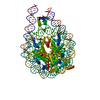
| Structure data | EMDB-60781, PDB-9ipu: |
| Chemicals |  ChemComp-ZN: |
| Source |
|
 Keywords Keywords | NUCLEAR PROTEIN / RNF168 / H1.0 / ubiquitylation / nucleosome / chromatosome |

 homo sapiens (human)