[English] 日本語
Yorodumi Papers
- Database of articles cited by EMDB/PDB/SASBDB data -

+
Search query

Keywords
Structure methods
Author
Journal
IF

-
Structure paper

TitleStructure and activation of the Drosophila insulin receptor by three Drosophila insulin-like peptides.
Journal, issue, pagesNat Commun, Vol. 16, Issue 1, Page 9504, Year 2025
Publish dateOct 28, 2025
AuthorsKai Cai / Michelle Ng / Rochele R Yamamoto / Mohammed Akhter Hossain / Catherine Hall / John D Wade / Marc Tatar / Eunhee Choi / Xiao-Chen Bai /
PubMed AbstractInsulin/IGF signaling (IIS) is a highly conserved pathway essential for physiological regulation from yeast to mammals. In Drosophila melanogaster, a single insulin-like receptor (dmIR) interacts ...Insulin/IGF signaling (IIS) is a highly conserved pathway essential for physiological regulation from yeast to mammals. In Drosophila melanogaster, a single insulin-like receptor (dmIR) interacts with various insulin-like peptides (DILPs), leading to diverse signaling and functional outcomes. However, the mechanisms by which different DILPs result in varied receptor activation and biological responses remain unclear. Here, we determine the cryo-electron microscopy (cryo-EM) structures of dmIR in complex with three DILPs: DILP1, DILP2, and DILP5. Our structural analyses reveal that each DILP induces distinct conformations of dmIR: the dmIR/DILP5 complex adopts the Ƭ-shaped asymmetric conformation with three bound DILP5 molecules; the dmIR/DILP2 complex displays the Γ-shaped asymmetric conformation with a single bound DILP2 molecule; and the dmIR/DILP1 complex shows both a Γ-shaped asymmetric conformation and a symmetric conformation that resembles a T-shape with a splayed stem. Functional assays demonstrate that the efficacy of DILP-mediated dmIR activation differs, with DILP5 inducing higher levels of receptor autophosphorylation, followed by DILP2 and DILP1. Together, these findings suggest that the distinct interactions between dmIR and DILPs dictate specific patterns of receptor activation.
External linksNat Commun / PubMed:41152236 / PubMed Central
MethodsEM (single particle)
Resolution3.6 - 4.4 Å
Structure data

EMDB-47967, PDB-9ef1:
Cryo-EM structure of Drosophila melanogaster insulin receptor (dmIR) bound with one DILP1, asymmetric conformation
Method: EM (single particle) / Resolution: 4.4 Å

EMDB-47969, PDB-9ef4:
Cryo-EM structure of Drosophila melanogaster insulin receptor (dmIR) bound with two DILP1, symmetric conformation
Method: EM (single particle) / Resolution: 3.9 Å

EMDB-47970, PDB-9ef5:
Cryo-EM structure of Drosophila melanogaster insulin receptor (dmIR) bound with one DILP2, asymmetric conformation
Method: EM (single particle) / Resolution: 3.7 Å

EMDB-47971, PDB-9ef9:
Cryo-EM structure of Drosophila melanogaster insulin receptor (dmIR) bound with three DILP5, asymmetric conformation
Method: EM (single particle) / Resolution: 3.6 Å

Chemicals

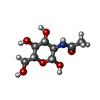
ChemComp-NAG:
2-acetamido-2-deoxy-beta-D-glucopyranose

Source
  • drosophila melanogaster (fruit fly)
KeywordsSTRUCTURAL PROTEIN / Insulin receptor / DILP

+
About Yorodumi Papers

-
News

-
Feb 9, 2022. New format data for meta-information of EMDB entries

New format data for meta-information of EMDB entries

  • Version 3 of the EMDB header file is now the official format.
  • The previous official version 1.9 will be removed from the archive.

Related info.:EMDB header

External links:wwPDB to switch to version 3 of the EMDB data model

-
Aug 12, 2020. Covid-19 info

Covid-19 info

URL: https://pdbj.org/emnavi/covid19.php

New page: Covid-19 featured information page in EM Navigator.

Related info.:Covid-19 info / Mar 5, 2020. Novel coronavirus structure data

+
Mar 5, 2020. Novel coronavirus structure data

Novel coronavirus structure data

Related info.:Yorodumi Speices / Aug 12, 2020. Covid-19 info

External links:COVID-19 featured content - PDBj / Molecule of the Month (242):Coronavirus Proteases

+
Jan 31, 2019. EMDB accession codes are about to change! (news from PDBe EMDB page)

EMDB accession codes are about to change! (news from PDBe EMDB page)

  • The allocation of 4 digits for EMDB accession codes will soon come to an end. Whilst these codes will remain in use, new EMDB accession codes will include an additional digit and will expand incrementally as the available range of codes is exhausted. The current 4-digit format prefixed with “EMD-” (i.e. EMD-XXXX) will advance to a 5-digit format (i.e. EMD-XXXXX), and so on. It is currently estimated that the 4-digit codes will be depleted around Spring 2019, at which point the 5-digit format will come into force.
  • The EM Navigator/Yorodumi systems omit the EMD- prefix.

Related info.:Q: What is EMD? / ID/Accession-code notation in Yorodumi/EM Navigator

External links:EMDB Accession Codes are Changing Soon! / Contact to PDBj

+
Jul 12, 2017. Major update of PDB

Major update of PDB

  • wwPDB released updated PDB data conforming to the new PDBx/mmCIF dictionary.
  • This is a major update changing the version number from 4 to 5, and with Remediation, in which all the entries are updated.
  • In this update, many items about electron microscopy experimental information are reorganized (e.g. em_software).
  • Now, EM Navigator and Yorodumi are based on the updated data.

External links:wwPDB Remediation / Enriched Model Files Conforming to OneDep Data Standards Now Available in the PDB FTP Archive

-
Yorodumi Papers

Database of articles cited by EMDB/PDB/SASBDB data

  • Database of articles cited by EMDB, PDB, and SASBDB entries
  • Using PubMed data

Related info.:EMDB / PDB / SASBDB / Yorodumi / EMN Papers / Changes in new EM Navigator and Yorodumi

Read more