[English] 日本語
Yorodumi Papers
- Database of articles cited by EMDB/PDB/SASBDB data -

+
Search query

Keywords
Structure methods
Author
Journal
IF

-
Structure paper

TitleAI-based discovery and cryoEM structural elucidation of a K channel pharmacochaperone.
Journal, issue, pagesElife, Vol. 13, Year 2025
Publish dateMar 26, 2025
AuthorsAssmaa Elsheikh / Camden M Driggers / Ha H Truong / Zhongying Yang / John Allen / Niel M Henriksen / Katarzyna Walczewska-Szewc / Show-Ling Shyng /
PubMed AbstractPancreatic K channel trafficking defects underlie congenital hyperinsulinism (CHI) cases unresponsive to the K channel opener diazoxide, the mainstay medical therapy for CHI. Current clinically used ...Pancreatic K channel trafficking defects underlie congenital hyperinsulinism (CHI) cases unresponsive to the K channel opener diazoxide, the mainstay medical therapy for CHI. Current clinically used K channel inhibitors have been shown to act as pharmacochaperones and restore surface expression of trafficking mutants; however, their therapeutic utility for K trafficking-impaired CHI is hindered by high affinity binding, which limits functional recovery of rescued channels. Recent structural studies of K channels employing cryo-electron microscopy (cryoEM) have revealed a promiscuous pocket where several known K pharmacochaperones bind. The structural knowledge provides a framework for discovering K channel pharmacochaperones with desired reversible inhibitory effects to permit functional recovery of rescued channels. Using an AI-based virtual screening technology AtomNet followed by functional validation, we identified a novel compound, termed Aekatperone, which exhibits chaperoning effects on K channel trafficking mutations. Aekatperone reversibly inhibits K channel activity with a half-maximal inhibitory concentration (IC) ~9 μM. Mutant channels rescued to the cell surface by Aekatperone showed functional recovery upon washout of the compound. CryoEM structure of K bound to Aekatperone revealed distinct binding features compared to known high affinity inhibitor pharmacochaperones. Our findings unveil a K pharmacochaperone enabling functional recovery of rescued channels as a promising therapeutic for CHI caused by K trafficking defects.
External linksElife / PubMed:40135739 / PubMed Central
MethodsEM (single particle)
Resolution4.1 Å
Structure data

EMDB-46820, PDB-9dfx:
Cryo-EM structure of a SUR1/Kir6.2 ATP-sensitive potassium channel in the presence of Aekatperone in the closed conformation
Method: EM (single particle) / Resolution: 4.1 Å

Chemicals

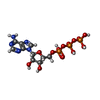
ChemComp-ATP:
ADENOSINE-5'-TRIPHOSPHATE / ATP, energy-carrying molecule*YM

ChemComp-K:
Unknown entry

PDB-1a4f:
BAR-HEADED GOOSE HEMOGLOBIN (OXY FORM)

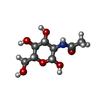
ChemComp-NAG:
2-acetamido-2-deoxy-beta-D-glucopyranose

Source
  • rattus norvegicus (Norway rat)
  • mesocricetus auratus (golden hamster)
KeywordsTRANSPORT PROTEIN / ATP-sensitive potassium channel / KATP channel / SUR1 / Kir6.2 / potassium transport / metabolic sensor / congenital hyperinsulinism / trafficking / pharmacochaperone

+
About Yorodumi Papers

-
News

-
Feb 9, 2022. New format data for meta-information of EMDB entries

New format data for meta-information of EMDB entries

  • Version 3 of the EMDB header file is now the official format.
  • The previous official version 1.9 will be removed from the archive.

Related info.:EMDB header

External links:wwPDB to switch to version 3 of the EMDB data model

-
Aug 12, 2020. Covid-19 info

Covid-19 info

URL: https://pdbj.org/emnavi/covid19.php

New page: Covid-19 featured information page in EM Navigator.

Related info.:Covid-19 info / Mar 5, 2020. Novel coronavirus structure data

+
Mar 5, 2020. Novel coronavirus structure data

Novel coronavirus structure data

Related info.:Yorodumi Speices / Aug 12, 2020. Covid-19 info

External links:COVID-19 featured content - PDBj / Molecule of the Month (242):Coronavirus Proteases

+
Jan 31, 2019. EMDB accession codes are about to change! (news from PDBe EMDB page)

EMDB accession codes are about to change! (news from PDBe EMDB page)

  • The allocation of 4 digits for EMDB accession codes will soon come to an end. Whilst these codes will remain in use, new EMDB accession codes will include an additional digit and will expand incrementally as the available range of codes is exhausted. The current 4-digit format prefixed with “EMD-” (i.e. EMD-XXXX) will advance to a 5-digit format (i.e. EMD-XXXXX), and so on. It is currently estimated that the 4-digit codes will be depleted around Spring 2019, at which point the 5-digit format will come into force.
  • The EM Navigator/Yorodumi systems omit the EMD- prefix.

Related info.:Q: What is EMD? / ID/Accession-code notation in Yorodumi/EM Navigator

External links:EMDB Accession Codes are Changing Soon! / Contact to PDBj

+
Jul 12, 2017. Major update of PDB

Major update of PDB

  • wwPDB released updated PDB data conforming to the new PDBx/mmCIF dictionary.
  • This is a major update changing the version number from 4 to 5, and with Remediation, in which all the entries are updated.
  • In this update, many items about electron microscopy experimental information are reorganized (e.g. em_software).
  • Now, EM Navigator and Yorodumi are based on the updated data.

External links:wwPDB Remediation / Enriched Model Files Conforming to OneDep Data Standards Now Available in the PDB FTP Archive

-
Yorodumi Papers

Database of articles cited by EMDB/PDB/SASBDB data

  • Database of articles cited by EMDB, PDB, and SASBDB entries
  • Using PubMed data

Related info.:EMDB / PDB / SASBDB / Yorodumi / EMN Papers / Changes in new EM Navigator and Yorodumi

Read more