[English] 日本語
Yorodumi Papers
- Database of articles cited by EMDB/PDB/SASBDB data -

+
Search query

Keywords
Structure methods
Author
Journal
IF

-
Structure paper

TitleLigand regulation and function of preformed EGFR dimers.
Journal, issue, pagesProc Natl Acad Sci U S A, Vol. 123, Issue 30, Page e2602436123, Year 2026
Publish dateJul 28, 2026
AuthorsYuhong Zuo / Hillel T Schwartz / Kahlil Walker / Long Han / Paul W Sternberg / Kathryn M Ferguson /
PubMed AbstractReceptor tyrosine kinases (RTKs) are key therapeutic targets in cancer, diabetes, and other diseases. With only one transmembrane α-helix-compared with seven in G-protein-coupled receptors-RTKs are ...Receptor tyrosine kinases (RTKs) are key therapeutic targets in cancer, diabetes, and other diseases. With only one transmembrane α-helix-compared with seven in G-protein-coupled receptors-RTKs are thought to be activated by ligand-induced dimerization. Complicating this view, however, one of the best-studied RTKs, the insulin receptor (IR), forms allosterically regulated covalent dimers. Moreover, noncovalent "preformed" dimers have frequently been reported for the sequence-related epidermal growth factor receptor (EGFR), one of the first RTKs for which ligand-induced dimerization was described. Here, we describe a detailed structural view of a preformed EGFR dimer. Using cryo-EM, we describe how the EGFR (LET-23) dimerizes without ligand. We show that preformed dimer formation modulates ligand sensitivity in vivo, but is not required for signaling itself. We also elucidate substantial ligand-induced conformational changes in LET-23 required for signaling. Our structures reveal unexpected similarities between regulation of LET-23 and the IR, suggesting that LET-23 may represent an evolutionary "missing link" between the IR and EGFR families. In the absence of ligand, intermolecular interactions within preformed receptor dimers hold the extracellular juxtamembrane regions far apart to separate the intracellular kinase domains so that they remain inactive. Ligand binding disrupts these interactions to remove the restraints on the kinase domains, which then can associate to become activated. Our analysis further suggests a unified model for the allosteric activation of preformed RTK dimers that has important implications for understanding cell-surface EGFR.
External linksProc Natl Acad Sci U S A / PubMed:42475585 / PubMed Central
MethodsEM (single particle)
Resolution2.37 - 4.0 Å
Structure data

EMDB-73275, PDB-9yor:
Cryo-EM structure of a preformed dimer of the C. elegans EGFR (LET-23) extracellular region
Method: EM (single particle) / Resolution: 2.9 Å

EMDB-73276, PDB-9yos:
Cryo-EM structure of an active dimer of the C. elegans EGFR (LET-23) extracellular region bound to LIN-3
Method: EM (single particle) / Resolution: 2.37 Å

EMDB-73277, PDB-9yot:
Cryo-EM structure of an inactive dimer of the C. elegans EGFR (LET-23) extracellular region bound to LIN-3.
Method: EM (single particle) / Resolution: 2.81 Å

EMDB-73278, PDB-9you:
Cryo-EM structure of a weak dimer of the C. elegans EGFR (LET-23) extracellular region with a domain IV loop deletion
Method: EM (single particle) / Resolution: 4.0 Å

EMDB-73279, PDB-9yov:
Cryo-EM structure of an active dimer of the C. elegans EGFR (LET-23) extracellular region with a domain IV loop deletion bound to LIN-3.
Method: EM (single particle) / Resolution: 3.36 Å

Chemicals

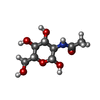
ChemComp-NAG:
2-acetamido-2-deoxy-beta-D-glucopyranose

Source
  • caenorhabditis elegans (invertebrata)
  • drosophila melanogaster (fruit fly)
KeywordsSIGNALING PROTEIN / Receptor Tyrosine Kinase / epidermal growth factor receptor / preformed dimer / LET-23 / ligand-bound dimer

+
About Yorodumi Papers

-
News

-
Feb 9, 2022. New format data for meta-information of EMDB entries

New format data for meta-information of EMDB entries

  • Version 3 of the EMDB header file is now the official format.
  • The previous official version 1.9 will be removed from the archive.

Related info.:EMDB header

External links:wwPDB to switch to version 3 of the EMDB data model

-
Aug 12, 2020. Covid-19 info

Covid-19 info

URL: https://pdbj.org/emnavi/covid19.php

New page: Covid-19 featured information page in EM Navigator.

Related info.:Covid-19 info / Mar 5, 2020. Novel coronavirus structure data

+
Mar 5, 2020. Novel coronavirus structure data

Novel coronavirus structure data

Related info.:Yorodumi Speices / Aug 12, 2020. Covid-19 info

External links:COVID-19 featured content - PDBj / Molecule of the Month (242):Coronavirus Proteases

+
Jan 31, 2019. EMDB accession codes are about to change! (news from PDBe EMDB page)

EMDB accession codes are about to change! (news from PDBe EMDB page)

  • The allocation of 4 digits for EMDB accession codes will soon come to an end. Whilst these codes will remain in use, new EMDB accession codes will include an additional digit and will expand incrementally as the available range of codes is exhausted. The current 4-digit format prefixed with “EMD-” (i.e. EMD-XXXX) will advance to a 5-digit format (i.e. EMD-XXXXX), and so on. It is currently estimated that the 4-digit codes will be depleted around Spring 2019, at which point the 5-digit format will come into force.
  • The EM Navigator/Yorodumi systems omit the EMD- prefix.

Related info.:Q: What is EMD? / ID/Accession-code notation in Yorodumi/EM Navigator

External links:EMDB Accession Codes are Changing Soon! / Contact to PDBj

+
Jul 12, 2017. Major update of PDB

Major update of PDB

  • wwPDB released updated PDB data conforming to the new PDBx/mmCIF dictionary.
  • This is a major update changing the version number from 4 to 5, and with Remediation, in which all the entries are updated.
  • In this update, many items about electron microscopy experimental information are reorganized (e.g. em_software).
  • Now, EM Navigator and Yorodumi are based on the updated data.

External links:wwPDB Remediation / Enriched Model Files Conforming to OneDep Data Standards Now Available in the PDB FTP Archive

-
Yorodumi Papers

Database of articles cited by EMDB/PDB/SASBDB data

  • Database of articles cited by EMDB, PDB, and SASBDB entries
  • Using PubMed data

Related info.:EMDB / PDB / SASBDB / Yorodumi / EMN Papers / Changes in new EM Navigator and Yorodumi

Read more