 Movie
Movie Controller

[English] 日本語
 Yorodumi
- PDB-9yos: Cryo-EM structure of an active dimer of the C. elegans EGFR (LET-... -
+ Open data

- Basic information
| Entry | Database: PDB / ID: 9yos | ||||||||||||||||||||||||
|---|---|---|---|---|---|---|---|---|---|---|---|---|---|---|---|---|---|---|---|---|---|---|---|---|---|
| Title | Cryo-EM structure of an active dimer of the C. elegans EGFR (LET-23) extracellular region bound to LIN-3 | ||||||||||||||||||||||||
 Components Components |
| ||||||||||||||||||||||||
 Keywords Keywords | SIGNALING PROTEIN / Receptor Tyrosine Kinase / epidermal growth factor receptor / ligand-bound dimer | ||||||||||||||||||||||||
| Function / homology |  Function and homology information Function and homology informationinductive cell-cell signaling / ectodermal cell fate determination / stomatogastric nervous system development / stem cell fate commitment / photoreceptor cell fate determination / photoreceptor cell differentiation / vulval cell fate specification / SHC1 events in ERBB2 signaling / Nuclear signaling by ERBB4 / Signaling by EGFR ...inductive cell-cell signaling / ectodermal cell fate determination / stomatogastric nervous system development / stem cell fate commitment / photoreceptor cell fate determination / photoreceptor cell differentiation / vulval cell fate specification / SHC1 events in ERBB2 signaling / Nuclear signaling by ERBB4 / Signaling by EGFR / GAB1 signalosome / EGFR interacts with phospholipase C-gamma / Sema4D induced cell migration and growth-cone collapse / ERBB2 Regulates Cell Motility / ERBB2 Activates PTK6 Signaling / epithelial cell proliferation involved in Malpighian tubule morphogenesis / Signaling by ERBB2 / Extra-nuclear estrogen signaling / Drug-mediated inhibition of ERBB2 signaling / determination of genital disc primordium / Signal transduction by L1 / positive regulation of vulval development / Downregulation of ERBB4 signaling / PIP3 activates AKT signaling / GRB2 events in EGFR signaling / SHC1 events in EGFR signaling / PI3K events in ERBB2 signaling / EGFR Transactivation by Gastrin / PI5P, PP2A and IER3 Regulate PI3K/AKT Signaling / Downregulation of ERBB2 signaling / ommatidial rotation / oenocyte development / RAF/MAP kinase cascade / EGFR downregulation / Cargo recognition for clathrin-mediated endocytosis / Clathrin-mediated endocytosis / vulval development / dorsal closure / spiracle morphogenesis, open tracheal system / positive regulation of ovulation / nematode larval development / ovulation / egg-laying behavior / border follicle cell migration / positive regulation of border follicle cell migration / uterus development / imaginal disc-derived wing morphogenesis / male genitalia development / peripheral nervous system development / regulation of cell fate specification / sleep / heart process / olfactory learning / behavioral response to ethanol / post-embryonic development / positive regulation of neurogenesis / epidermal growth factor receptor activity / epidermal growth factor receptor binding / lateral plasma membrane / transmembrane receptor protein tyrosine kinase activity / positive regulation of epithelial cell proliferation / basal plasma membrane / molecular function activator activity / growth factor activity / receptor protein-tyrosine kinase / epidermal growth factor receptor signaling pathway / cell-cell junction / positive regulation of proteasomal ubiquitin-dependent protein catabolic process / neuron differentiation / basolateral plasma membrane / positive regulation of MAPK cascade / positive regulation of ERK1 and ERK2 cascade / cell surface receptor signaling pathway / signaling receptor complex / apical plasma membrane / receptor ligand activity / negative regulation of gene expression / Golgi membrane / lipid binding / positive regulation of cell population proliferation / negative regulation of apoptotic process / regulation of DNA-templated transcription / endoplasmic reticulum membrane / endoplasmic reticulum / : / ATP binding / membrane / plasma membrane Similarity search - Function | ||||||||||||||||||||||||
| Biological species |   Caenorhabditis elegans (invertebrata) Caenorhabditis elegans (invertebrata)  Drosophila melanogaster (fruit fly) Drosophila melanogaster (fruit fly) | ||||||||||||||||||||||||
| Method | ELECTRON MICROSCOPY / single particle reconstruction / cryo EM / Resolution: 2.37 Å | ||||||||||||||||||||||||
 Authors Authors | Zuo, Y. / Han, L. / Ferguson, K.M. | ||||||||||||||||||||||||
| Funding support |  United States, 1items United States, 1items
| ||||||||||||||||||||||||
 Citation Citation | Journal: Proc Natl Acad Sci U S A / Year: 2026 Title: Ligand regulation and function of preformed EGFR dimers. Authors: Yuhong Zuo / Hillel T Schwartz / Kahlil Walker / Long Han / Paul W Sternberg / Kathryn M Ferguson / Abstract: Receptor tyrosine kinases (RTKs) are key therapeutic targets in cancer, diabetes, and other diseases. With only one transmembrane α-helix-compared with seven in G-protein-coupled receptors-RTKs are ...Receptor tyrosine kinases (RTKs) are key therapeutic targets in cancer, diabetes, and other diseases. With only one transmembrane α-helix-compared with seven in G-protein-coupled receptors-RTKs are thought to be activated by ligand-induced dimerization. Complicating this view, however, one of the best-studied RTKs, the insulin receptor (IR), forms allosterically regulated covalent dimers. Moreover, noncovalent "preformed" dimers have frequently been reported for the sequence-related epidermal growth factor receptor (EGFR), one of the first RTKs for which ligand-induced dimerization was described. Here, we describe a detailed structural view of a preformed EGFR dimer. Using cryo-EM, we describe how the EGFR (LET-23) dimerizes without ligand. We show that preformed dimer formation modulates ligand sensitivity in vivo, but is not required for signaling itself. We also elucidate substantial ligand-induced conformational changes in LET-23 required for signaling. Our structures reveal unexpected similarities between regulation of LET-23 and the IR, suggesting that LET-23 may represent an evolutionary "missing link" between the IR and EGFR families. In the absence of ligand, intermolecular interactions within preformed receptor dimers hold the extracellular juxtamembrane regions far apart to separate the intracellular kinase domains so that they remain inactive. Ligand binding disrupts these interactions to remove the restraints on the kinase domains, which then can associate to become activated. Our analysis further suggests a unified model for the allosteric activation of preformed RTK dimers that has important implications for understanding cell-surface EGFR. | ||||||||||||||||||||||||
| History |
|
- Structure visualization
| Structure viewer | Molecule: MolmilJmol/JSmol |
|---|
- Downloads & links
-Download
| PDBx/mmCIF format | 9yos.cif.gz | 424 KB | Display | PDBx/mmCIF format |
|---|---|---|---|---|
| PDB format | pdb9yos.ent.gz | 275.1 KB | Display | PDB format |
| PDBx/mmJSON format | 9yos.json.gz | Tree view | PDBx/mmJSON format | |
| Others |  Other downloads Other downloads |
-Validation report
| Arichive directory | https://data.pdbj.org/pub/pdb/validation_reports/yo/9yosftp://data.pdbj.org/pub/pdb/validation_reports/yo/9yos | HTTPS FTP |
|---|
-Related structure data
| Related structure data |  73276MC  9yorC  9yotC  9youC  9yovC M: map data used to model this data C: citing same article ( |
|---|---|
| Similar structure data |


-Links
 PDBj
PDBj
- Assembly
| Deposited unit | 
|
|---|---|
| 1 |
|
-Components
| #1: Protein | Mass: 91067.219 Da / Num. of mol.: 2 Source method: isolated from a genetically manipulated source Details: Extracellular region (aa 27-819) of C. elegans EGFR, LET-23, with a C-terminal 6x-His tag Source: (gene. exp.) Caenorhabditis elegans (invertebrata) / Gene: let-23, kin-7, ZK1067.1 / Plasmid: pFastBac / Cell line (production host): Sf9 / Production host:  Spodoptera frugiperda (fall armyworm) Spodoptera frugiperda (fall armyworm)References: UniProt: P24348, receptor protein-tyrosine kinase #2: Protein | Mass: 11781.285 Da / Num. of mol.: 2 Source method: isolated from a genetically manipulated source Details: The EGF domain of LIN-3 (aa K148-N206) follows an N-terminal fusion comprising (i) an Arg, (ii) 6xHis tag (iii) aa 44-79 of Drosophila melanogaster SPITZ (Q01083) and (iv) a Factor Xa ...Details: The EGF domain of LIN-3 (aa K148-N206) follows an N-terminal fusion comprising (i) an Arg, (ii) 6xHis tag (iii) aa 44-79 of Drosophila melanogaster SPITZ (Q01083) and (iv) a Factor Xa cleavage site (IEDGR). See PMID 26060020.,The EGF domain of LIN-3 (aa K148-N206) follows an N-terminal fusion comprising (i) an Arg, (ii) 6xHis tag (iii) aa 44-79 of Drosophila melanogaster SPITZ (Q01083) and (iv) a Factor Xa cleavage site (IEDGR). See PMID 26060020. Source: (gene. exp.) Drosophila melanogaster (fruit fly), (gene. exp.) Caenorhabditis elegans (invertebrata)Gene: spi, CG10334, lin-3, let-94, F36H1.4 / Plasmid: PMT / Cell line (production host): SCHNEIDER 2(S2) CELLS / Production host: Drosophila melanogaster (fruit fly) / References: UniProt: Q01083, UniProt: Q03345#3: Polysaccharide | Source method: isolated from a genetically manipulated source #4: Polysaccharide | 2-acetamido-2-deoxy-beta-D-glucopyranose-(1-4)-2-acetamido-2-deoxy-beta-D-glucopyranose Source method: isolated from a genetically manipulated source #5: Sugar | ChemComp-NAG / 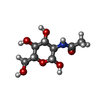 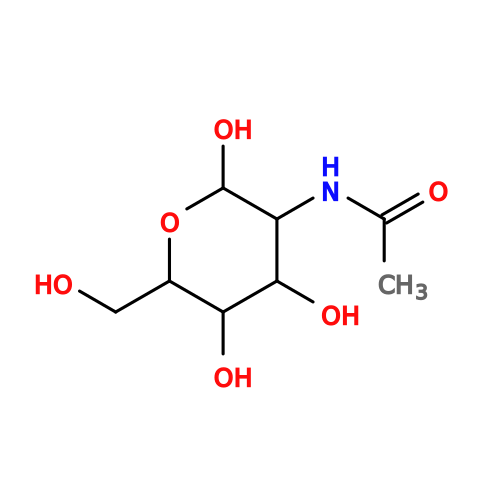 Type: D-saccharide, beta linking / Mass: 221.208 Da / Num. of mol.: 4 / Source method: obtained synthetically / Formula: C8H15NO6 Type: D-saccharide, beta linking / Mass: 221.208 Da / Num. of mol.: 4 / Source method: obtained synthetically / Formula: C8H15NO6Has ligand of interest | N | Has protein modification | Y | |
|---|
-Experimental details
-Experiment
| Experiment | Method: ELECTRON MICROSCOPY |
|---|---|
| EM experiment | Aggregation state: PARTICLE / 3D reconstruction method: single particle reconstruction |
- Sample preparation
| Component | Name: Active dimer of the C. elegans EGFR (LET-23) extracellular region bound to LIN-3 Type: COMPLEX Details: Extracellular region (aa 27-819) of C. elegans EGFR, LET-23, with a C-terminal 6x-His tag bound to the EGF domain of LIN-3 (aa K148-N206), with an N-terminal fusion comprising (i) an Arg, ...Details: Extracellular region (aa 27-819) of C. elegans EGFR, LET-23, with a C-terminal 6x-His tag bound to the EGF domain of LIN-3 (aa K148-N206), with an N-terminal fusion comprising (i) an Arg, (ii) 6xHis tag (iii) aa 44-79 of Drosophila melanogaster SPITZ (Q01083) and (iv) a Factor Xa cleavage site (IEDGR). Entity ID: #1-#2 / Source: RECOMBINANT |
|---|---|
| Molecular weight | Experimental value: NO |
| Source (natural) | Organism: Caenorhabditis elegans (invertebrata) |
| Source (recombinant) | Organism: Spodoptera frugiperda (fall armyworm) / Strain: Sf9 / Plasmid: pFastBac |
| Buffer solution | pH: 7.4 |
| Specimen | Conc.: 5 mg/ml / Embedding applied: NO / Shadowing applied: NO / Staining applied: NO / Vitrification applied: YES |
| Vitrification | Cryogen name: ETHANE / Humidity: 100 % / Chamber temperature: 289 K |
- Electron microscopy imaging
| Experimental equipment |  Model: Titan Krios / Image courtesy: FEI Company |
|---|---|
| Microscopy | Model: TFS KRIOS |
| Electron gun | Electron source:  FIELD EMISSION GUN / Accelerating voltage: 300 kV / Illumination mode: FLOOD BEAM FIELD EMISSION GUN / Accelerating voltage: 300 kV / Illumination mode: FLOOD BEAM |
| Electron lens | Mode: BRIGHT FIELD / Nominal defocus max: 2000 nm / Nominal defocus min: 800 nm |
| Image recording | Electron dose: 50 e/Å2 / Film or detector model: GATAN K3 BIOQUANTUM (6k x 4k) |
- Processing
| EM software |
| ||||||||||||||||||||||||
|---|---|---|---|---|---|---|---|---|---|---|---|---|---|---|---|---|---|---|---|---|---|---|---|---|---|
| CTF correction | Type: PHASE FLIPPING AND AMPLITUDE CORRECTION | ||||||||||||||||||||||||
| 3D reconstruction | Resolution: 2.37 Å / Resolution method: FSC 0.143 CUT-OFF / Num. of particles: 285565 / Symmetry type: POINT | ||||||||||||||||||||||||
| Refinement | Cross valid method: NONE Stereochemistry target values: GeoStd + Monomer Library + CDL v1.2 | ||||||||||||||||||||||||
| Displacement parameters | Biso mean: 136.39 Å2 | ||||||||||||||||||||||||
| Refine LS restraints |
|
