[English] 日本語
Yorodumi Papers
- Database of articles cited by EMDB/PDB/SASBDB data -

+
Search query

Keywords
Structure methods
Author
Journal
IF

-
Structure paper

TitleCryo-EM structures of UBA6 reveal mechanisms of E1-E2 specificity and dual FAT10/ubiquitin thioester transfer.
Journal, issue, pagesNat Commun, Vol. 17, Issue 1, Year 2026
Publish dateFeb 28, 2026
AuthorsDigant Nayak / Lijia Jia / Priscila Dos Santos Bury / Eliza A Ruben / Ankita Shukla / Anindita Nayak / Caleb M Stratton / Pirouz Ebadi / Hee Cho / Anna A Tumanova / Joyce T Varughese / Lingmin Yuan / Fei Gao / Kristin E Cano / Christopher Davies / Patrick Sung / Michaela U Gack / Elizabeth V Wasmuth / Shaun K Olsen /
PubMed AbstractUBA1 and UBA6 define parallel ubiquitin (Ub) activation systems that perform non-overlapping roles in Ub and ubiquitin-like protein (Ubl) signaling. Whereas UBA1 supports the canonical Ub pathway, ...UBA1 and UBA6 define parallel ubiquitin (Ub) activation systems that perform non-overlapping roles in Ub and ubiquitin-like protein (Ubl) signaling. Whereas UBA1 supports the canonical Ub pathway, UBA6 also activates the Ubl FAT10, linking Ub signaling to immune-regulated proteostasis. In addition to selective Ub/Ubl activation, UBA1 and UBA6 engage distinct sets of E2s, yet how these enzymes achieve selective E2 engagement has remained unclear. Using chemical trapping and high-resolution cryo-EM, we determine four structures of UBA6-E2 complexes representing the thioester-transfer step with either FAT10 or Ub, revealing how this E1 distinguishes its cognate partners. UBA6 achieves E2 specificity through coordinated contributions of the UFD and SCCH domains, a dual-domain mechanism that contrasts with the UFD-dominated selectivity of UBA1. The structures further show that an existing inositol hexakisphosphate (InsP₆)-binding site, unique to UBA6, stabilizes an expanded SCCH cleft that pre-organizes the enzyme for selective engagement of UBA6-specific E2s. These findings define principles for E1-E2 recognition and identify InsP₆ as a cofactor shaping specificity within the Ub-like conjugation network.
External linksNat Commun / PubMed:41764162 / PubMed Central
MethodsEM (single particle)
Resolution2.73 - 3.86 Å
Structure data

EMDB-73059, PDB-9ykv:
Cryo-EM structure of double-loaded human UBA6-UBE2Z-FAT10(t)/FAT10(a) thioester mimetic complex.
Method: EM (single particle) / Resolution: 2.73 Å

EMDB-73060, PDB-9ykw:
Cryo-EM structure of double-loaded human UBA6-UBE2Z-Ub(t)/Ub(a) thioester mimetic complex.
Method: EM (single particle) / Resolution: 3.86 Å

EMDB-73079, PDB-9ylb:
Cryo-EM structure of single-loaded human UBA6-UBE2Z/FAT10(a) adenylate complex.
Method: EM (single particle) / Resolution: 3.24 Å

EMDB-73081, PDB-9ylf:
Cryo-EM structure of single-loaded human UBA6-UBE2Z/Ub(a) adenylate complex.
Method: EM (single particle) / Resolution: 3.14 Å

Chemicals

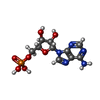
ChemComp-AMP:
ADENOSINE MONOPHOSPHATE / AMP*YM

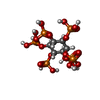
ChemComp-IHP:
INOSITOL HEXAKISPHOSPHATE

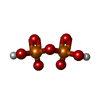
ChemComp-POP:
PYROPHOSPHATE 2-

Source
  • homo sapiens (human)
KeywordsTRANSFERASE/Ligase / E1 E2 enzymes / TRANSFERASE / TRANSFERASE-Ligase complex

+
About Yorodumi Papers

-
News

-
Feb 9, 2022. New format data for meta-information of EMDB entries

New format data for meta-information of EMDB entries

  • Version 3 of the EMDB header file is now the official format.
  • The previous official version 1.9 will be removed from the archive.

Related info.:EMDB header

External links:wwPDB to switch to version 3 of the EMDB data model

-
Aug 12, 2020. Covid-19 info

Covid-19 info

URL: https://pdbj.org/emnavi/covid19.php

New page: Covid-19 featured information page in EM Navigator.

Related info.:Covid-19 info / Mar 5, 2020. Novel coronavirus structure data

+
Mar 5, 2020. Novel coronavirus structure data

Novel coronavirus structure data

Related info.:Yorodumi Speices / Aug 12, 2020. Covid-19 info

External links:COVID-19 featured content - PDBj / Molecule of the Month (242):Coronavirus Proteases

+
Jan 31, 2019. EMDB accession codes are about to change! (news from PDBe EMDB page)

EMDB accession codes are about to change! (news from PDBe EMDB page)

  • The allocation of 4 digits for EMDB accession codes will soon come to an end. Whilst these codes will remain in use, new EMDB accession codes will include an additional digit and will expand incrementally as the available range of codes is exhausted. The current 4-digit format prefixed with “EMD-” (i.e. EMD-XXXX) will advance to a 5-digit format (i.e. EMD-XXXXX), and so on. It is currently estimated that the 4-digit codes will be depleted around Spring 2019, at which point the 5-digit format will come into force.
  • The EM Navigator/Yorodumi systems omit the EMD- prefix.

Related info.:Q: What is EMD? / ID/Accession-code notation in Yorodumi/EM Navigator

External links:EMDB Accession Codes are Changing Soon! / Contact to PDBj

+
Jul 12, 2017. Major update of PDB

Major update of PDB

  • wwPDB released updated PDB data conforming to the new PDBx/mmCIF dictionary.
  • This is a major update changing the version number from 4 to 5, and with Remediation, in which all the entries are updated.
  • In this update, many items about electron microscopy experimental information are reorganized (e.g. em_software).
  • Now, EM Navigator and Yorodumi are based on the updated data.

External links:wwPDB Remediation / Enriched Model Files Conforming to OneDep Data Standards Now Available in the PDB FTP Archive

-
Yorodumi Papers

Database of articles cited by EMDB/PDB/SASBDB data

  • Database of articles cited by EMDB, PDB, and SASBDB entries
  • Using PubMed data

Related info.:EMDB / PDB / SASBDB / Yorodumi / EMN Papers / Changes in new EM Navigator and Yorodumi

Read more