[English] 日本語
Yorodumi
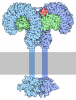
- EMDB-73060: Cryo-EM structure of double-loaded human UBA6-UBE2Z-Ub(t)/Ub(a) t... -

+
Open data


ID or keywords:

Loading...

-
Basic information

Entry
Database: EMDB / ID: EMD-73060
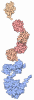
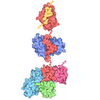
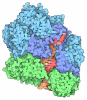
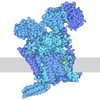
TitleCryo-EM structure of double-loaded human UBA6-UBE2Z-Ub(t)/Ub(a) thioester mimetic complex.
Map datastructure of double-loaded human UBA6-UBE2Z-Ub(t)/Ub(a) thioester mimetic complex.
Sample
  • Complex: Complex
    • Protein or peptide: Ubiquitin-like modifier-activating enzyme 6
    • Protein or peptide: Ubiquitin
    • Protein or peptide: Ubiquitin-conjugating enzyme E2 Z
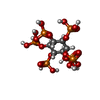
  • Ligand: INOSITOL HEXAKISPHOSPHATE
KeywordsE1 E2 enzymes / TRANSFERASE / TRANSFERASE-Ligase complex
Function / homology
Function and homology information


FAT10 activating enzyme activity / E1 ubiquitin-activating enzyme / ubiquitin activating enzyme activity / E2 ubiquitin-conjugating enzyme / ubiquitin conjugating enzyme activity / Dengue Virus Attachment and Entry / Maturation of protein E / Maturation of protein E / ER Quality Control Compartment (ERQC) / Myoclonic epilepsy of Lafora ...FAT10 activating enzyme activity / E1 ubiquitin-activating enzyme / ubiquitin activating enzyme activity / E2 ubiquitin-conjugating enzyme / ubiquitin conjugating enzyme activity / Dengue Virus Attachment and Entry / Maturation of protein E / Maturation of protein E / ER Quality Control Compartment (ERQC) / Myoclonic epilepsy of Lafora / FLT3 signaling by CBL mutants / IRAK2 mediated activation of TAK1 complex / Alpha-protein kinase 1 signaling pathway / Glycogen synthesis / IRAK1 recruits IKK complex / IRAK1 recruits IKK complex upon TLR7/8 or 9 stimulation / Prevention of phagosomal-lysosomal fusion / Endosomal Sorting Complex Required For Transport (ESCRT) / Membrane binding and targetting of GAG proteins / Regulation of TBK1, IKKε (IKBKE)-mediated activation of IRF3, IRF7 / Negative regulation of FLT3 / PTK6 Regulates RTKs and Their Effectors AKT1 and DOK1 / Regulation of TBK1, IKKε-mediated activation of IRF3, IRF7 upon TLR3 ligation / IRAK2 mediated activation of TAK1 complex upon TLR7/8 or 9 stimulation / Constitutive Signaling by NOTCH1 HD Domain Mutants / NOTCH2 Activation and Transmission of Signal to the Nucleus / TICAM1,TRAF6-dependent induction of TAK1 complex / TICAM1-dependent activation of IRF3/IRF7 / APC/C:Cdc20 mediated degradation of Cyclin B / Downregulation of ERBB4 signaling / APC-Cdc20 mediated degradation of Nek2A / Regulation of FZD by ubiquitination / p75NTR recruits signalling complexes / InlA-mediated entry of Listeria monocytogenes into host cells / TRAF6 mediated IRF7 activation in TLR7/8 or 9 signaling / NF-kB is activated and signals survival / TRAF6-mediated induction of TAK1 complex within TLR4 complex / Regulation of pyruvate metabolism / Pexophagy / PD-L1(CD274) glycosylation and translocation to plasma membrane / Downregulation of ERBB2:ERBB3 signaling / NRIF signals cell death from the nucleus / Regulation of PTEN localization / Regulation of innate immune responses to cytosolic DNA / VLDLR internalisation and degradation / Activated NOTCH1 Transmits Signal to the Nucleus / Synthesis of active ubiquitin: roles of E1 and E2 enzymes / Translesion synthesis by REV1 / TICAM1, RIP1-mediated IKK complex recruitment / ZNF598 and the Ribosome-associated Quality Trigger (RQT) complex dissociate a ribosome stalled on a no-go mRNA / Regulation of BACH1 activity / Translesion synthesis by POLK / JNK (c-Jun kinases) phosphorylation and activation mediated by activated human TAK1 / InlB-mediated entry of Listeria monocytogenes into host cell / MAP3K8 (TPL2)-dependent MAPK1/3 activation / Activation of IRF3, IRF7 mediated by TBK1, IKKε (IKBKE) / Translesion synthesis by POLI / Downregulation of TGF-beta receptor signaling / Josephin domain DUBs / Gap-filling DNA repair synthesis and ligation in GG-NER / IKK complex recruitment mediated by RIP1 / PINK1-PRKN Mediated Mitophagy / TGF-beta receptor signaling in EMT (epithelial to mesenchymal transition) / TNFR1-induced NF-kappa-B signaling pathway / Regulation of activated PAK-2p34 by proteasome mediated degradation / TCF dependent signaling in response to WNT / Regulation of NF-kappa B signaling / activated TAK1 mediates p38 MAPK activation / Maturation of DENV proteins / Autodegradation of Cdh1 by Cdh1:APC/C / APC/C:Cdc20 mediated degradation of Securin / NOTCH3 Activation and Transmission of Signal to the Nucleus / Regulation of signaling by CBL / Negative regulators of DDX58/IFIH1 signaling / N-glycan trimming in the ER and Calnexin/Calreticulin cycle / Asymmetric localization of PCP proteins / Negative regulation of FGFR3 signaling / Ubiquitin-dependent degradation of Cyclin D / Fanconi Anemia Pathway / Peroxisomal protein import / SCF-beta-TrCP mediated degradation of Emi1 / NIK-->noncanonical NF-kB signaling / Stabilization of p53 / AUF1 (hnRNP D0) binds and destabilizes mRNA / TNFR2 non-canonical NF-kB pathway / Negative regulation of FGFR2 signaling / Enterobacterial factors antagonize host defense / Negative regulation of FGFR4 signaling / Negative regulation of FGFR1 signaling / Downregulation of SMAD2/3:SMAD4 transcriptional activity / Termination of translesion DNA synthesis / Assembly of the pre-replicative complex / Vpu mediated degradation of CD4 / EGFR downregulation / Regulation of TNFR1 signaling / Cdc20:Phospho-APC/C mediated degradation of Cyclin A / Assembly Of The HIV Virion / SMAD2/SMAD3:SMAD4 heterotrimer regulates transcription / Dectin-1 mediated noncanonical NF-kB signaling / Degradation of DVL
Similarity search - Function
Ubiquitin-activating enzyme E1, FCCH domain / Ubiquitin-activating enzyme E1, four-helix bundle / Ubiquitin-activating enzyme E1 FCCH domain / Ubiquitin-activating enzyme E1 four-helix bundle / Ubiquitin-activating enzyme E1 / Ubiquitin-activating enzyme E1, C-terminal / Ubiquitin-activating enzyme E1, C-terminal domain superfamily / Ubiquitin-activating enzyme E1, SCCH domain / Ubiquitin-activating enzyme E1, FCCH domain superfamily / Ubiquitin fold domain ...Ubiquitin-activating enzyme E1, FCCH domain / Ubiquitin-activating enzyme E1, four-helix bundle / Ubiquitin-activating enzyme E1 FCCH domain / Ubiquitin-activating enzyme E1 four-helix bundle / Ubiquitin-activating enzyme E1 / Ubiquitin-activating enzyme E1, C-terminal / Ubiquitin-activating enzyme E1, C-terminal domain superfamily / Ubiquitin-activating enzyme E1, SCCH domain / Ubiquitin-activating enzyme E1, FCCH domain superfamily / Ubiquitin fold domain / Ubiquitin-activating enzyme e1 C-terminal domain / Ubiquitin-activating enzyme, SCCH domain / Ubiquitin-activating enzyme, SCCH domain / Ubiquitin/SUMO-activating enzyme E1-like / Ubiquitin-activating enzyme E1, inactive adenylation domain, subdomain 1 / ThiF/MoeB/HesA family / THIF-type NAD/FAD binding fold / ThiF family / Ubiquitin-activating enzyme / Ubiquitin-conjugating enzyme E2 / Ubiquitin-conjugating enzyme / Ubiquitin-conjugating (UBC) core domain profile. / Ubiquitin-conjugating enzyme E2, catalytic domain homologues / Ubiquitin-conjugating enzyme/RWD-like / : / Ubiquitin domain signature. / Ubiquitin conserved site / Ubiquitin domain / Ubiquitin family / Ubiquitin homologues / Ubiquitin domain profile. / Ubiquitin-like domain / Ubiquitin-like domain superfamily
Similarity search - Domain/homology
Ubiquitin-like modifier-activating enzyme 6 / Polyubiquitin-C / Ubiquitin-conjugating enzyme E2 Z
Similarity search - Component
Biological speciesHomo sapiens (human)
Methodsingle particle reconstruction / cryo EM / Resolution: 3.86 Å
AuthorsJia L / Ruben EA / Bury PS / Nayak D / Wasmuth EV / Olsen SK
Funding support United States, 1 items
OrganizationGrant numberCountry
National Institutes of Health/National Institute of General Medical Sciences (NIH/NIGMS) United States
CitationJournal: Nat Commun / Year: 2026
Title: Cryo-EM structures of UBA6 reveal mechanisms of E1-E2 specificity and dual FAT10/ubiquitin thioester transfer.
Authors: Digant Nayak / Lijia Jia / Priscila Dos Santos Bury / Eliza A Ruben / Ankita Shukla / Anindita Nayak / Caleb M Stratton / Pirouz Ebadi / Hee Cho / Anna A Tumanova / Joyce T Varughese / ...Authors: Digant Nayak / Lijia Jia / Priscila Dos Santos Bury / Eliza A Ruben / Ankita Shukla / Anindita Nayak / Caleb M Stratton / Pirouz Ebadi / Hee Cho / Anna A Tumanova / Joyce T Varughese / Lingmin Yuan / Fei Gao / Kristin E Cano / Christopher Davies / Patrick Sung / Michaela U Gack / Elizabeth V Wasmuth / Shaun K Olsen /
Abstract: UBA1 and UBA6 define parallel ubiquitin (Ub) activation systems that perform non-overlapping roles in Ub and ubiquitin-like protein (Ubl) signaling. Whereas UBA1 supports the canonical Ub pathway, ...UBA1 and UBA6 define parallel ubiquitin (Ub) activation systems that perform non-overlapping roles in Ub and ubiquitin-like protein (Ubl) signaling. Whereas UBA1 supports the canonical Ub pathway, UBA6 also activates the Ubl FAT10, linking Ub signaling to immune-regulated proteostasis. In addition to selective Ub/Ubl activation, UBA1 and UBA6 engage distinct sets of E2s, yet how these enzymes achieve selective E2 engagement has remained unclear. Using chemical trapping and high-resolution cryo-EM, we determine four structures of UBA6-E2 complexes representing the thioester-transfer step with either FAT10 or Ub, revealing how this E1 distinguishes its cognate partners. UBA6 achieves E2 specificity through coordinated contributions of the UFD and SCCH domains, a dual-domain mechanism that contrasts with the UFD-dominated selectivity of UBA1. The structures further show that an existing inositol hexakisphosphate (InsP₆)-binding site, unique to UBA6, stabilizes an expanded SCCH cleft that pre-organizes the enzyme for selective engagement of UBA6-specific E2s. These findings define principles for E1-E2 recognition and identify InsP₆ as a cofactor shaping specificity within the Ub-like conjugation network.
History
DepositionOct 7, 2025-
Header (metadata) releaseAug 12, 2026-
Map releaseAug 12, 2026-
UpdateAug 12, 2026-
Current statusAug 12, 2026Processing site: RCSB / Status: Released

-
Structure visualization

Supplemental images

Downloads & links

-
Map

FileDownload / File: emd_73060.map.gz / Format: CCP4 / Size: 64 MB / Type: IMAGE STORED AS FLOATING POINT NUMBER (4 BYTES)
Annotationstructure of double-loaded human UBA6-UBE2Z-Ub(t)/Ub(a) thioester mimetic complex.
Projections & slices

Image control

Size
Brightness
Contrast
Others
AxesZ (Sec.)Y (Row.)X (Col.)
0.87 Å/pix.
x 256 pix.
= 222.72 Å
0.87 Å/pix.
x 256 pix.
= 222.72 Å
0.87 Å/pix.
x 256 pix.
= 222.72 Å

Surface

Projections

Slices (1/3)

Slices (1/2)

Slices (2/3)

Images are generated by Spider.

Voxel sizeX=Y=Z: 0.87 Å
Density
Contour LevelBy AUTHOR: 0.106
Minimum - Maximum-0.30782878 - 0.4902829
Average (Standard dev.)0.00044659845 (±0.018797392)
SymmetrySpace group: 1
Details

EMDB XML:

Map geometry
Axis orderXYZ
Origin000
Dimensions256256256
Spacing256256256
CellA=B=C: 222.72 Å
α=β=γ: 90.0 °

-
Supplemental data

-
Mask #1

Fileemd_73060_msk_1.map
Projections & Slices
AxesZYX

Projections

Slices (1/2)
Density Histograms

-
Additional map: Additional Map

Fileemd_73060_additional_1.map
AnnotationAdditional Map
Projections & Slices
AxesZYX

Projections

Slices (1/2)
Density Histograms

-
Half map: Half Map B

Fileemd_73060_half_map_1.map
AnnotationHalf Map B
Projections & Slices
AxesZYX

Projections

Slices (1/2)
Density Histograms

-
Half map: Half Map A

Fileemd_73060_half_map_2.map
AnnotationHalf Map A
Projections & Slices
AxesZYX

Projections

Slices (1/2)
Density Histograms

-
Sample components

-
Entire : Complex

EntireName: Complex
Components
  • Complex: Complex
    • Protein or peptide: Ubiquitin-like modifier-activating enzyme 6
    • Protein or peptide: Ubiquitin
    • Protein or peptide: Ubiquitin-conjugating enzyme E2 Z
  • Ligand: INOSITOL HEXAKISPHOSPHATE

-
Supramolecule #1: Complex

SupramoleculeName: Complex / type: complex / ID: 1 / Parent: 0 / Macromolecule list: #1-#3
Source (natural)Organism: Homo sapiens (human)

-
Macromolecule #1: Ubiquitin-like modifier-activating enzyme 6

MacromoleculeName: Ubiquitin-like modifier-activating enzyme 6 / type: protein_or_peptide / ID: 1 / Number of copies: 1 / Enantiomer: LEVO / EC number: E1 ubiquitin-activating enzyme
Source (natural)Organism: Homo sapiens (human)
Molecular weightTheoretical: 114.475867 KDa
Recombinant expressionOrganism: Trichoplusia ni (cabbage looper)
SequenceString: VEIDDALYSR QRYVLGDTAM QKMAKSHVFL SGMGGLGLEI AKNLVLAGIK AVTIHDTEKC QAWDLGTNFF LSEDDVVNKR NRAEAVLKH IAELNPYVHV TSSSVPFNET TDLSFLDKYQ CVVLTEMKLP LQKKINDFCR SQCPPIKFIS ADVHGIWSRL F CDFGDEFE ...String:
VEIDDALYSR QRYVLGDTAM QKMAKSHVFL SGMGGLGLEI AKNLVLAGIK AVTIHDTEKC QAWDLGTNFF LSEDDVVNKR NRAEAVLKH IAELNPYVHV TSSSVPFNET TDLSFLDKYQ CVVLTEMKLP LQKKINDFCR SQCPPIKFIS ADVHGIWSRL F CDFGDEFE VLDTTGEEPK EIFISNITQA NPGIVTCLEN HPHKLETGQF LTFREINGMT GLNGSIQQIT VISPFSFSIG DT TELEPYL HGGIAVQVKT PKTVFFESLE RQLKHPKCLI VDFSNPEAPL EIHTAMLALD QFQEKYSRKP NVGCQQDSEE LLK LATSIS ETLEEKPDVN ADIVHWLSWT AQGFLSPLAA AVGGVASQEV LKAVTGKFSP LCQWLYLEAA DIVESLGKPE CEEF LPRGD RYDALRACIG DTLCQKLQNL NIFLVGCGAI GCEMLKNFAL LGVGTSKEKG MITVTDPDLI EKSNLNRQFL FRPHH IQKP KSYTAADATL KINSQIKIDA HLNKVCPTTE TIYNDEFYTK QDVIITALDN VEARRYVDSR CLANLRPLLD SGTMGT KGH TEVIVPHLTE SYNSHRDPPE EEIPFCTLKS FPAAIEHTIQ WARDKFESSF SHKPSLFNKF WQTYSSAEEV LQKIQSG HS LEGCFQVIKL LSRRPRNWSQ CVELARLKFE KYFNHKALQL LHCFPLDIRL KDGSLFWQSP KRPPSPIKFD LNEPLHLS F LQNAAKLYAT VYCIPFAEED LSADALLNIL SEVKIQEFKP SNKVVQTDET ARKPDHVPIS SEDERNAIFQ LEKAILSNE ATKSDLQMAV LSFEKDDDHN GHIDFITAAS NLRAKMYSIE PADRFKTKRI AGKIIPAIAT TTATVSGLVA LEMIKVTGGY PFEAYKNCF LNLAIPIVVF TETTEVRKTK IRNGISFTIW DRWTVHGKED FTLLDFINAV KEKYGIEPTM VVQGVKMLYV P VMPGHAKR LKLTMHKLVK PTTEKKYVDL TVSFAPDIDG DEDLPGPPVR YYFSHDTD

UniProtKB: Ubiquitin-like modifier-activating enzyme 6

-
Macromolecule #2: Ubiquitin

MacromoleculeName: Ubiquitin / type: protein_or_peptide / ID: 2 / Number of copies: 2 / Enantiomer: LEVO
Source (natural)Organism: Homo sapiens (human)
Molecular weightTheoretical: 8.576831 KDa
Recombinant expressionOrganism: Escherichia coli (E. coli)
SequenceString:
MQIFVKTLTG KTITLEVEPS DTIENVKAKI QDKEGIPPDQ QRLIFAGKQL EDGRTLSDYN IQKESTLHLV LRLRGG

UniProtKB: Polyubiquitin-C

-
Macromolecule #3: Ubiquitin-conjugating enzyme E2 Z

MacromoleculeName: Ubiquitin-conjugating enzyme E2 Z / type: protein_or_peptide / ID: 3 / Number of copies: 1 / Enantiomer: LEVO / EC number: E2 ubiquitin-conjugating enzyme
Source (natural)Organism: Homo sapiens (human)
Molecular weightTheoretical: 29.908982 KDa
Recombinant expressionOrganism: Escherichia coli (E. coli)
SequenceString: GERTAPQSLL RIKRDIMSIY KEPPPGMFVV PDTVDMTKIH ALITGPFDTP YEGGFFLFVF RCPPDYPIHP PRVKLMTTGN NTVRFNPNF KRNGRVCLSI LGTWTGPAWS PAQSISSVLI SIQSLMTENP YHNEPGFEQE RHPGDSKNYN ECIRHETIRV A VCDMMEGK ...String:
GERTAPQSLL RIKRDIMSIY KEPPPGMFVV PDTVDMTKIH ALITGPFDTP YEGGFFLFVF RCPPDYPIHP PRVKLMTTGN NTVRFNPNF KRNGRVCLSI LGTWTGPAWS PAQSISSVLI SIQSLMTENP YHNEPGFEQE RHPGDSKNYN ECIRHETIRV A VCDMMEGK SPSPEPLRGV MEKSFLEYYD FYEVACKDRL HLQGQTMQDP FGEKRGHFDY QSLLMRLGLI RQKVLERLHN EN AEMDSDS SSSGTETDLH GSLRV

UniProtKB: Ubiquitin-conjugating enzyme E2 Z

-
Macromolecule #4: INOSITOL HEXAKISPHOSPHATE

MacromoleculeName: INOSITOL HEXAKISPHOSPHATE / type: ligand / ID: 4 / Number of copies: 1 / Formula: IHP
Molecular weightTheoretical: 660.035 Da
Chemical component information

ChemComp-IHP:
INOSITOL HEXAKISPHOSPHATE

-
Experimental details

-
Structure determination

Methodcryo EM
Processingsingle particle reconstruction
Aggregation stateparticle

-
Sample preparation

BufferpH: 7.5
VitrificationCryogen name: ETHANE

-
Electron microscopy

MicroscopeTFS GLACIOS
Image recordingFilm or detector model: FEI FALCON IV (4k x 4k) / Average electron dose: 50.0 e/Å2
Electron beamAcceleration voltage: 200 kV / Electron source: FIELD EMISSION GUN
Electron opticsIllumination mode: FLOOD BEAM / Imaging mode: BRIGHT FIELD / Nominal defocus max: 2.0 µm / Nominal defocus min: 0.8 µm

+
Image processing

CTF correctionType: PHASE FLIPPING AND AMPLITUDE CORRECTION
Startup modelType of model: PDB ENTRY
PDB model - PDB ID:
Final reconstructionResolution.type: BY AUTHOR / Resolution: 3.86 Å / Resolution method: FSC 0.143 CUT-OFF / Software - Name: cryoSPARC / Number images used: 129706
Initial angle assignmentType: ANGULAR RECONSTITUTION
Final angle assignmentType: ANGULAR RECONSTITUTION

+
About Yorodumi

-
News

-
Feb 9, 2022. New format data for meta-information of EMDB entries

New format data for meta-information of EMDB entries

  • Version 3 of the EMDB header file is now the official format.
  • The previous official version 1.9 will be removed from the archive.

Related info.:EMDB header

External links:wwPDB to switch to version 3 of the EMDB data model

-
Aug 12, 2020. Covid-19 info

Covid-19 info

URL: https://pdbj.org/emnavi/covid19.php

New page: Covid-19 featured information page in EM Navigator.

Related info.:Covid-19 info / Mar 5, 2020. Novel coronavirus structure data

+
Mar 5, 2020. Novel coronavirus structure data

Novel coronavirus structure data

Related info.:Yorodumi Speices / Aug 12, 2020. Covid-19 info

External links:COVID-19 featured content - PDBj / Molecule of the Month (242):Coronavirus Proteases

+
Jan 31, 2019. EMDB accession codes are about to change! (news from PDBe EMDB page)

EMDB accession codes are about to change! (news from PDBe EMDB page)

  • The allocation of 4 digits for EMDB accession codes will soon come to an end. Whilst these codes will remain in use, new EMDB accession codes will include an additional digit and will expand incrementally as the available range of codes is exhausted. The current 4-digit format prefixed with “EMD-” (i.e. EMD-XXXX) will advance to a 5-digit format (i.e. EMD-XXXXX), and so on. It is currently estimated that the 4-digit codes will be depleted around Spring 2019, at which point the 5-digit format will come into force.
  • The EM Navigator/Yorodumi systems omit the EMD- prefix.

Related info.:Q: What is EMD? / ID/Accession-code notation in Yorodumi/EM Navigator

External links:EMDB Accession Codes are Changing Soon! / Contact to PDBj

+
Jul 12, 2017. Major update of PDB

Major update of PDB

  • wwPDB released updated PDB data conforming to the new PDBx/mmCIF dictionary.
  • This is a major update changing the version number from 4 to 5, and with Remediation, in which all the entries are updated.
  • In this update, many items about electron microscopy experimental information are reorganized (e.g. em_software).
  • Now, EM Navigator and Yorodumi are based on the updated data.

External links:wwPDB Remediation / Enriched Model Files Conforming to OneDep Data Standards Now Available in the PDB FTP Archive

-
Yorodumi

Thousand views of thousand structures

  • Yorodumi is a browser for structure data from EMDB, PDB, SASBDB, etc.
  • This page is also the successor to EM Navigator detail page, and also detail information page/front-end page for Omokage search.
  • The word "yorodu" (or yorozu) is an old Japanese word meaning "ten thousand". "mi" (miru) is to see.

Related info.:EMDB / PDB / SASBDB / Comparison of 3 databanks / Yorodumi Search / Aug 31, 2016. New EM Navigator & Yorodumi / Yorodumi Papers / Jmol/JSmol / Function and homology information / Changes in new EM Navigator and Yorodumi

Read more