 ムービー
ムービー コントローラー
 構造ビューア
 万見文献について


+検索条件
-Structure paper
| タイトル | Structural basis for uPAR binding to an antibody developed for targeted cancer therapy. Mechanistic insights into flexibility, ligand recognition, and molecular imaging. |
|---|---|
| ジャーナル・号・ページ | Protein Sci, Vol. 35, Issue 2, Page e70473, Year 2026 |
| 掲載日 | 2026年1月23日 |
 著者 著者 | Rex F Anane / Anni Kumari / Hari Venugopal / Sylvain Trépout / James C Whisstock / Lars H Engelholm / Ruby H P Law / Michael Ploug /   |
| PubMed 要旨 | The urokinase-type plasminogen activator receptor (uPAR) is currently gaining momentum as a promising molecular target for treatment of various solid cancers. For patient stratification, we developed ...The urokinase-type plasminogen activator receptor (uPAR) is currently gaining momentum as a promising molecular target for treatment of various solid cancers. For patient stratification, we developed a high-affinity uPAR-targeting peptide (AE105) detecting primary cancer lesions as well as occult metastasis by positron emission tomography (PET) imaging. uPAR-targeting by AE105 is also used for optical imaging in fluorescence-guided surgery of, for example, head-and-neck cancers. Recently, we showed that a monoclonal anti-uPAR antibody (FL1), in the form of an antibody-drug conjugate (FL1-ADC), efficiently eradicate pancreatic ductal carcinomas in surrogate mouse models leading to long-term remissions. In the current study, we solved high-resolution cryo-EM structures of FL1 in complex with two different conformational states of uPAR. Combined with comprehensive kinetic data from surface plasmon resonance studies, our cryo-EM structures provide essential insights into how FL1 binding impacts the interdomain flexibility of uPAR by restricting the movement of its N-terminal LU domain. This constraint from the bound FL1 drives uPAR into its open conformation, which leads to a pronounced reduction in the binding affinity for both its natural protease ligand (300-fold) and the PET imaging probe AE105 (25-fold). Collectively, these consequences of FL1-binding on uPAR conformation are considered beneficial for both targeted cancer treatment with FL1-ADCs and for the accompanying evaluation of treatment efficacy by longitudinal AE105-based PET imaging. |
 リンク リンク | Protein Sci / PubMed:41575054 / PubMed Central |
| 手法 | EM (単粒子) |
| 解像度 | 2.94 - 4.8 Å |
| 構造データ | EMDB-72760, PDB-9yc5: EMDB-72761, PDB-9yc6: |
| 化合物 | 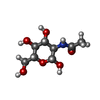 ChemComp-NAG: |
| 由来 |
|
 キーワード キーワード | IMMUNE SYSTEM / Complex / Targeted cancer therapy / Monoclonal anti-uPAR antibody FL1 / Antibody-drug conjugate |


 homo sapiens (ヒト)
 mus musculus (ハツカネズミ)