 Movie
Movie Controller

[English] 日本語
 Yorodumi
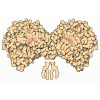
- EMDB-72760: Human uPAR bound to the Fab fragment of targeted cancer therapeut... -
+ Open data

- Basic information
| Entry |  | |||||||||||||||
|---|---|---|---|---|---|---|---|---|---|---|---|---|---|---|---|---|
| Title | Human uPAR bound to the Fab fragment of targeted cancer therapeutic antibody FL1 | |||||||||||||||
 Map data Map data | ||||||||||||||||
 Sample Sample |
| |||||||||||||||
 Keywords Keywords | Complex / Targeted cancer therapy / Monoclonal anti-uPAR antibody FL1 / Antibody-drug conjugate / IMMUNE SYSTEM | |||||||||||||||
| Function / homology |  Function and homology information Function and homology informationurokinase plasminogen activator receptor activity / cell-matrix adhesion mediator activity / Attachment of GPI anchor to uPAR / protein complex involved in cell-matrix adhesion / Regulation of FXIIa and plasma kallikrein activity / positive regulation of extracellular matrix disassembly / urokinase plasminogen activator signaling pathway / regulation of plasminogen activation / positive regulation of homotypic cell-cell adhesion / regulation of fibrinolysis ...urokinase plasminogen activator receptor activity / cell-matrix adhesion mediator activity / Attachment of GPI anchor to uPAR / protein complex involved in cell-matrix adhesion / Regulation of FXIIa and plasma kallikrein activity / positive regulation of extracellular matrix disassembly / urokinase plasminogen activator signaling pathway / regulation of plasminogen activation / positive regulation of homotypic cell-cell adhesion / regulation of fibrinolysis / serine-type endopeptidase complex / Dissolution of Fibrin Clot / protein localization to cell surface / positive regulation of DNA binding / extrinsic component of membrane / plasminogen activation / negative regulation of intrinsic apoptotic signaling pathway / positive regulation of epidermal growth factor receptor signaling pathway / positive regulation of release of cytochrome c from mitochondria / regulation of proteolysis / regulation of cell adhesion / FXIIa activates plasma kallikrein-kinin system / cell-matrix adhesion / specific granule membrane / positive regulation of protein phosphorylation / chemotaxis / blood coagulation / enzyme activator activity / signaling receptor activity / endoplasmic reticulum lumen / external side of plasma membrane / protein domain specific binding / signaling receptor binding / focal adhesion / negative regulation of apoptotic process / Neutrophil degranulation / endoplasmic reticulum membrane / enzyme binding / signal transduction / cell surface / extracellular region / membrane / plasma membrane Similarity search - Function | |||||||||||||||
| Biological species |  Homo sapiens (human) / Homo sapiens (human) /   Mus musculus (house mouse) Mus musculus (house mouse) | |||||||||||||||
| Method | single particle reconstruction / cryo EM / Resolution: 2.94 Å | |||||||||||||||
 Authors Authors | Anane RF / Whisstock JC / Engelholm LH / Law RHP / Ploug M | |||||||||||||||
| Funding support |  Denmark, Denmark,  Australia, 4 items Australia, 4 items
| |||||||||||||||
 Citation Citation | Journal: Protein Sci / Year: 2026 Title: Structural basis for uPAR binding to an antibody developed for targeted cancer therapy. Mechanistic insights into flexibility, ligand recognition, and molecular imaging. Authors: Rex F Anane / Anni Kumari / Hari Venugopal / Sylvain Trépout / James C Whisstock / Lars H Engelholm / Ruby H P Law / Michael Ploug / Abstract: The urokinase-type plasminogen activator receptor (uPAR) is currently gaining momentum as a promising molecular target for treatment of various solid cancers. For patient stratification, we developed ...The urokinase-type plasminogen activator receptor (uPAR) is currently gaining momentum as a promising molecular target for treatment of various solid cancers. For patient stratification, we developed a high-affinity uPAR-targeting peptide (AE105) detecting primary cancer lesions as well as occult metastasis by positron emission tomography (PET) imaging. uPAR-targeting by AE105 is also used for optical imaging in fluorescence-guided surgery of, for example, head-and-neck cancers. Recently, we showed that a monoclonal anti-uPAR antibody (FL1), in the form of an antibody-drug conjugate (FL1-ADC), efficiently eradicate pancreatic ductal carcinomas in surrogate mouse models leading to long-term remissions. In the current study, we solved high-resolution cryo-EM structures of FL1 in complex with two different conformational states of uPAR. Combined with comprehensive kinetic data from surface plasmon resonance studies, our cryo-EM structures provide essential insights into how FL1 binding impacts the interdomain flexibility of uPAR by restricting the movement of its N-terminal LU domain. This constraint from the bound FL1 drives uPAR into its open conformation, which leads to a pronounced reduction in the binding affinity for both its natural protease ligand (300-fold) and the PET imaging probe AE105 (25-fold). Collectively, these consequences of FL1-binding on uPAR conformation are considered beneficial for both targeted cancer treatment with FL1-ADCs and for the accompanying evaluation of treatment efficacy by longitudinal AE105-based PET imaging. | |||||||||||||||
| History |
|
- Structure visualization
| Supplemental images |
|---|

- Downloads & links
-EMDB archive
| Map data | emd_72760.map.gz | 117.9 MB | EMDB map data format | |
|---|---|---|---|---|
| Header (meta data) | emd-72760-v30.xmlemd-72760.xml | 25.5 KB 25.5 KB | Display Display | EMDB header |
| FSC (resolution estimation) | emd_72760_fsc.xml | 10.6 KB | Display | FSC data file |
| Images |  emd_72760.png emd_72760.png | 45.3 KB | ||
| Filedesc metadata | emd-72760.cif.gz | 7.8 KB | ||
| Others | emd_72760_half_map_1.map.gzemd_72760_half_map_2.map.gz | 116 MB 116 MB | ||
| Archive directory |  https://data.pdbj.org/pub/emdb/structures/EMD-72760ftp://data.pdbj.org/pub/emdb/structures/EMD-72760 https://data.pdbj.org/pub/emdb/structures/EMD-72760ftp://data.pdbj.org/pub/emdb/structures/EMD-72760 | HTTPS FTP |
-Related structure data
| Related structure data |  9yc5MC  9yc6C M: atomic model generated by this map C: citing same article ( |
|---|---|
| Similar structure data |

-Links
| EMDB pages | EMDB (EBI/PDBe) / EMDataResource |
|---|---|
| Related items in Molecule of the Month |
-Map
| File | Download / File: emd_72760.map.gz / Format: CCP4 / Size: 125 MB / Type: IMAGE STORED AS FLOATING POINT NUMBER (4 BYTES) | ||||||||||||||||||||||||||||||||||||
|---|---|---|---|---|---|---|---|---|---|---|---|---|---|---|---|---|---|---|---|---|---|---|---|---|---|---|---|---|---|---|---|---|---|---|---|---|---|
| Projections & slices | Image control
Images are generated by Spider. | ||||||||||||||||||||||||||||||||||||
| Voxel size | X=Y=Z: 0.82 Å | ||||||||||||||||||||||||||||||||||||
| Density |
| ||||||||||||||||||||||||||||||||||||
| Symmetry | Space group: 1 | ||||||||||||||||||||||||||||||||||||
| Details | EMDB XML:
|
 Z (Sec.)
 Y (Row.)
 X (Col.)


-Supplemental data
-Half map: #2
| File | emd_72760_half_map_1.map | ||||||||||||
|---|---|---|---|---|---|---|---|---|---|---|---|---|---|
| Projections & Slices |
| ||||||||||||
| Density Histograms |


-Half map: #1
| File | emd_72760_half_map_2.map | ||||||||||||
|---|---|---|---|---|---|---|---|---|---|---|---|---|---|
| Projections & Slices |
| ||||||||||||
| Density Histograms |


- Sample components
-Entire : Binary complex of human uPAR and Fab fragment of anti-uPAR antibo...
| Entire | Name: Binary complex of human uPAR and Fab fragment of anti-uPAR antibody FL1 |
|---|---|
| Components |
|
-Supramolecule #1: Binary complex of human uPAR and Fab fragment of anti-uPAR antibo...
| Supramolecule | Name: Binary complex of human uPAR and Fab fragment of anti-uPAR antibody FL1 type: complex / ID: 1 / Parent: 0 / Macromolecule list: #1-#3 Details: Full-length human uPAR, and full-length antibody FL1 (IgG) were mixed to form the protein complex which was used for EM sample. |
|---|---|
| Source (natural) | Organism: Homo sapiens (human) |
-Macromolecule #1: Urokinase plasminogen activator surface receptor
| Macromolecule | Name: Urokinase plasminogen activator surface receptor / type: protein_or_peptide / ID: 1 / Number of copies: 1 / Enantiomer: LEVO |
|---|---|
| Source (natural) | Organism: Homo sapiens (human) |
| Molecular weight | Theoretical: 31.501342 KDa |
| Recombinant expression | Organism:   Drosophila melanogaster (fruit fly) Drosophila melanogaster (fruit fly) |
| Sequence | String: LRCMQCKTNG DCRVEECALG QDLCRTTIVR LWEEGEELEL VEKSCTHSEK TNRTLSYRTG LKITSLTEVV CGLDLCNQGN SGRAVTYSR SRYLECISCG SSDMSCERGR HQSLQCRSPE EQCLDVVTHW IQEGEEGRPK DDRHLRGCGY LPGCPGSNGF H NNDTFHFL ...String: LRCMQCKTNG DCRVEECALG QDLCRTTIVR LWEEGEELEL VEKSCTHSEK TNRTLSYRTG LKITSLTEVV CGLDLCNQGN SGRAVTYSR SRYLECISCG SSDMSCERGR HQSLQCRSPE EQCLDVVTHW IQEGEEGRPK DDRHLRGCGY LPGCPGSNGF H NNDTFHFL KCCNTTKCNE GPILELENLP QNGRQCYSCK GNSTHGCSSE ETFLIDCRGP MNQCLVATGT HEPKNQSYMV RG CATASMC QHAHLGDAFS MNHIDVSCCT KSGCNHPDLD VQYRSG UniProtKB: Urokinase plasminogen activator surface receptor |
-Macromolecule #2: Anti-uPAR antibody FL1 Fab heavy chain
| Macromolecule | Name: Anti-uPAR antibody FL1 Fab heavy chain / type: protein_or_peptide / ID: 2 / Number of copies: 1 / Enantiomer: LEVO |
|---|---|
| Source (natural) | Organism: Mus musculus (house mouse) |
| Molecular weight | Theoretical: 23.581258 KDa |
| Recombinant expression | Organism: Mus musculus (house mouse) |
| Sequence | String: EVQLQQSGSV LVRPGTSVNL SCKASGYTFT SYWMSWVKQR PGQGLEWIGE IFPKSGRINS NENFRGKATL TVDTSSSTAY INLSSLTSE DSAVYYCSPI YSGDYGFADW GQGTLVTVSA AKTTPPSVYP LAPGSAAQTN SMVTLGCLVK GYFPEPVTVT W NSGSLSSG ...String: EVQLQQSGSV LVRPGTSVNL SCKASGYTFT SYWMSWVKQR PGQGLEWIGE IFPKSGRINS NENFRGKATL TVDTSSSTAY INLSSLTSE DSAVYYCSPI YSGDYGFADW GQGTLVTVSA AKTTPPSVYP LAPGSAAQTN SMVTLGCLVK GYFPEPVTVT W NSGSLSSG VHTFPAVLQS DLYTLSSSVT VPSSTWPSET VTCNVAHPAS STKVDKKIVP RDC |
-Macromolecule #3: Anti-uPAR antibody FL1 Fab light chain
| Macromolecule | Name: Anti-uPAR antibody FL1 Fab light chain / type: protein_or_peptide / ID: 3 / Number of copies: 1 / Enantiomer: LEVO |
|---|---|
| Source (natural) | Organism: Mus musculus (house mouse) |
| Molecular weight | Theoretical: 24.168818 KDa |
| Recombinant expression | Organism: Mus musculus (house mouse) |
| Sequence | String: DIVMTQTPLS LPVSLGDQAS ISCRSSQSVV SNNGKTYLEW YLQKPGQSPK LLIYKVSNRF SGVPDRFSGS GSGTDFTLKI SRVEAEDLG VYYCFQGSHV PWTFGGGTKL EVKRADAAPT VSIFPPSSEQ LTSGGASVVC FLNNFYPKDI NVKWKIDGSE R QNGVLNSW ...String: DIVMTQTPLS LPVSLGDQAS ISCRSSQSVV SNNGKTYLEW YLQKPGQSPK LLIYKVSNRF SGVPDRFSGS GSGTDFTLKI SRVEAEDLG VYYCFQGSHV PWTFGGGTKL EVKRADAAPT VSIFPPSSEQ LTSGGASVVC FLNNFYPKDI NVKWKIDGSE R QNGVLNSW TDQDSKDSTY SMSSTLTLTK DEYERHNSYT CEATHKTSTS PIVKSFNRNE C |
-Macromolecule #5: 2-acetamido-2-deoxy-beta-D-glucopyranose
| Macromolecule | Name: 2-acetamido-2-deoxy-beta-D-glucopyranose / type: ligand / ID: 5 / Number of copies: 2 / Formula: NAG |
|---|---|
| Molecular weight | Theoretical: 221.208 Da |
| Chemical component information | 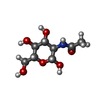 ChemComp-NAG: |
-Experimental details
-Structure determination
| Method | cryo EM |
|---|---|
 Processing Processing | single particle reconstruction |
| Aggregation state | particle |
-Sample preparation
| Concentration | 3.5 mg/mL | |||||||||||||||
|---|---|---|---|---|---|---|---|---|---|---|---|---|---|---|---|---|
| Buffer | pH: 7.4 Component:
Details: 20mM Tris, 150mM NaCl, 2.5% Glycerol, 1mM EDTA, pH 7.4 | |||||||||||||||
| Grid | Model: UltrAuFoil R1.2/1.3 / Material: GOLD / Mesh: 300 / Pretreatment - Type: GLOW DISCHARGE / Pretreatment - Time: 30 sec. / Pretreatment - Pressure: 3.9 kPa | |||||||||||||||
| Vitrification | Cryogen name: ETHANE / Chamber humidity: 100 % / Chamber temperature: 277.15 K / Instrument: FEI VITROBOT MARK IV | |||||||||||||||
| Details | Full-length human uPAR, and full-length antibody FL1 (IgG) were mixed in 2:1 molar ratio to form the protein complex which was used for EM sample. |
- Electron microscopy
| Microscope | TFS KRIOS |
|---|---|
| Specialist optics | Phase plate: VOLTA PHASE PLATE / Energy filter - Name: GIF Bioquantum / Energy filter - Slit width: 10 eV |
| Image recording | Film or detector model: GATAN K3 BIOQUANTUM (6k x 4k) / Digitization - Dimensions - Width: 5760 pixel / Digitization - Dimensions - Height: 4092 pixel / Number grids imaged: 1 / Number real images: 7181 / Average exposure time: 4.92 sec. / Average electron dose: 10.7 e/Å2 / Details: Images were collected at a pixel size of 0.8234 |
| Electron beam | Acceleration voltage: 300 kV / Electron source:  FIELD EMISSION GUN FIELD EMISSION GUN |
| Electron optics | Illumination mode: FLOOD BEAM / Imaging mode: BRIGHT FIELD / Cs: 2.7 mm / Nominal defocus max: 2.0 µm / Nominal defocus min: 0.5 µm / Nominal magnification: 105000 |
| Sample stage | Specimen holder model: FEI TITAN KRIOS AUTOGRID HOLDER / Cooling holder cryogen: NITROGEN |
| Experimental equipment |  Model: Titan Krios / Image courtesy: FEI Company |
+Image processing

-Atomic model buiding 1
| Initial model | PDB ID: Chain - Residue range: 114-299 / Chain - Source name: AlphaFold / Chain - Initial model type: in silico model |
|---|---|
| Details | An initial local fitting was performed with ISOLDE implemented in ChimeraX prior to real-space refinement in phenix. |
| Refinement | Space: REAL / Protocol: FLEXIBLE FIT / Overall B value: 112 / Target criteria: cross-correlation coefficient |
| Output model | PDB-9yc5: |

