 Movie
Movie Controller

[English] 日本語
 Yorodumi
- PDB-9yc5: Human uPAR bound to the Fab fragment of targeted cancer therapeut... -
+ Open data

- Basic information
| Entry | Database: PDB / ID: 9yc5 | ||||||||||||||||||||||||
|---|---|---|---|---|---|---|---|---|---|---|---|---|---|---|---|---|---|---|---|---|---|---|---|---|---|
| Title | Human uPAR bound to the Fab fragment of targeted cancer therapeutic antibody FL1 | ||||||||||||||||||||||||
 Components Components |
| ||||||||||||||||||||||||
 Keywords Keywords | IMMUNE SYSTEM / Complex / Targeted cancer therapy / Monoclonal anti-uPAR antibody FL1 / Antibody-drug conjugate | ||||||||||||||||||||||||
| Function / homology |  Function and homology information Function and homology informationurokinase plasminogen activator receptor activity / cell-matrix adhesion mediator activity / Attachment of GPI anchor to uPAR / protein complex involved in cell-matrix adhesion / Regulation of FXIIa and plasma kallikrein activity / positive regulation of extracellular matrix disassembly / urokinase plasminogen activator signaling pathway / regulation of plasminogen activation / positive regulation of homotypic cell-cell adhesion / regulation of fibrinolysis ...urokinase plasminogen activator receptor activity / cell-matrix adhesion mediator activity / Attachment of GPI anchor to uPAR / protein complex involved in cell-matrix adhesion / Regulation of FXIIa and plasma kallikrein activity / positive regulation of extracellular matrix disassembly / urokinase plasminogen activator signaling pathway / regulation of plasminogen activation / positive regulation of homotypic cell-cell adhesion / regulation of fibrinolysis / serine-type endopeptidase complex / Dissolution of Fibrin Clot / protein localization to cell surface / positive regulation of DNA binding / extrinsic component of membrane / plasminogen activation / negative regulation of intrinsic apoptotic signaling pathway / positive regulation of epidermal growth factor receptor signaling pathway / positive regulation of release of cytochrome c from mitochondria / regulation of proteolysis / regulation of cell adhesion / cell-matrix adhesion / specific granule membrane / FXIIa activates plasma kallikrein-kinin system / positive regulation of protein phosphorylation / chemotaxis / blood coagulation / enzyme activator activity / signaling receptor activity / endoplasmic reticulum lumen / external side of plasma membrane / protein domain specific binding / signaling receptor binding / focal adhesion / negative regulation of apoptotic process / Neutrophil degranulation / endoplasmic reticulum membrane / signal transduction / enzyme binding / cell surface / extracellular region / membrane / plasma membrane Similarity search - Function | ||||||||||||||||||||||||
| Biological species |  Homo sapiens (human) Homo sapiens (human)  Mus musculus (house mouse) Mus musculus (house mouse) | ||||||||||||||||||||||||
| Method | ELECTRON MICROSCOPY / single particle reconstruction / cryo EM / Resolution: 2.94 Å | ||||||||||||||||||||||||
 Authors Authors | Anane, R.F. / Whisstock, J.C. / Engelholm, L.H. / Law, R.H.P. / Ploug, M. | ||||||||||||||||||||||||
| Funding support |  Denmark, Denmark,  Australia, 4items Australia, 4items
| ||||||||||||||||||||||||
 Citation Citation | Journal: Protein Sci / Year: 2026 Title: Structural basis for uPAR binding to an antibody developed for targeted cancer therapy. Mechanistic insights into flexibility, ligand recognition, and molecular imaging. Authors: Rex F Anane / Anni Kumari / Hari Venugopal / Sylvain Trépout / James C Whisstock / Lars H Engelholm / Ruby H P Law / Michael Ploug / Abstract: The urokinase-type plasminogen activator receptor (uPAR) is currently gaining momentum as a promising molecular target for treatment of various solid cancers. For patient stratification, we developed ...The urokinase-type plasminogen activator receptor (uPAR) is currently gaining momentum as a promising molecular target for treatment of various solid cancers. For patient stratification, we developed a high-affinity uPAR-targeting peptide (AE105) detecting primary cancer lesions as well as occult metastasis by positron emission tomography (PET) imaging. uPAR-targeting by AE105 is also used for optical imaging in fluorescence-guided surgery of, for example, head-and-neck cancers. Recently, we showed that a monoclonal anti-uPAR antibody (FL1), in the form of an antibody-drug conjugate (FL1-ADC), efficiently eradicate pancreatic ductal carcinomas in surrogate mouse models leading to long-term remissions. In the current study, we solved high-resolution cryo-EM structures of FL1 in complex with two different conformational states of uPAR. Combined with comprehensive kinetic data from surface plasmon resonance studies, our cryo-EM structures provide essential insights into how FL1 binding impacts the interdomain flexibility of uPAR by restricting the movement of its N-terminal LU domain. This constraint from the bound FL1 drives uPAR into its open conformation, which leads to a pronounced reduction in the binding affinity for both its natural protease ligand (300-fold) and the PET imaging probe AE105 (25-fold). Collectively, these consequences of FL1-binding on uPAR conformation are considered beneficial for both targeted cancer treatment with FL1-ADCs and for the accompanying evaluation of treatment efficacy by longitudinal AE105-based PET imaging. | ||||||||||||||||||||||||
| History |
|
- Structure visualization
| Structure viewer | Molecule: MolmilJmol/JSmol |
|---|
- Downloads & links
-Download
| PDBx/mmCIF format | 9yc5.cif.gz | 232 KB | Display | PDBx/mmCIF format |
|---|---|---|---|---|
| PDB format | pdb9yc5.ent.gz | 186.4 KB | Display | PDB format |
| PDBx/mmJSON format | 9yc5.json.gz | Tree view | PDBx/mmJSON format | |
| Others |  Other downloads Other downloads |
-Validation report
| Arichive directory | https://data.pdbj.org/pub/pdb/validation_reports/yc/9yc5ftp://data.pdbj.org/pub/pdb/validation_reports/yc/9yc5 | HTTPS FTP |
|---|
-Related structure data
| Related structure data |  72760MC  9yc6C M: map data used to model this data C: citing same article ( |
|---|---|
| Similar structure data |

-Links
 PDBj
PDBj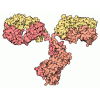
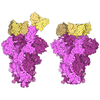
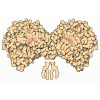
- Assembly
| Deposited unit | 
|
|---|---|
| 1 |
|
-Components
| #1: Protein | Mass: 31501.342 Da / Num. of mol.: 1 Source method: isolated from a genetically manipulated source Source: (gene. exp.) Homo sapiens (human) / Gene: PLAUR, MO3, UPAR / Cell line (production host): S2 / Production host:   Drosophila melanogaster (fruit fly) / References: UniProt: Q03405 Drosophila melanogaster (fruit fly) / References: UniProt: Q03405 | ||||
|---|---|---|---|---|---|
| #2: Antibody | Mass: 23581.258 Da / Num. of mol.: 1 Source method: isolated from a genetically manipulated source Source: (gene. exp.) Mus musculus (house mouse) / Cell (production host): Hybridomas / Cell line (production host): Hybridomas / Production host: Mus musculus (house mouse) | ||||
| #3: Antibody | Mass: 24168.818 Da / Num. of mol.: 1 Source method: isolated from a genetically manipulated source Source: (gene. exp.) Mus musculus (house mouse) / Cell (production host): Hybridomas / Cell line (production host): Hybridomas / Production host: Mus musculus (house mouse) | ||||
| #4: Polysaccharide | beta-D-mannopyranose-(1-4)-2-acetamido-2-deoxy-beta-D-glucopyranose-(1-4)-2-acetamido-2-deoxy-beta- ...beta-D-mannopyranose-(1-4)-2-acetamido-2-deoxy-beta-D-glucopyranose-(1-4)-2-acetamido-2-deoxy-beta-D-glucopyranose Source method: isolated from a genetically manipulated source | ||||
| #5: Sugar | 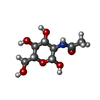 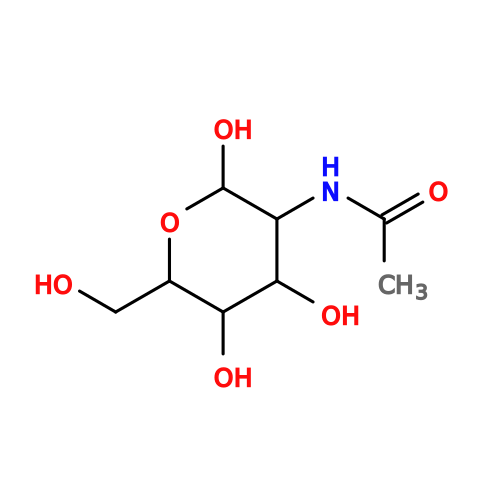 Type: D-saccharide, beta linking / Mass: 221.208 Da / Num. of mol.: 2 / Source method: obtained synthetically / Formula: C8H15NO6 Type: D-saccharide, beta linking / Mass: 221.208 Da / Num. of mol.: 2 / Source method: obtained synthetically / Formula: C8H15NO6Has ligand of interest | N | Has protein modification | Y | |
-Experimental details
-Experiment
| Experiment | Method: ELECTRON MICROSCOPY |
|---|---|
| EM experiment | Aggregation state: PARTICLE / 3D reconstruction method: single particle reconstruction |
- Sample preparation
| Component | Name: Binary complex of human uPAR and Fab fragment of anti-uPAR antibody FL1 Type: COMPLEX Details: Full-length human uPAR, and full-length antibody FL1 (IgG) were mixed to form the protein complex which was used for EM sample. Entity ID: #1-#3 / Source: MULTIPLE SOURCES | |||||||||||||||||||||||||
|---|---|---|---|---|---|---|---|---|---|---|---|---|---|---|---|---|---|---|---|---|---|---|---|---|---|---|
| Source (natural) | Organism: Homo sapiens (human) | |||||||||||||||||||||||||
| Source (recombinant) | Organism: Drosophila melanogaster (fruit fly) | |||||||||||||||||||||||||
| Buffer solution | pH: 7.4 Details: 20mM Tris, 150mM NaCl, 2.5% Glycerol, 1mM EDTA, pH 7.4 | |||||||||||||||||||||||||
| Buffer component |
| |||||||||||||||||||||||||
| Specimen | Conc.: 3.5 mg/ml / Embedding applied: NO / Shadowing applied: NO / Staining applied: NO / Vitrification applied: YES Details: Full-length human uPAR, and full-length antibody FL1 (IgG) were mixed in 2:1 molar ratio to form the protein complex which was used for EM sample. | |||||||||||||||||||||||||
| Specimen support | Grid material: GOLD / Grid mesh size: 300 divisions/in. / Grid type: UltrAuFoil R1.2/1.3 | |||||||||||||||||||||||||
| Vitrification | Instrument: FEI VITROBOT MARK IV / Cryogen name: ETHANE / Humidity: 100 % / Chamber temperature: 277.15 K |
- Electron microscopy imaging
| Experimental equipment |  Model: Titan Krios / Image courtesy: FEI Company |
|---|---|
| Microscopy | Model: TFS KRIOS |
| Electron gun | Electron source:  FIELD EMISSION GUN / Accelerating voltage: 300 kV / Illumination mode: FLOOD BEAM FIELD EMISSION GUN / Accelerating voltage: 300 kV / Illumination mode: FLOOD BEAM |
| Electron lens | Mode: BRIGHT FIELD / Nominal magnification: 105000 X / Nominal defocus max: 2000 nm / Nominal defocus min: 500 nm / Cs: 2.7 mm |
| Specimen holder | Cryogen: NITROGEN / Specimen holder model: FEI TITAN KRIOS AUTOGRID HOLDER |
| Image recording | Average exposure time: 4.92 sec. / Electron dose: 10.7 e/Å2 / Film or detector model: GATAN K3 BIOQUANTUM (6k x 4k) / Num. of grids imaged: 1 / Num. of real images: 7181 / Details: Images were collected at a pixel size of 0.8234 |
| EM imaging optics | Energyfilter name: GIF Bioquantum / Energyfilter slit width: 10 eV / Phase plate: VOLTA PHASE PLATE |
| Image scans | Width: 5760 / Height: 4092 |
- Processing
| EM software |
| ||||||||||||||||||||||||||||||||||||||||||||||||||
|---|---|---|---|---|---|---|---|---|---|---|---|---|---|---|---|---|---|---|---|---|---|---|---|---|---|---|---|---|---|---|---|---|---|---|---|---|---|---|---|---|---|---|---|---|---|---|---|---|---|---|---|
| Image processing | Details: Following motion correction, 4345 images were selected for particle picking | ||||||||||||||||||||||||||||||||||||||||||||||||||
| CTF correction | Details: CTF corrections were performed after 3D reconstruction to improve the final resolution Type: PHASE FLIPPING AND AMPLITUDE CORRECTION | ||||||||||||||||||||||||||||||||||||||||||||||||||
| Particle selection | Num. of particles selected: 7426690 Details: The 7426690 particles were picked by automated particle picking using blob picker. Several rounds of 2D classification were performed to discard particles of low quality, producing 184642 ...Details: The 7426690 particles were picked by automated particle picking using blob picker. Several rounds of 2D classification were performed to discard particles of low quality, producing 184642 particles of good quality which were used for 3D reconstruction. | ||||||||||||||||||||||||||||||||||||||||||||||||||
| Symmetry | Point symmetry: C1 (asymmetric) | ||||||||||||||||||||||||||||||||||||||||||||||||||
| 3D reconstruction | Resolution: 2.94 Å / Resolution method: FSC 0.143 CUT-OFF / Num. of particles: 184642 / Num. of class averages: 16 / Symmetry type: POINT | ||||||||||||||||||||||||||||||||||||||||||||||||||
| Atomic model building | B value: 112 / Protocol: FLEXIBLE FIT / Space: REAL / Target criteria: cross-correlation coefficient Details: An initial local fitting was performed with ISOLDE implemented in ChimeraX prior to real-space refinement in phenix. | ||||||||||||||||||||||||||||||||||||||||||||||||||
| Atomic model building | Accession code: AF-Q03405-F1-v4 / Chain residue range: 114-299 / Source name: AlphaFold / Type: in silico model | ||||||||||||||||||||||||||||||||||||||||||||||||||
| Refine LS restraints |
|
