 ムービー
ムービー コントローラー
 構造ビューア
 万見文献について


+検索条件
-Structure paper
| タイトル | Snapshots of the dynamic basis of NTSR1 G protein subtype promiscuity. |
|---|---|
| ジャーナル・号・ページ | Nature, Vol. 652, Issue 8110, Page 803-811, Year 2026 |
| 掲載日 | 2026年3月11日 |
 著者 著者 | Alina A Vo / Arnab Modak / Sumin Lu / Scott C Blanchard / Nevin A Lambert / Michael J Robertson /  |
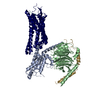
| PubMed 要旨 | G-protein-coupled receptors (GPCRs) are capable of signalling through four families of G protein α subunits. Although hundreds of nucleotide-free GPCR-G protein complex structures have been solved, ...G-protein-coupled receptors (GPCRs) are capable of signalling through four families of G protein α subunits. Although hundreds of nucleotide-free GPCR-G protein complex structures have been solved, the mechanism of G protein subtype selectivity remains poorly understood, with recent studies suggesting a role for dynamic nucleotide-bound intermediate states. Here we use time-resolved cryo-electron microscopy to visualize the GTP-induced activation of Gαβγ and Gαβγ heterotrimers bound to the neurotensin receptor 1 (NTSR1), which has been demonstrated to be highly promiscuous in G protein coupling and to possess unusual conformations in the nucleotide-free complex. We resolve ensembles of states along the G protein activation pathway, with differences in the structures and their relative populations between Gα and Gα. Structural analysis reveals a key role for several motifs, including intracellular loop 2 (ICL2) and ICL3, in stabilizing the observed intermediate states. Our results are supported by molecular dynamics simulations and kinetic bioluminescence resonance energy transfer experiments, which reveal that the stability of these intermediate states and the signalling of various G proteins are correlated with ICL2 and ICL3 sequences. Single-molecule fluorescence assays of GTP-induced NTSR1-G protein complex dissociation reveal that NTSR1 is liberated significantly faster from Gα, consistent with the relative lack of stable Gα-GTP intermediate states compared with Gα. These findings highlight that transient intermediate-state complexes along the G protein activation pathway have an important role in G protein selection that cannot be explained by nucleotide-free states alone. |
 リンク リンク | Nature / PubMed:41813894 / PubMed Central |
| 手法 | EM (単粒子) |
| 解像度 | 2.1 - 3.9 Å |
| 構造データ | EMDB-71358, PDB-9p7z: EMDB-71359, PDB-9p80:  EMDB-71360: NTSR1-Gi-NTS(8-13) Complex in the Canonical, AHD Closed State (C-Closed-Apo) EMDB-71361, PDB-9p81: EMDB-71362, PDB-9p82: EMDB-71363, PDB-9p83: EMDB-71364, PDB-9p84: EMDB-71365, PDB-9p85: EMDB-71366, PDB-9p86: EMDB-71367, PDB-9p87: EMDB-71368, PDB-9p88: EMDB-71369, PDB-9p89: EMDB-71370, PDB-9p8a:  EMDB-74080: NTSR1-Gi-NTS(8-13) GTP-Bound Complex in the Canonical, AHD Closed State (C-Closed-GTP), MSP1D1 Nanodisc  EMDB-74081: NTSR1-Gi-NTS(8-13), GTP-bound Complex in the Canonical, AHD Open State (C-Open-GTP), MSP1D1 |
| 化合物 |  ChemComp-MG: 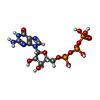 ChemComp-GTP:  ChemComp-HOH: |
| 由来 |
|
 キーワード キーワード | SIGNALING PROTEIN / Complex / Agonist |




 homo sapiens (ヒト)