 Movie
Movie Controller

[English] 日本語
 Yorodumi
- EMDB-71366: NTSR1-G11-NTS(8-13) Complex in the Canonical, AHD Open State (C-O... -
+ Open data

- Basic information
| Entry |  | |||||||||
|---|---|---|---|---|---|---|---|---|---|---|
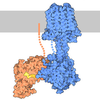
| Title | NTSR1-G11-NTS(8-13) Complex in the Canonical, AHD Open State (C-Open-Apo) | |||||||||
 Map data Map data | ||||||||||
 Sample Sample |
| |||||||||
 Keywords Keywords | Complex / Agonist / SIGNALING PROTEIN | |||||||||
| Function / homology |  Function and homology information Function and homology informationphospholipase C-activating G protein-coupled acetylcholine receptor signaling pathway / Fatty Acids bound to GPR40 (FFAR1) regulate insulin secretion / G protein-coupled neurotensin receptor activity / phospholipase C-activating dopamine receptor signaling pathway / Acetylcholine regulates insulin secretion / inositol phosphate catabolic process / symmetric synapse / positive regulation of locomotion / cranial skeletal system development / regulation of inositol trisphosphate biosynthetic process ...phospholipase C-activating G protein-coupled acetylcholine receptor signaling pathway / Fatty Acids bound to GPR40 (FFAR1) regulate insulin secretion / G protein-coupled neurotensin receptor activity / phospholipase C-activating dopamine receptor signaling pathway / Acetylcholine regulates insulin secretion / inositol phosphate catabolic process / symmetric synapse / positive regulation of locomotion / cranial skeletal system development / regulation of inositol trisphosphate biosynthetic process / endothelin receptor signaling pathway / positive regulation of gamma-aminobutyric acid secretion / PLC beta mediated events / entrainment of circadian clock / D-aspartate import across plasma membrane / positive regulation of arachidonate secretion / L-glutamate import across plasma membrane / vocalization behavior / regulation of behavioral fear response / regulation of respiratory gaseous exchange / cAMP biosynthetic process / negative regulation of systemic arterial blood pressure / positive regulation of inhibitory postsynaptic potential / negative regulation of release of sequestered calcium ion into cytosol / response to food / positive regulation of glutamate secretion / regulation of membrane depolarization / response to lipid / temperature homeostasis / positive regulation of inositol phosphate biosynthetic process / response to stress / detection of temperature stimulus involved in sensory perception of pain / action potential / phototransduction, visible light / photoreceptor outer segment / conditioned place preference / Turbulent (oscillatory, disturbed) flow shear stress activates signaling by PIEZO1 and integrins in endothelial cells / positive regulation of release of sequestered calcium ion into cytosol / Peptide ligand-binding receptors / dendritic shaft / neuropeptide signaling pathway / regulation of blood pressure / G protein-coupled receptor binding / G protein-coupled receptor activity / cytoplasmic side of plasma membrane / G-protein beta/gamma-subunit complex binding / adenylate cyclase-modulating G protein-coupled receptor signaling pathway / phospholipase C-activating G protein-coupled receptor signaling pathway / Olfactory Signaling Pathway / Activation of the phototransduction cascade / terminal bouton / G protein-coupled acetylcholine receptor signaling pathway / G beta:gamma signalling through PLC beta / Presynaptic function of Kainate receptors / Thromboxane signalling through TP receptor / Activation of G protein gated Potassium channels / Inhibition of voltage gated Ca2+ channels via Gbeta/gamma subunits / G-protein activation / Glucagon signaling in metabolic regulation / G beta:gamma signalling through CDC42 / Prostacyclin signalling through prostacyclin receptor / Synthesis, secretion, and inactivation of Glucagon-like Peptide-1 (GLP-1) / G beta:gamma signalling through BTK / photoreceptor disc membrane / ADP signalling through P2Y purinoceptor 12 / Glucagon-type ligand receptors / Sensory perception of sweet, bitter, and umami (glutamate) taste / Adrenaline,noradrenaline inhibits insulin secretion / Vasopressin regulates renal water homeostasis via Aquaporins / Glucagon-like Peptide-1 (GLP1) regulates insulin secretion / G alpha (z) signalling events / cellular response to catecholamine stimulus / ADP signalling through P2Y purinoceptor 1 / G beta:gamma signalling through PI3Kgamma / ADORA2B mediated anti-inflammatory cytokines production / adenylate cyclase-activating dopamine receptor signaling pathway / cellular response to prostaglandin E stimulus / Cooperation of PDCL (PhLP1) and TRiC/CCT in G-protein beta folding / GPER1 signaling / heterotrimeric G-protein complex / Inactivation, recovery and regulation of the phototransduction cascade / G alpha (12/13) signalling events / G-protein beta-subunit binding / extracellular vesicle / Thrombin signalling through proteinase activated receptors (PARs) / signaling receptor complex adaptor activity / GTPase binding / G protein activity / chemical synaptic transmission / Ca2+ pathway / High laminar flow shear stress activates signaling by PIEZO1 and PECAM1:CDH5:KDR in endothelial cells / G alpha (i) signalling events / dendritic spine / G alpha (s) signalling events / G alpha (q) signalling events / Hydrolases; Acting on acid anhydrides; Acting on GTP to facilitate cellular and subcellular movement / perikaryon / Ras protein signal transduction / Extra-nuclear estrogen signaling / positive regulation of apoptotic process Similarity search - Function | |||||||||
| Biological species |  Homo sapiens (human) Homo sapiens (human) | |||||||||
| Method | single particle reconstruction / cryo EM / Resolution: 2.9 Å | |||||||||
 Authors Authors | Robertson MJ | |||||||||
| Funding support |  United States, 2 items United States, 2 items
| |||||||||
 Citation Citation | Journal: Nature / Year: 2026 Title: Snapshots of the dynamic basis of NTSR1 G protein subtype promiscuity. Authors: Alina A Vo / Arnab Modak / Sumin Lu / Scott C Blanchard / Nevin A Lambert / Michael J Robertson / Abstract: G-protein-coupled receptors (GPCRs) are capable of signalling through four families of G protein α subunits. Although hundreds of nucleotide-free GPCR-G protein complex structures have been solved, ...G-protein-coupled receptors (GPCRs) are capable of signalling through four families of G protein α subunits. Although hundreds of nucleotide-free GPCR-G protein complex structures have been solved, the mechanism of G protein subtype selectivity remains poorly understood, with recent studies suggesting a role for dynamic nucleotide-bound intermediate states. Here we use time-resolved cryo-electron microscopy to visualize the GTP-induced activation of Gαβγ and Gαβγ heterotrimers bound to the neurotensin receptor 1 (NTSR1), which has been demonstrated to be highly promiscuous in G protein coupling and to possess unusual conformations in the nucleotide-free complex. We resolve ensembles of states along the G protein activation pathway, with differences in the structures and their relative populations between Gα and Gα. Structural analysis reveals a key role for several motifs, including intracellular loop 2 (ICL2) and ICL3, in stabilizing the observed intermediate states. Our results are supported by molecular dynamics simulations and kinetic bioluminescence resonance energy transfer experiments, which reveal that the stability of these intermediate states and the signalling of various G proteins are correlated with ICL2 and ICL3 sequences. Single-molecule fluorescence assays of GTP-induced NTSR1-G protein complex dissociation reveal that NTSR1 is liberated significantly faster from Gα, consistent with the relative lack of stable Gα-GTP intermediate states compared with Gα. These findings highlight that transient intermediate-state complexes along the G protein activation pathway have an important role in G protein selection that cannot be explained by nucleotide-free states alone. | |||||||||
| History |
|
- Structure visualization
| Supplemental images |
|---|

- Downloads & links
-EMDB archive
| Map data | emd_71366.map.gz | 79 MB | EMDB map data format | |
|---|---|---|---|---|
| Header (meta data) | emd-71366-v30.xmlemd-71366.xml | 23.8 KB 23.8 KB | Display Display | EMDB header |
| Images |  emd_71366.png emd_71366.png | 78.9 KB | ||
| Filedesc metadata | emd-71366.cif.gz | 6.8 KB | ||
| Others | emd_71366_additional_1.map.gzemd_71366_half_map_1.map.gzemd_71366_half_map_2.map.gz | 41.9 MB 77.6 MB 77.6 MB | ||
| Archive directory |  http://ftp.pdbj.org/pub/emdb/structures/EMD-71366ftp://ftp.pdbj.org/pub/emdb/structures/EMD-71366 http://ftp.pdbj.org/pub/emdb/structures/EMD-71366ftp://ftp.pdbj.org/pub/emdb/structures/EMD-71366 | HTTPS FTP |
-Related structure data
| Related structure data |  9p86MC  9p7zC  9p80C  9p81C  9p82C  9p83C  9p84C  9p85C 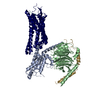 9p87C  9p88C  9p89C  9p8aC M: atomic model generated by this map C: citing same article ( |
|---|---|
| Similar structure data |


-Links
| EMDB pages | EMDB (EBI/PDBe) / EMDataResource |
|---|---|
| Related items in Molecule of the Month |





-Map
| File | Download / File: emd_71366.map.gz / Format: CCP4 / Size: 83.7 MB / Type: IMAGE STORED AS FLOATING POINT NUMBER (4 BYTES) | ||||||||||||||||||||||||||||||||||||
|---|---|---|---|---|---|---|---|---|---|---|---|---|---|---|---|---|---|---|---|---|---|---|---|---|---|---|---|---|---|---|---|---|---|---|---|---|---|
| Projections & slices | Image control
Images are generated by Spider. | ||||||||||||||||||||||||||||||||||||
| Voxel size | X=Y=Z: 0.832 Å | ||||||||||||||||||||||||||||||||||||
| Density |
| ||||||||||||||||||||||||||||||||||||
| Symmetry | Space group: 1 | ||||||||||||||||||||||||||||||||||||
| Details | EMDB XML:
|
 Z (Sec.)
 Y (Row.)
 X (Col.)


-Supplemental data
-Additional map: Unsharpened Map
| File | emd_71366_additional_1.map | ||||||||||||
|---|---|---|---|---|---|---|---|---|---|---|---|---|---|
| Annotation | Unsharpened Map | ||||||||||||
| Projections & Slices |
| ||||||||||||
| Density Histograms |


-Half map: #2
| File | emd_71366_half_map_1.map | ||||||||||||
|---|---|---|---|---|---|---|---|---|---|---|---|---|---|
| Projections & Slices |
| ||||||||||||
| Density Histograms |


-Half map: #1
| File | emd_71366_half_map_2.map | ||||||||||||
|---|---|---|---|---|---|---|---|---|---|---|---|---|---|
| Projections & Slices |
| ||||||||||||
| Density Histograms |


- Sample components
-Entire : NTSR1-Gi-NTS(8-13) Complex in the Canonical, AHD Open State
| Entire | Name: NTSR1-Gi-NTS(8-13) Complex in the Canonical, AHD Open State |
|---|---|
| Components |
|
-Supramolecule #1: NTSR1-Gi-NTS(8-13) Complex in the Canonical, AHD Open State
| Supramolecule | Name: NTSR1-Gi-NTS(8-13) Complex in the Canonical, AHD Open State type: complex / ID: 1 / Parent: 0 / Macromolecule list: #2-#3, #5 |
|---|---|
| Source (natural) | Organism: Homo sapiens (human) |
-Macromolecule #1: Guanine nucleotide-binding protein G(I)/G(S)/G(T) subunit beta-1
| Macromolecule | Name: Guanine nucleotide-binding protein G(I)/G(S)/G(T) subunit beta-1 type: protein_or_peptide / ID: 1 / Number of copies: 1 / Enantiomer: LEVO |
|---|---|
| Source (natural) | Organism: Homo sapiens (human) |
| Molecular weight | Theoretical: 37.671102 KDa |
| Recombinant expression | Organism:  Trichoplusia ni (cabbage looper) Trichoplusia ni (cabbage looper) |
| Sequence | String: PGSSGSELDQ LRQEAEQLKN QIRDARKACA DATLSQITNN IDPVGRIQMR TRRTLRGHLA KIYAMHWGTD SRLLVSASQD GKLIIWDSY TTNKVHAIPL RSSWVMTCAY APSGNYVACG GLDNICSIYN LKTREGNVRV SRELAGHTGY LSCCRFLDDN Q IVTSSGDT ...String: PGSSGSELDQ LRQEAEQLKN QIRDARKACA DATLSQITNN IDPVGRIQMR TRRTLRGHLA KIYAMHWGTD SRLLVSASQD GKLIIWDSY TTNKVHAIPL RSSWVMTCAY APSGNYVACG GLDNICSIYN LKTREGNVRV SRELAGHTGY LSCCRFLDDN Q IVTSSGDT TCALWDIETG QQTTTFTGHT GDVMSLSLAP DTRLFVSGAC DASAKLWDVR EGMCRQTFTG HESDINAICF FP NGNAFAT GSDDATCRLF DLRADQELMT YSHDNIICGI TSVSFSKSGR LLLAGYDDFN CNVWDALKAD RAGVLAGHDN RVS CLGVTD DGMAVATGSW DSFLKIWN UniProtKB: Guanine nucleotide-binding protein G(I)/G(S)/G(T) subunit beta-1 |
-Macromolecule #2: Guanine nucleotide-binding protein G(I)/G(S)/G(O) subunit gamma-2
| Macromolecule | Name: Guanine nucleotide-binding protein G(I)/G(S)/G(O) subunit gamma-2 type: protein_or_peptide / ID: 2 / Number of copies: 1 / Enantiomer: LEVO |
|---|---|
| Source (natural) | Organism: Homo sapiens (human) |
| Molecular weight | Theoretical: 7.861143 KDa |
| Recombinant expression | Organism: Trichoplusia ni (cabbage looper) |
| Sequence | String: MASNNTASIA QARKLVEQLK MEANIDRIKV SKAAADLMAY CEAHAKEDPL LTPVPASENP FREKKFFCAI L UniProtKB: Guanine nucleotide-binding protein G(I)/G(S)/G(O) subunit gamma-2 |
-Macromolecule #3: NTS(8-13)
| Macromolecule | Name: NTS(8-13) / type: protein_or_peptide / ID: 3 / Number of copies: 1 / Enantiomer: LEVO |
|---|---|
| Source (natural) | Organism: Homo sapiens (human) |
| Molecular weight | Theoretical: 819.007 Da |
| Sequence | String: RRPYIL |
-Macromolecule #4: Neurotensin receptor type 1
| Macromolecule | Name: Neurotensin receptor type 1 / type: protein_or_peptide / ID: 4 / Number of copies: 1 / Enantiomer: LEVO |
|---|---|
| Source (natural) | Organism: Homo sapiens (human) |
| Molecular weight | Theoretical: 48.396734 KDa |
| Recombinant expression | Organism:  Spodoptera frugiperda (fall armyworm) Spodoptera frugiperda (fall armyworm) |
| Sequence | String: DYKDDDDAMG QPGNGSAFLL APNRSHAPDH DVENLYFQGQ RAQAGLEEAL LAPGFGNASG NASERVLAAP SSELDVNTDI YSKVLVTAV YLALFVVGTV GNTVTLFTLA RKKSLQSLQS TVHYHLGSLA LSDLLTLLLA MPVELYNFIW VHHPWAFGDA G CRGYYFLR ...String: DYKDDDDAMG QPGNGSAFLL APNRSHAPDH DVENLYFQGQ RAQAGLEEAL LAPGFGNASG NASERVLAAP SSELDVNTDI YSKVLVTAV YLALFVVGTV GNTVTLFTLA RKKSLQSLQS TVHYHLGSLA LSDLLTLLLA MPVELYNFIW VHHPWAFGDA G CRGYYFLR DACTYATALN VASLSVERYL AICHPFKAKT LMSRSRTKKF ISAIWLASAL LAVPMLFTMG EQNRSADGQH AG GLVCTPT IHTATVKVVI QVNTFMSFIF PMVVISVLNT IIANKLTVMV RQAAEQGQVC TVGGPGRVQA LRHGVRVLRA VVI AFVVCW LPYHVRRLMF CYISDEQWTP FLYDFYHYFY MVTNALFYVS STINPILYNL VSANFRHIFL ATLACLCPVW RRRR KRPAF SRKADSVSSN HTLSSNATRE TLYLEVLFQG UniProtKB: Neurotensin receptor type 1 |
-Macromolecule #5: Guanine nucleotide-binding protein subunit alpha-11
| Macromolecule | Name: Guanine nucleotide-binding protein subunit alpha-11 / type: protein_or_peptide / ID: 5 / Number of copies: 1 / Enantiomer: LEVO EC number: Hydrolases; Acting on acid anhydrides; Acting on GTP to facilitate cellular and subcellular movement |
|---|---|
| Source (natural) | Organism: Homo sapiens (human) |
| Molecular weight | Theoretical: 42.191281 KDa |
| Recombinant expression | Organism: Trichoplusia ni (cabbage looper) |
| Sequence | String: MTLESMMACC LSDEVKESKR INAEIEKQLR RDKRDARREL KLLLLGTGES GKSTFIKQMR IIHAAGYSEE DKRGFTKLVY QNIFTAMQA MIRAMETLKI LYKYEQNKAN ALLIREVDVE KVTTFEHQYV SAIKTLWEDP GIQECYDRRR EYQLSDSAKY Y LTDVDRIA ...String: MTLESMMACC LSDEVKESKR INAEIEKQLR RDKRDARREL KLLLLGTGES GKSTFIKQMR IIHAAGYSEE DKRGFTKLVY QNIFTAMQA MIRAMETLKI LYKYEQNKAN ALLIREVDVE KVTTFEHQYV SAIKTLWEDP GIQECYDRRR EYQLSDSAKY Y LTDVDRIA TLGYLPTQQD VLRVRVPTTG IIEYPFDLEN IIFRMVDVGG QRSERRKWIH CFENVTSIMF LVALSEYDQV LV ESDNENR MEESKALFRT IITYPWFQNS SVILFLNKKD LLEDKILYSH LVDYFPEFDG PQRDAQAARE FILKMFVDLN PDS DKIIYS HFTCATDTEN IRFVFAAVKD TILQLNLKEY NLV UniProtKB: Guanine nucleotide-binding protein subunit alpha-11 |
-Experimental details
-Structure determination
| Method | cryo EM |
|---|---|
 Processing Processing | single particle reconstruction |
| Aggregation state | particle |
-Sample preparation
| Buffer | pH: 7.5 |
|---|---|
| Vitrification | Cryogen name: ETHANE |
- Electron microscopy
| Microscope | TFS KRIOS |
|---|---|
| Image recording | Film or detector model: GATAN K3 BIOQUANTUM (6k x 4k) / Average electron dose: 55.0 e/Å2 |
| Electron beam | Acceleration voltage: 300 kV / Electron source:  FIELD EMISSION GUN FIELD EMISSION GUN |
| Electron optics | Illumination mode: FLOOD BEAM / Imaging mode: BRIGHT FIELD / Nominal defocus max: 1.4000000000000001 µm / Nominal defocus min: 0.6 µm |
| Experimental equipment |  Model: Titan Krios / Image courtesy: FEI Company |
