 Movie
Movie Controller
 Structure viewers
 About Yorodumi Papers


+Search query
-Structure paper
| Title | Cryo-EM structure of the tissue factor/factor VIIa complex with a factor X mimetic reveals a novel allosteric mechanism. |
|---|---|
| Journal, issue, pages | Blood, Vol. 146, Issue 23, Page 2833-2842, Year 2025 |
| Publish date | Dec 4, 2025 |
 Authors Authors | Josepha C Sedzro / Amanda L Photenhauer / Fabienne Birkle / Katarina Meze / Alex Mortenson / Cade Duckworth / Po-Chao Wen / Sarah Kearns / Michael A Cianfrocco / Emad Tajkhorshid / Melanie D Ohi / James H Morrissey /  |
| PubMed Abstract | Blood clotting is triggered in hemostasis and thrombosis when the membrane-bound tissue factor (TF)/factor VIIa (FVIIa) complex activates factor X (FX). There are no structures of TF/FVIIa on ...Blood clotting is triggered in hemostasis and thrombosis when the membrane-bound tissue factor (TF)/factor VIIa (FVIIa) complex activates factor X (FX). There are no structures of TF/FVIIa on membranes, with or without FX. Using cryoelectron microscopy (cryo-EM) to address this gap, we assembled TF/FVIIa complexes on nanoscale membrane bilayers (nanodiscs), bound to XK1 and an antibody fragment. XK1 is a FX mimetic whose protease domain is replaced by the first Kunitz-type (K1) domain of the TF pathway inhibitor, whereas 10H10 is a noninhibitory, anti-TF antibody. We determined a cryo-EM structure of a TF/FVIIa/XK1/10H10/nanodisc complex with a resolution of 3.7 Å, allowing us to model all the protein backbones. TF/FVIIa extends perpendicularly from the membrane, interacting with a "handle-shaped" XK1 at 2 locations: the K1 domain docks into FVIIa's active site, whereas the γ-carboxyglutamate-rich (GLA) domain binds to the TF substrate-binding exosite. The FX and FVIIa GLA domains also contact each other and the membrane surface. Except for a minor contact between the first epidermal growth factor (EGF)-like domain of XK1 and TF, the rest of the FX light chain does not interact with TF/FVIIa. The structure reveals a previously unrecognized, membrane-dependent allosteric activation mechanism between FVIIa and TF, in which a serine-rich loop in TF that partially obscures the TF exosite must undergo a shift to allow access of the FX GLA domain to its final binding location on the membrane-bound TF/FVIIa complex. This mechanism also provides a novel explanation for the otherwise puzzling phenomenon of TF encryption/decryption on cell surfaces. |
 External links External links | Blood / PubMed:40811856 / PubMed Central |
| Methods | EM (single particle) |
| Resolution | 3.2 - 6.0 Å |
| Structure data | EMDB-71090, PDB-9p0x:  EMDB-71093: Nanodisc-embedded human TF/FVIIa/XK1 in complex with 10H10 Fab  EMDB-71094: Nanodisc-embedded human TF/FVIIa/XK1  EMDB-71095: Nanodisc-embedded human TF/FVIIa/XK1 in complex with 10H10 Fab (3D Flexible Refinement) |
| Chemicals |  ChemComp-MG:  ChemComp-CA: 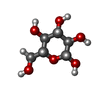 ChemComp-BGC: 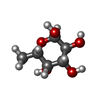 ChemComp-FUC: |
| Source |
|
 Keywords Keywords | BLOOD CLOTTING / complex / nanodisc |


 mus musculus (house mouse)
 homo sapiens (human)
 escherichia coli (E. coli)