[English] 日本語
Yorodumi Papers
- Database of articles cited by EMDB/PDB/SASBDB data -

+
Search query

Keywords
Structure methods
Author
Journal
IF

-
Structure paper

TitleOC43 clinical isolate spike proteins have distinct carbohydrate-binding properties.
Journal, issue, pagesNat Commun, Year 2026
Publish dateMay 16, 2026
AuthorsZaky Hassan / Min Jin / Ying Liu / Zhijie Li / Alan H M Wong / Marc Desforges / Adam Forman / Mark Nitz / Tarini Gunawardena / Theo J Moraes / Masahiro Narimatsu / Jeffrey L Wrana / Hai Yu / Xi Chen / James M Rini /
PubMed AbstractThe human coronavirus HCoV-OC43 (OC43) is the most widespread of the four common cold-causing seasonal coronaviruses, and tissue culture-adapted strains of it have been used for ~50 years. ...The human coronavirus HCoV-OC43 (OC43) is the most widespread of the four common cold-causing seasonal coronaviruses, and tissue culture-adapted strains of it have been used for ~50 years. Nevertheless, clinical isolates of OC43 differ from tissue culture-adapted OC43 in ways that call into question the value of the latter as a model. Among these are differences in their entry mechanisms and the activities of their hemagglutinin-esterases (HE). We now show that the spike proteins of OC43 clinical isolates differ from that of the tissue culture-adapted reference strain (OC43-Lab) in their carbohydrate-binding properties and ability to bind mucins, decoy receptors cleaved by the HE. We also show that, unlike HCoV-HKU1 (HKU1), they do not bind with high affinity and specificity the 9-O-acetylated α2-8-linked disialic acid moiety implicated in viral entry for OC43-Lab and HKU1. The spike proteins of the OC43 clinical isolates possess two inserts, not found in OC43-Lab, that flank the carbohydrate-binding site. Our structural analysis of a representative clinical isolate shows that insert-2 is a determinant of these specificity differences and that the carbohydrate-binding site undergoes conformational changes on carbohydrate binding. These structural features are shared by HKU1 and suggest common mechanisms for adaptation to the human sialoglycome.
External linksNat Commun / PubMed:42143065
MethodsEM (single particle)
Resolution1.68 - 2.05 Å
Structure data

EMDB-70900, PDB-9ovk:
Cryo-EM structure of HCoV-OC43-Lab Spike glycoprotein in complex with 9O-acetyl GD3 sialoglycan (D1 domain local refine)
Method: EM (single particle) / Resolution: 1.7 Å

EMDB-70901, PDB-9ovl:
Cryo-EM structure of HCoV-OC43-Lab Spike glycoprotein in complex with 9O-acetyl GD3 sialoglycan
Method: EM (single particle) / Resolution: 1.68 Å

EMDB-70902, PDB-9ovm:
Cryo-EM structure of HCoV-OC43-C2 Spike glycoprotein (local refined D1 domain)
Method: EM (single particle) / Resolution: 2.05 Å

EMDB-70903, PDB-9ovn:
Cryo-EM structure of HCoV-OC43-C2 Spike glycoprotein
Method: EM (single particle) / Resolution: 1.93 Å

EMDB-70904, PDB-9ovo:
Cryo-EM structure of HCoV-OC43-C2 Spike glycoprotein in complex with 9O-acetyl GD3 sialoglycan (Local refined D1 domain)
Method: EM (single particle) / Resolution: 1.98 Å

Chemicals

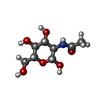
ChemComp-NAG:
2-acetamido-2-deoxy-beta-D-glucopyranose

PDB-1ar1:
Structure at 2.7 Angstrom Resolution of the Paracoccus Denitrificans two-subunit Cytochrome C Oxidase Complexed with an Antibody Fv Fragment

ChemComp-HOH:
WATER

Source
  • human coronavirus oc43
KeywordsVIRAL PROTEIN / spike glycoprotein ectodomain / proline stablized

+
About Yorodumi Papers

-
News

-
Feb 9, 2022. New format data for meta-information of EMDB entries

New format data for meta-information of EMDB entries

  • Version 3 of the EMDB header file is now the official format.
  • The previous official version 1.9 will be removed from the archive.

Related info.:EMDB header

External links:wwPDB to switch to version 3 of the EMDB data model

-
Aug 12, 2020. Covid-19 info

Covid-19 info

URL: https://pdbj.org/emnavi/covid19.php

New page: Covid-19 featured information page in EM Navigator.

Related info.:Covid-19 info / Mar 5, 2020. Novel coronavirus structure data

+
Mar 5, 2020. Novel coronavirus structure data

Novel coronavirus structure data

Related info.:Yorodumi Speices / Aug 12, 2020. Covid-19 info

External links:COVID-19 featured content - PDBj / Molecule of the Month (242):Coronavirus Proteases

+
Jan 31, 2019. EMDB accession codes are about to change! (news from PDBe EMDB page)

EMDB accession codes are about to change! (news from PDBe EMDB page)

  • The allocation of 4 digits for EMDB accession codes will soon come to an end. Whilst these codes will remain in use, new EMDB accession codes will include an additional digit and will expand incrementally as the available range of codes is exhausted. The current 4-digit format prefixed with “EMD-” (i.e. EMD-XXXX) will advance to a 5-digit format (i.e. EMD-XXXXX), and so on. It is currently estimated that the 4-digit codes will be depleted around Spring 2019, at which point the 5-digit format will come into force.
  • The EM Navigator/Yorodumi systems omit the EMD- prefix.

Related info.:Q: What is EMD? / ID/Accession-code notation in Yorodumi/EM Navigator

External links:EMDB Accession Codes are Changing Soon! / Contact to PDBj

+
Jul 12, 2017. Major update of PDB

Major update of PDB

  • wwPDB released updated PDB data conforming to the new PDBx/mmCIF dictionary.
  • This is a major update changing the version number from 4 to 5, and with Remediation, in which all the entries are updated.
  • In this update, many items about electron microscopy experimental information are reorganized (e.g. em_software).
  • Now, EM Navigator and Yorodumi are based on the updated data.

External links:wwPDB Remediation / Enriched Model Files Conforming to OneDep Data Standards Now Available in the PDB FTP Archive

-
Yorodumi Papers

Database of articles cited by EMDB/PDB/SASBDB data

  • Database of articles cited by EMDB, PDB, and SASBDB entries
  • Using PubMed data

Related info.:EMDB / PDB / SASBDB / Yorodumi / EMN Papers / Changes in new EM Navigator and Yorodumi

Read more