 Movie
Movie Controller

[English] 日本語
 Yorodumi
- EMDB-70901: Cryo-EM structure of HCoV-OC43-Lab Spike glycoprotein in complex ... -
+ Open data

- Basic information
| Entry |  | |||||||||
|---|---|---|---|---|---|---|---|---|---|---|
| Title | Cryo-EM structure of HCoV-OC43-Lab Spike glycoprotein in complex with 9O-acetyl GD3 sialoglycan | |||||||||
 Map data Map data | ||||||||||
 Sample Sample |
| |||||||||
 Keywords Keywords | spike glycoprotein ectodomain / proline stablized / VIRAL PROTEIN | |||||||||
| Function / homology |  Function and homology information Function and homology informationhost cell endoplasmic reticulum-Golgi intermediate compartment membrane / receptor-mediated virion attachment to host cell / endocytosis involved in viral entry into host cell / fusion of virus membrane with host plasma membrane / fusion of virus membrane with host endosome membrane / viral envelope / host cell plasma membrane / virion membrane / membrane Similarity search - Function | |||||||||
| Biological species |  Human coronavirus OC43 Human coronavirus OC43 | |||||||||
| Method | single particle reconstruction / cryo EM / Resolution: 1.68 Å | |||||||||
 Authors Authors | Jin M / Rini JM | |||||||||
| Funding support |  Canada, 1 items Canada, 1 items
| |||||||||
 Citation Citation | Journal: Nat Commun / Year: 2026 Title: OC43 clinical isolate spike proteins have distinct carbohydrate-binding properties. Authors: Zaky Hassan / Min Jin / Ying Liu / Zhijie Li / Alan H M Wong / Marc Desforges / Adam Forman / Mark Nitz / Tarini Gunawardena / Theo J Moraes / Masahiro Narimatsu / Jeffrey L Wrana / Hai Yu / ...Authors: Zaky Hassan / Min Jin / Ying Liu / Zhijie Li / Alan H M Wong / Marc Desforges / Adam Forman / Mark Nitz / Tarini Gunawardena / Theo J Moraes / Masahiro Narimatsu / Jeffrey L Wrana / Hai Yu / Xi Chen / James M Rini /  Abstract: The human coronavirus HCoV-OC43 (OC43) is the most widespread of the four common cold-causing seasonal coronaviruses, and tissue culture-adapted strains of it have been used for ~50 years. ...The human coronavirus HCoV-OC43 (OC43) is the most widespread of the four common cold-causing seasonal coronaviruses, and tissue culture-adapted strains of it have been used for ~50 years. Nevertheless, clinical isolates of OC43 differ from tissue culture-adapted OC43 in ways that call into question the value of the latter as a model. Among these are differences in their entry mechanisms and the activities of their hemagglutinin-esterases (HE). We now show that the spike proteins of OC43 clinical isolates differ from that of the tissue culture-adapted reference strain (OC43-Lab) in their carbohydrate-binding properties and ability to bind mucins, decoy receptors cleaved by the HE. We also show that, unlike HCoV-HKU1 (HKU1), they do not bind with high affinity and specificity the 9-O-acetylated α2-8-linked disialic acid moiety implicated in viral entry for OC43-Lab and HKU1. The spike proteins of the OC43 clinical isolates possess two inserts, not found in OC43-Lab, that flank the carbohydrate-binding site. Our structural analysis of a representative clinical isolate shows that insert-2 is a determinant of these specificity differences and that the carbohydrate-binding site undergoes conformational changes on carbohydrate binding. These structural features are shared by HKU1 and suggest common mechanisms for adaptation to the human sialoglycome. | |||||||||
| History |
|
- Structure visualization
| Supplemental images |
|---|

- Downloads & links
-EMDB archive
| Map data | emd_70901.map.gz | 301.8 MB | EMDB map data format | |
|---|---|---|---|---|
| Header (meta data) | emd-70901-v30.xmlemd-70901.xml | 20.9 KB 20.9 KB | Display Display | EMDB header |
| FSC (resolution estimation) | emd_70901_fsc.xml | 17.7 KB | Display | FSC data file |
| Images |  emd_70901.png emd_70901.png | 55.1 KB | ||
| Masks | emd_70901_msk_1.map | 600.7 MB | Mask map | |
| Filedesc metadata | emd-70901.cif.gz | 7.1 KB | ||
| Others | emd_70901_half_map_1.map.gzemd_70901_half_map_2.map.gz | 557.6 MB 557.6 MB | ||
| Archive directory |  https://data.pdbj.org/pub/emdb/structures/EMD-70901ftp://data.pdbj.org/pub/emdb/structures/EMD-70901 https://data.pdbj.org/pub/emdb/structures/EMD-70901ftp://data.pdbj.org/pub/emdb/structures/EMD-70901 | HTTPS FTP |
-Related structure data
| Related structure data |  9ovlMC  9ovkC  9ovmC  9ovnC  9ovoC  9ovpC M: atomic model generated by this map C: citing same article ( |
|---|---|
| Similar structure data |


-Links
| EMDB pages | EMDB (EBI/PDBe) / EMDataResource |
|---|
-Map
| File | Download / File: emd_70901.map.gz / Format: CCP4 / Size: 600.7 MB / Type: IMAGE STORED AS FLOATING POINT NUMBER (4 BYTES) | ||||||||||||||||||||||||||||||||||||
|---|---|---|---|---|---|---|---|---|---|---|---|---|---|---|---|---|---|---|---|---|---|---|---|---|---|---|---|---|---|---|---|---|---|---|---|---|---|
| Projections & slices | Image control
Images are generated by Spider. | ||||||||||||||||||||||||||||||||||||
| Voxel size | X=Y=Z: 0.64 Å | ||||||||||||||||||||||||||||||||||||
| Density |
| ||||||||||||||||||||||||||||||||||||
| Symmetry | Space group: 1 | ||||||||||||||||||||||||||||||||||||
| Details | EMDB XML:
|
 Z (Sec.)
 Y (Row.)
 X (Col.)


-Supplemental data
-Mask #1
| File | emd_70901_msk_1.map | ||||||||||||
|---|---|---|---|---|---|---|---|---|---|---|---|---|---|
| Projections & Slices |
| ||||||||||||
| Density Histograms |


-Half map: #1
| File | emd_70901_half_map_1.map | ||||||||||||
|---|---|---|---|---|---|---|---|---|---|---|---|---|---|
| Projections & Slices |
| ||||||||||||
| Density Histograms |


-Half map: #2
| File | emd_70901_half_map_2.map | ||||||||||||
|---|---|---|---|---|---|---|---|---|---|---|---|---|---|
| Projections & Slices |
| ||||||||||||
| Density Histograms |


- Sample components
-Entire : Human coronavirus OC43 spike glycoprotein
| Entire | Name: Human coronavirus OC43 spike glycoprotein |
|---|---|
| Components |
|
-Supramolecule #1: Human coronavirus OC43 spike glycoprotein
| Supramolecule | Name: Human coronavirus OC43 spike glycoprotein / type: complex / ID: 1 / Parent: 0 / Macromolecule list: #1 Details: Ectodomain generated by recombinant expression in HEK293 Freestyle cells |
|---|---|
| Source (natural) | Organism: Human coronavirus OC43 |
-Macromolecule #1: Spike glycoprotein
| Macromolecule | Name: Spike glycoprotein / type: protein_or_peptide / ID: 1 / Number of copies: 3 / Enantiomer: LEVO |
|---|---|
| Source (natural) | Organism: Human coronavirus OC43 |
| Molecular weight | Theoretical: 149.1025 KDa |
| Recombinant expression | Organism:  Homo sapiens (human) Homo sapiens (human) |
| Sequence | String: VIGDLKCTSD NINDKDTGPP PISTDTVDVT NGLGTYYVLD RVYLNTTLFL NGYYPTSGST YRNMALKGSV LLSRLWFKPP FLSDFINGI FAKVKNTKVI KDRVMYSEFP AITIGSTFVN TSYSVVVQPR TINSTQDGDN KLQGLLEVSV CQYNMCEYPQ T ICHPNLGN ...String: VIGDLKCTSD NINDKDTGPP PISTDTVDVT NGLGTYYVLD RVYLNTTLFL NGYYPTSGST YRNMALKGSV LLSRLWFKPP FLSDFINGI FAKVKNTKVI KDRVMYSEFP AITIGSTFVN TSYSVVVQPR TINSTQDGDN KLQGLLEVSV CQYNMCEYPQ T ICHPNLGN HRKELWHLDT GVVSCLYKRN FTYDVNADYL YFHFYQEGGT FYAYFTDTGV VTKFLFNVYL GMALSHYYVM PL TCNSKLT LEYWVTPLTS RQYLLAFNQD GIIFNAVDCM SDFMSEIKCK TQSIAPPTGV YELNGYTVQP IADVYRRKPN LPN CNIEAW LNDKSVPSPL NWERKTFSNC NFNMSSLMSF IQADSFTCNN IDAAKIYGMC FSSITIDKFA IPNGRKVDLQ LGNL GYLQS FNYRIDTTAT SCQLYYNLPA ANVSVSRFNP STWNKRFGFI EDSVFKPRPA GVLTNHDVVY AQHCFKAPKN FCPCK LNGS CVGSGPGKNN GIGTCPAGTN YLTCDNLCTP DPITFTGTYK CPQTKSLVGI GEHCSGLAVK SDYCGGNSCT CRPQAF LGW SADSCLQGDK CNIFANFILH DVNSGLTCST DLQKANTDII LGVCVNYDLY GILGQGIFVE VNATYYNSWQ NLLYDSN GN LYGFRDYITN RTFMIRSCYS GRVSAAFHAN SSEPALLFRN IKCNYVFNNS LTRQLQPINY FDSYLGCVVN AYNSTAIS V QTCDLTVGSG YCVDYSKNRR SRGAITTGYR FTNFEPFTVN SVNDSLEPVG GLYEIQIPSE FTIGNMVEFI QTSSPKVTI DCAAFVCGDY AACKSQLVEY GSFCDNINAI LTEVNELLDT TQLQVANSLM NGVTLSTKLK DGVNFNVDDI NFSPVLGCLG SECSKASSR SAIEDLLFDK VKLSDVGFVE AYNNCTGGAE IRDLICVQSY KGIKVLPPLL SENQISGYTL AATSASLFPP W TAAAGVPF YLNVQYRING LGVTMDVLSQ NQKLIANAFN NALYAIQEGF DAPNSALVKI QAVVNANAEA LNNLLQQLSN RF GAISASL QEILSRLDPP EAEAQIDRLI NGRLTALNAY VSQQLSDSTL VKFSAAQAME KVNECVKSQS SRINFCGNGN HII SLVQNA PYGLYFIHFS YVPTKYVTAR VSPGLCIAGD RGIAPKSGYF VNVNNTWMYT GSGYYYPEPI TENNVVVMST CAVN YTKAP YVMLNTSIPN LPDFKEELDQ WFKNQTSVAP DLSLDYINVT FLDLQVEMNR LQEAIKVLNQ SYINLKDIGT YEYYV KSGG YIPEAPRDGQ AYVRKDGEWV LLSTFLNSGR AHHHHHHGAG GLNDIFEAQK IEWHEDTAAA UniProtKB: Spike glycoprotein |
-Macromolecule #3: 2-acetamido-2-deoxy-beta-D-glucopyranose
| Macromolecule | Name: 2-acetamido-2-deoxy-beta-D-glucopyranose / type: ligand / ID: 3 / Number of copies: 33 / Formula: NAG |
|---|---|
| Molecular weight | Theoretical: 221.208 Da |
| Chemical component information | 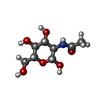 ChemComp-NAG: |
-Macromolecule #4: 5-acetamido-8-O-(5-acetamido-9-O-acetyl-3,5-dideoxy-D-glycero-alp...
| Macromolecule | Name: 5-acetamido-8-O-(5-acetamido-9-O-acetyl-3,5-dideoxy-D-glycero-alpha-D-galacto-non-2-ulopyranonosyl)-3,5-dideoxy-D-glycero-alpha-D-galacto-non-2-ulopyranosonic acid type: ligand / ID: 4 / Number of copies: 3 / Formula: A1AR1 |
|---|---|
| Molecular weight | Theoretical: 642.561 Da |
-Experimental details
-Structure determination
| Method | cryo EM |
|---|---|
 Processing Processing | single particle reconstruction |
| Aggregation state | particle |
-Sample preparation
| Buffer | pH: 8 Component:
| |||||||||
|---|---|---|---|---|---|---|---|---|---|---|
| Grid | Model: C-flat-2/2 / Support film - Material: GOLD / Support film - topology: HOLEY / Support film - Film thickness: 20 | |||||||||
| Vitrification | Cryogen name: ETHANE / Chamber humidity: 100 % / Chamber temperature: 277 K / Instrument: FEI VITROBOT MARK IV |
- Electron microscopy
| Microscope | TFS KRIOS |
|---|---|
| Image recording | Film or detector model: FEI FALCON IV (4k x 4k) / Average electron dose: 36.0 e/Å2 |
| Electron beam | Acceleration voltage: 300 kV / Electron source:  FIELD EMISSION GUN FIELD EMISSION GUN |
| Electron optics | Illumination mode: FLOOD BEAM / Imaging mode: BRIGHT FIELD / Cs: 2.7 mm / Nominal defocus max: 2.0 µm / Nominal defocus min: 1.0 µm / Nominal magnification: 120000 |
| Sample stage | Specimen holder model: FEI TITAN KRIOS AUTOGRID HOLDER / Cooling holder cryogen: NITROGEN |
| Experimental equipment |  Model: Titan Krios / Image courtesy: FEI Company |

