 Movie
Movie Controller
 Structure viewers
 About Yorodumi Papers


+Search query
-Structure paper
| Title | Cryo-electron microscopy reveals sequential binding and activation of Ryanodine Receptors by statin triplets. |
|---|---|
| Journal, issue, pages | Nat Commun, Vol. 16, Issue 1, Page 11508, Year 2025 |
| Publish date | Nov 20, 2025 |
 Authors Authors | Steven Molinarolo / Carmen R Valdivia / Héctor H Valdivia / Filip Van Petegem /   |
| PubMed Abstract | Statins are the most prescribed class of drugs and inhibit a key enzyme in the cholesterol biosynthesis pathway. Many patients have reported mild to severe muscle related symptoms and a subset are at ...Statins are the most prescribed class of drugs and inhibit a key enzyme in the cholesterol biosynthesis pathway. Many patients have reported mild to severe muscle related symptoms and a subset are at risk for rhabdomyolysis. Sequence variants in RyR1, the skeletal muscle Ryanodine Receptor, correlate with intolerance to statins, but whether RyR1 can bind statins directly has remained unclear. Here we report cryo-EM structures of RyR1 in the absence and presence of atorvastatin, firmly establishing RyR1 as an unintended off-target. Our results show an unusual binding mode whereby three atorvastatin molecules bind together in a cleft formed by the pseudo-voltage sensing domain, making extensive interactions with each other and with RyR1. Atorvastatin activates RyR1 in a sequential way, whereby one statin per subunit can bind to the transmembrane region of a closed RyR1, with small structural perturbations that prime the channel for opening. Binding of two additional statins per subunit is associated with a widening of the pseudo-voltage sensing domain that triggers opening of the pore. Comparison with atorvastatin binding to HMG-CoA reductase, its intended target, offers clues on how to modify the statin to reduce RyR1 binding, while leaving binding to HMG-CoA reductase unperturbed. |
 External links External links | Nat Commun / PubMed:41266329 / PubMed Central |
| Methods | EM (single particle) |
| Resolution | 2.85 - 4.08 Å |
| Structure data |  EMDB-70574: Cryo-EM Structure of Ryanodine Receptor 1: DMSO Control Consensus Map  EMDB-70575: Cryo-EM Structure of Ryanodine Receptor 1: DMSO Control N-terminal Domain Locally Refined Map  EMDB-70576: Cryo-EM Structure of Ryanodine Receptor 1: DMSO Control BSol Locally Refined Map  EMDB-70577: Cryo-EM Structure of Ryanodine Receptor 1: DMSO Control C-terminal Domain Locally Refined Map  EMDB-70578: Cryo-EM Structure of Ryanodine Receptor 1: DMSO Control Transmembrane Domain (C4) Locally Refined Map  EMDB-70579: Cryo-EM Structure of Ryanodine Receptor 1: Drug Bound Closed Conformation Consensus Map  EMDB-70580: Cryo-EM Structure of Ryanodine Receptor 1: Drug Bound Closed Conformation N-terminal Domain Locally Refined Map  EMDB-70581: Cryo-EM Structure of Ryanodine Receptor 1: Drug Bound Closed Conformation BSol Locally Refined Map  EMDB-70582: Cryo-EM Structure of Ryanodine Receptor 1: Drug Bound Closed Conformation C-terminal Domain Locally Refined Map  EMDB-70583: Cryo-EM Structure of Ryanodine Receptor 1: Drug Bound Closed Conformation Transmembrane Domain (C4) Locally Refined Map EMDB-70589: Cryo-EM Structure of Ryanodine Receptor 1: Drug Bound Open Conformation Composite Map EMDB-70590: Cryo-EM Structure of Rabbit Ryanodine Receptor 1: Atorvastatin Bound Closed Conformation Composite Map EMDB-70591: Cryo-EM Structure of Rabbit Ryanodine Receptor 1: DMSO Control Composite Map  EMDB-70599: Cryo-EM Structure of Pig Ryanodine Receptor 1 R615C Mutant: Drug Bound Open Conformation Consensus Map  EMDB-70600: Cryo-EM Structure of Pig Ryanodine Receptor 1 R615C Mutant: Drug Bound Closed Conformation Consensus Map  EMDB-71920: Cryo-EM Structure of Pig Ryanodine Receptor 1 R615C Mutant: Drug Bound Open Conformation Transmembrane Domain (C4) Locally Refined Map  EMDB-71921: Cryo-EM Structure of Pig Ryanodine Receptor 1 R615C Mutant: Drug Bound Open Conformation BSol Domain Locally Refined Map  EMDB-71922: Cryo-EM Structure of Pig Ryanodine Receptor 1 R615C Mutant: Drug Bound Open Conformation N-terminal Domain Locally Refined Map  EMDB-71923: Cryo-EM Structure of Pig Ryanodine Receptor 1 R615C Mutant: Drug Bound Open Conformation C-terminal Domain Locally Refined Map EMDB-71924: Cryo-EM Structure of Pig Ryanodine Receptor 1 R615C Mutant: Atorvastatin Bound Open Conformation Composite Map |
| Chemicals | 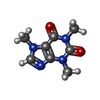 ChemComp-CFF:  ChemComp-CA: 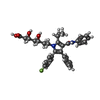 ChemComp-117:  ChemComp-ZN: |
| Source |
|
 Keywords Keywords | TRANSPORT PROTEIN/Isomerase / Ion channel / Calcium Channel / TRANSPORT PROTEIN / TRANSPORT PROTEIN-Isomerase complex / Ion channel Calcium Channel |


 oryctolagus cuniculus (rabbit)
 homo sapiens (human)
 sus scrofa (pig)