[English] 日本語
Yorodumi Papers
- Database of articles cited by EMDB/PDB/SASBDB data -

+
Search query

Keywords
Structure methods
Author
Journal
IF

-
Structure paper

TitleStructures of myxobacterial phytochrome revealed by cryo-EM using the Spotiton technique and with x-ray crystallography.
Journal, issue, pagesStruct Dyn, Vol. 12, Issue 3, Page 034701, Year 2025
Publish dateMay 1, 2025
AuthorsPrabin Karki / David Menendez / William Budell / Shishir Dangi / Carolina Hernandez / Joshua Mendez / Srinivasan Muniyappan / Shibom Basu / Peter Schwander / Tek N Malla / Emina A Stojković / Marius Schmidt /
PubMed AbstractPhytochromes are red-light photoreceptors first identified in plants, with homologs found in bacteria and fungi, that regulate a variety of critical physiological processes. They undergo a reversible ...Phytochromes are red-light photoreceptors first identified in plants, with homologs found in bacteria and fungi, that regulate a variety of critical physiological processes. They undergo a reversible photocycle between two distinct states: a red-light-absorbing Pr form and a far-red light-absorbing Pfr form. This Pr/Pfr photoconversion controls the activity of a C-terminal enzymatic domain, typically a histidine kinase (HK). However, the molecular mechanisms underlying light-induced regulation of HK activity in bacteria remain poorly understood, as only a few structures of unmodified bacterial phytochromes with HK activity are known. Recently, cryo-EM structures of a wild-type bacterial phytochrome with HK activity are solved that reveal homodimers in both the Pr and Pfr states, as well as a heterodimer with individual monomers in distinct Pr and Pfr states. Cryo-EM structures of a truncated version of the same phytochrome-lacking the HK domain-also show a homodimer in the Pfr state and a Pr/Pfr heterodimer. Here, we describe in detail how structural information is obtained from cryo-EM data on a full-length intact bacteriophytochrome, and how the cryo-EM structure can contribute to the understanding of the function of the phytochrome. In addition, we compare the cryo-EM structure to an unusual x-ray structure that is obtained from a fragmented full-length phytochrome crystallized in the Pr-state.
External linksStruct Dyn / PubMed:40322674 / PubMed Central
MethodsEM (single particle) / X-ray diffraction
Resolution2.1 - 6.0 Å
Structure data

EMDB-70119: Pr/Pr homodimer of Stigmatella aurantiaca bacteriophytochrome 2
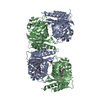
Method: EM (single particle) / Resolution: 6.0 Å

PDB-9naa:
Unusual structure of a bacteriophytochrome fragment derived from full length SaBphP2
Method: X-RAY DIFFRACTION / Resolution: 2.1 Å

Chemicals

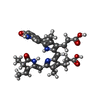
ChemComp-EL5:
3-[(2Z)-2-({3-(2-carboxyethyl)-5-[(E)-(4-ethenyl-3-methyl-5-oxo-1,5-dihydro-2H-pyrrol-2-ylidene)methyl]-4-methyl-1H-pyrrol-2-yl}methylidene)-5-{(Z)-[(3E,4S)-3-ethylidene-4-methyl-5-oxopyrrolidin-2-ylidene]methyl}-4-methyl-2H-pyrrol-3-yl]propanoic acid

ChemComp-HOH:
WATER

Source
  • stigmatella aurantiaca (bacteria)
KeywordsSIGNALING PROTEIN / phytochrome / myxobacteria / biliverdin

+
About Yorodumi Papers

-
News

-
Feb 9, 2022. New format data for meta-information of EMDB entries

New format data for meta-information of EMDB entries

  • Version 3 of the EMDB header file is now the official format.
  • The previous official version 1.9 will be removed from the archive.

Related info.:EMDB header

External links:wwPDB to switch to version 3 of the EMDB data model

-
Aug 12, 2020. Covid-19 info

Covid-19 info

URL: https://pdbj.org/emnavi/covid19.php

New page: Covid-19 featured information page in EM Navigator.

Related info.:Covid-19 info / Mar 5, 2020. Novel coronavirus structure data

+
Mar 5, 2020. Novel coronavirus structure data

Novel coronavirus structure data

Related info.:Yorodumi Speices / Aug 12, 2020. Covid-19 info

External links:COVID-19 featured content - PDBj / Molecule of the Month (242):Coronavirus Proteases

+
Jan 31, 2019. EMDB accession codes are about to change! (news from PDBe EMDB page)

EMDB accession codes are about to change! (news from PDBe EMDB page)

  • The allocation of 4 digits for EMDB accession codes will soon come to an end. Whilst these codes will remain in use, new EMDB accession codes will include an additional digit and will expand incrementally as the available range of codes is exhausted. The current 4-digit format prefixed with “EMD-” (i.e. EMD-XXXX) will advance to a 5-digit format (i.e. EMD-XXXXX), and so on. It is currently estimated that the 4-digit codes will be depleted around Spring 2019, at which point the 5-digit format will come into force.
  • The EM Navigator/Yorodumi systems omit the EMD- prefix.

Related info.:Q: What is EMD? / ID/Accession-code notation in Yorodumi/EM Navigator

External links:EMDB Accession Codes are Changing Soon! / Contact to PDBj

+
Jul 12, 2017. Major update of PDB

Major update of PDB

  • wwPDB released updated PDB data conforming to the new PDBx/mmCIF dictionary.
  • This is a major update changing the version number from 4 to 5, and with Remediation, in which all the entries are updated.
  • In this update, many items about electron microscopy experimental information are reorganized (e.g. em_software).
  • Now, EM Navigator and Yorodumi are based on the updated data.

External links:wwPDB Remediation / Enriched Model Files Conforming to OneDep Data Standards Now Available in the PDB FTP Archive

-
Yorodumi Papers

Database of articles cited by EMDB/PDB/SASBDB data

  • Database of articles cited by EMDB, PDB, and SASBDB entries
  • Using PubMed data

Related info.:EMDB / PDB / SASBDB / Yorodumi / EMN Papers / Changes in new EM Navigator and Yorodumi

Read more