 Movie
Movie Controller
 Structure viewers
 About Yorodumi Papers


+Search query
-Structure paper
| Title | Structural basis for lysophosphatidic acid recognition and atypical Gα coupling by LPAR5. |
|---|---|
| Journal, issue, pages | Proc Natl Acad Sci U S A, Vol. 123, Issue 25, Page e2537482123, Year 2026 |
| Publish date | Jun 23, 2026 |
 Authors Authors | Xin Li / Kai Wang / Zhongliang Xing / Min Zhang / Wen Hu / Qingning Yuan / H Eric Xu / Li-Hua Zhao /  |
| PubMed Abstract | Lysophosphatidic acid receptor 5 (LPAR5) is a non-endothelial differentiation gene class A G protein-coupled receptor that regulates neuropathic pain, itch, and cancer progression through coupling to ...Lysophosphatidic acid receptor 5 (LPAR5) is a non-endothelial differentiation gene class A G protein-coupled receptor that regulates neuropathic pain, itch, and cancer progression through coupling to G proteins. Here, we report the cryo-EM structure of LPAR5 bound to 1-oleoyl-lysophosphatidic acid (LPA) in complex with G at 2.96 Å resolution, revealing a distinct mode of receptor activation and G protein coupling. The phosphate headgroup of LPA forms extensive polar interactions with residues from extracellular loop 2 and transmembrane helices TM5-TM7, while the lipid tail inserts into a deep hydrophobic cavity formed by TM3-TM5. Site-directed mutagenesis confirms the functional importance of these interactions. Remarkably, LPAR5 exhibits a noncanonical G protein coupling mode. Unlike previously reported GPCR-G protein structures in which the Gα C-terminal α5 helix ("wavy hook") primarily engages TM6, the wavy hook in LPAR5 is positioned toward the intracellular loop 1-helix 8 interface. This configuration is associated with limited TM6 outward displacement and modest rearrangement at the toggle-switch position (6.48). The resulting interface is stabilized by receptor-specific interactions and supported by functional data. Together, these findings reveal an alternative mode of GPCR-G protein coupling and highlight the structural plasticity underlying signaling specificity in LPA receptors. |
 External links External links | Proc Natl Acad Sci U S A / PubMed:42313925 / PubMed Central |
| Methods | EM (single particle) |
| Resolution | 2.96 Å |
| Structure data | EMDB-67439, PDB-20zx: |
| Chemicals | 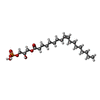 ChemComp-UBL: |
| Source |
|
 Keywords Keywords | MEMBRANE PROTEIN / LPAR5 / LPA |


 homo sapiens (human)
 rattus norvegicus (Norway rat)
 bos taurus (domestic cattle)