[English] 日本語
Yorodumi Papers
- Database of articles cited by EMDB/PDB/SASBDB data -

+
Search query

Keywords
Structure methods
Author
Journal
IF

-
Structure paper

TitleBroad Neutralizing Activity of Monoclonal Antibodies Against the Omicron Variants Isolated From Patients With Early Severe Acute Respiratory Syndrome Coronavirus-2.
Journal, issue, pagesJ Med Virol, Vol. 98, Issue 5, Page e70969, Year 2026
Publish dateJul 16, 2026
AuthorsDa Sol Kim / Uijin Kim / Hye-Min Woo / Hansaem Lee / Eun-Seong Jo / Min Jeong Noh / So-Young Lee / Byoung Kwon Park / Jeong-Sun Yang / Kyung-Chang Kim / Joo-Yeon Lee / Dong-Min Wang / Hyun-Soo Cho / Hyun-Joo Kim /
PubMed AbstractSince its emergence in 2019, severe acute respiratory syndrome coronavirus-2 (SARS-CoV-2) has caused a global pandemic driven by rapid mutation and high transmissibility. Current therapeutic ...Since its emergence in 2019, severe acute respiratory syndrome coronavirus-2 (SARS-CoV-2) has caused a global pandemic driven by rapid mutation and high transmissibility. Current therapeutic strategies may not effectively address the continuously evolving mutant strains, underscoring the need for treatments with broad neutralizing activity. Two monoclonal antibodies (mAbs): SR-23 and CS-42, isolated from convalescent patients infected with SARS-CoV-2 during the early phase of the 2020 pandemic, demonstrated significant neutralizing activities against a variety of variants. Specifically, SR-23 exhibited neutralizing activity against BA.5 and XBB1.5, whereas CS-42 showed efficacy against Delta, BA.1, and BA.2 variants. In addition, combining the two mAbs demonstrated improved neutralization activity. Cryo-electron microscopy (cryo-EM) structural analysis revealed that SR-23 and CS-42 bind to nonoverlapping epitopes on the SARS-CoV-2 spike protein. Furthermore, both antibodies exhibited strong therapeutic effects in K18-hACE2 mice infected with D614G, BA.2, and XBB.1.5. These findings provide insights into the development of antibody-based therapeutics targeting emerging Omicron variants and suggest that combined administration could broaden neutralizing activity.
External linksJ Med Virol / PubMed:42126192 / PubMed Central
MethodsEM (single particle)
Resolution2.8 - 3.2 Å
Structure data

EMDB-66860, PDB-9xgw:
Cryo-EM structure of SARS-CoV-2 receptor binding domain in complex with CS-42 Fab (local refinement of RBD and Fv)
Method: EM (single particle) / Resolution: 3.2 Å

EMDB-66861, PDB-9xgx:
Cryo-EM structure of SARS-CoV-2 receptor binding domain in complex with SR-23 Fab (local refinement of RBD and Fv)
Method: EM (single particle) / Resolution: 2.8 Å

Chemicals

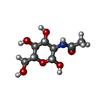
ChemComp-NAG:
2-acetamido-2-deoxy-beta-D-glucopyranose

Source
  • severe acute respiratory syndrome coronavirus 2
  • homo sapiens (human)
KeywordsVIRAL PROTEIN/IMMUNE SYSTEM / Viral protein / antibody / VIRAL PROTEIN-IMMUNE SYSTEM complex

+
About Yorodumi Papers

-
News

-
Feb 9, 2022. New format data for meta-information of EMDB entries

New format data for meta-information of EMDB entries

  • Version 3 of the EMDB header file is now the official format.
  • The previous official version 1.9 will be removed from the archive.

Related info.:EMDB header

External links:wwPDB to switch to version 3 of the EMDB data model

-
Aug 12, 2020. Covid-19 info

Covid-19 info

URL: https://pdbj.org/emnavi/covid19.php

New page: Covid-19 featured information page in EM Navigator.

Related info.:Covid-19 info / Mar 5, 2020. Novel coronavirus structure data

+
Mar 5, 2020. Novel coronavirus structure data

Novel coronavirus structure data

Related info.:Yorodumi Speices / Aug 12, 2020. Covid-19 info

External links:COVID-19 featured content - PDBj / Molecule of the Month (242):Coronavirus Proteases

+
Jan 31, 2019. EMDB accession codes are about to change! (news from PDBe EMDB page)

EMDB accession codes are about to change! (news from PDBe EMDB page)

  • The allocation of 4 digits for EMDB accession codes will soon come to an end. Whilst these codes will remain in use, new EMDB accession codes will include an additional digit and will expand incrementally as the available range of codes is exhausted. The current 4-digit format prefixed with “EMD-” (i.e. EMD-XXXX) will advance to a 5-digit format (i.e. EMD-XXXXX), and so on. It is currently estimated that the 4-digit codes will be depleted around Spring 2019, at which point the 5-digit format will come into force.
  • The EM Navigator/Yorodumi systems omit the EMD- prefix.

Related info.:Q: What is EMD? / ID/Accession-code notation in Yorodumi/EM Navigator

External links:EMDB Accession Codes are Changing Soon! / Contact to PDBj

+
Jul 12, 2017. Major update of PDB

Major update of PDB

  • wwPDB released updated PDB data conforming to the new PDBx/mmCIF dictionary.
  • This is a major update changing the version number from 4 to 5, and with Remediation, in which all the entries are updated.
  • In this update, many items about electron microscopy experimental information are reorganized (e.g. em_software).
  • Now, EM Navigator and Yorodumi are based on the updated data.

External links:wwPDB Remediation / Enriched Model Files Conforming to OneDep Data Standards Now Available in the PDB FTP Archive

-
Yorodumi Papers

Database of articles cited by EMDB/PDB/SASBDB data

  • Database of articles cited by EMDB, PDB, and SASBDB entries
  • Using PubMed data

Related info.:EMDB / PDB / SASBDB / Yorodumi / EMN Papers / Changes in new EM Navigator and Yorodumi

Read more