Journal: J Med Virol / Year: 2026 Title: Broad Neutralizing Activity of Monoclonal Antibodies Against the Omicron Variants Isolated From Patients With Early Severe Acute Respiratory Syndrome Coronavirus-2. Authors: Da Sol Kim / Uijin Kim / Hye-Min Woo / Hansaem Lee / Eun-Seong Jo / Min Jeong Noh / So-Young Lee / Byoung Kwon Park / Jeong-Sun Yang / Kyung-Chang Kim / Joo-Yeon Lee / Dong-Min Wang / Hyun- ...Authors: Da Sol Kim / Uijin Kim / Hye-Min Woo / Hansaem Lee / Eun-Seong Jo / Min Jeong Noh / So-Young Lee / Byoung Kwon Park / Jeong-Sun Yang / Kyung-Chang Kim / Joo-Yeon Lee / Dong-Min Wang / Hyun-Soo Cho / Hyun-Joo Kim / Abstract: Since its emergence in 2019, severe acute respiratory syndrome coronavirus-2 (SARS-CoV-2) has caused a global pandemic driven by rapid mutation and high transmissibility. Current therapeutic ...Since its emergence in 2019, severe acute respiratory syndrome coronavirus-2 (SARS-CoV-2) has caused a global pandemic driven by rapid mutation and high transmissibility. Current therapeutic strategies may not effectively address the continuously evolving mutant strains, underscoring the need for treatments with broad neutralizing activity. Two monoclonal antibodies (mAbs): SR-23 and CS-42, isolated from convalescent patients infected with SARS-CoV-2 during the early phase of the 2020 pandemic, demonstrated significant neutralizing activities against a variety of variants. Specifically, SR-23 exhibited neutralizing activity against BA.5 and XBB1.5, whereas CS-42 showed efficacy against Delta, BA.1, and BA.2 variants. In addition, combining the two mAbs demonstrated improved neutralization activity. Cryo-electron microscopy (cryo-EM) structural analysis revealed that SR-23 and CS-42 bind to nonoverlapping epitopes on the SARS-CoV-2 spike protein. Furthermore, both antibodies exhibited strong therapeutic effects in K18-hACE2 mice infected with D614G, BA.2, and XBB.1.5. These findings provide insights into the development of antibody-based therapeutics targeting emerging Omicron variants and suggest that combined administration could broaden neutralizing activity.
Model: Quantifoil R1.2/1.3 / Material: COPPER / Mesh: 200 / Support film - #0 - Film type ID: 1 / Support film - #0 - Material: CARBON / Support film - #0 - topology: HOLEY / Support film - #0 - Film thickness: 12 / Support film - #1 - Film type ID: 2 / Support film - #1 - Material: CARBON / Support film - #1 - topology: CONTINUOUS / Support film - #1 - Film thickness: 2 / Pretreatment - Type: GLOW DISCHARGE / Pretreatment - Time: 15 sec. / Pretreatment - Atmosphere: AIR
Vitrification
Cryogen name: ETHANE / Chamber humidity: 100 % / Chamber temperature: 277.15 K / Instrument: FEI VITROBOT MARK IV
-
Electron microscopy
Microscope
TFS KRIOS
Image recording
Film or detector model: FEI FALCON IV (4k x 4k) / Average electron dose: 60.0 e/Å2
Electron beam
Acceleration voltage: 300 kV / Electron source: FIELD EMISSION GUN
Resolution.type: BY AUTHOR / Resolution: 3.2 Å / Resolution method: FSC 0.143 CUT-OFF / Software - Name: cryoSPARC (ver. 4.7.1) Software - details: local refinement using a mask covering RBD and Fab is used. Number images used: 37804
Initial angle assignment
Type: MAXIMUM LIKELIHOOD
Final angle assignment
Type: MAXIMUM LIKELIHOOD
Final 3D classification
Number classes: 3 / Avg.num./class: 60000 / Software - Name: cryoSPARC (ver. 4.7.1) Software - details: heterogenous refinement was used to classify the particle images.
FSC plot (resolution estimation)
-
Atomic model buiding 1
Initial model
Chain - Source name: AlphaFold / Chain - Initial model type: in silico model
Refinement
Space: REAL / Protocol: RIGID BODY FIT
Output model
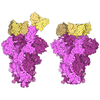
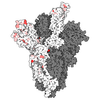
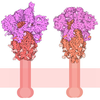
PDB-9xgw: Cryo-EM structure of SARS-CoV-2 receptor binding domain in complex with CS-42 Fab (local refinement of RBD and Fv)
+
About Yorodumi
-
News
-
Feb 9, 2022. New format data for meta-information of EMDB entries
New format data for meta-information of EMDB entries
Version 3 of the EMDB header file is now the official format.
The previous official version 1.9 will be removed from the archive.
In the structure databanks used in Yorodumi, some data are registered as the other names, "COVID-19 virus" and "2019-nCoV". Here are the details of the virus and the list of structure data.
Jan 31, 2019. EMDB accession codes are about to change! (news from PDBe EMDB page)
EMDB accession codes are about to change! (news from PDBe EMDB page)
The allocation of 4 digits for EMDB accession codes will soon come to an end. Whilst these codes will remain in use, new EMDB accession codes will include an additional digit and will expand incrementally as the available range of codes is exhausted. The current 4-digit format prefixed with “EMD-” (i.e. EMD-XXXX) will advance to a 5-digit format (i.e. EMD-XXXXX), and so on. It is currently estimated that the 4-digit codes will be depleted around Spring 2019, at which point the 5-digit format will come into force.
The EM Navigator/Yorodumi systems omit the EMD- prefix.
Related info.:Q: What is EMD? / ID/Accession-code notation in Yorodumi/EM Navigator
Yorodumi is a browser for structure data from EMDB, PDB, SASBDB, etc.
This page is also the successor to EM Navigator detail page, and also detail information page/front-end page for Omokage search.
The word "yorodu" (or yorozu) is an old Japanese word meaning "ten thousand". "mi" (miru) is to see.
Related info.:EMDB / PDB / SASBDB / Comparison of 3 databanks / Yorodumi Search / Aug 31, 2016. New EM Navigator & Yorodumi / Yorodumi Papers / Jmol/JSmol / Function and homology information / Changes in new EM Navigator and Yorodumi
 Movie
Movie Controller

 Yorodumi
 Open data
 Basic information
 Map data
 Sample
 Keywords
 Function and homology information
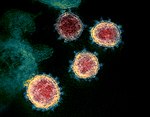 Severe acute respiratory syndrome coronavirus 2 /
  Homo sapiens (human)
 Authors
 Korea, Republic Of, 2 items
  Citation
 Structure visualization
 Downloads & links
 emd_66860.png
 https://data.pdbj.org/pub/emdb/structures/EMD-66860


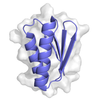
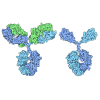
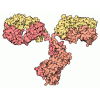
 Z (Sec.)
 Y (Row.)
 X (Col.)


 Sample components
 Spodoptera frugiperda (fall armyworm)
 Processing
 Electron microscopy
 FIELD EMISSION GUN

