[English] 日本語
Yorodumi Papers
- Database of articles cited by EMDB/PDB/SASBDB data -

+
Search query

Keywords
Structure methods
Author
Journal
IF

-
Structure paper

TitleUnderstanding the Catalytic Determinant role of Diaphorase-Like Subunit in Formate Dehydrogenases via Redox Couples.
Journal, issue, pagesAdv Sci (Weinh), Page e75764, Year 2026
Publish dateMay 19, 2026
AuthorsKuncheng Zhang / Weisong Liu / Hao Su / Huijuan Cui / Yuanming Wang / Zhiguang Zhu / Chun You / Lingling Zhang /
PubMed AbstractMulti-subunit formate dehydrogenases (FDHs), which catalyze the interconversion of formate and carbon dioxide (CO), have drawn increasing attention for mitigating climate change and advancing ...Multi-subunit formate dehydrogenases (FDHs), which catalyze the interconversion of formate and carbon dioxide (CO), have drawn increasing attention for mitigating climate change and advancing environmental protection owing to their advantages of oxygen tolerance and easy heterogenous expression. However, differently sourced multi-subunit FDHs exhibit distinct catalytic biases, and the reasons remain unclear. On the basis of the exceptional observation of Rhodobacter aestuarii FDH favoring CO reduction, this study unveiled an oxidation inhibition effect in exclusively NADH/NAD-involved catalysis via kinetics analysis in terms of different redox couples. Substrate truncation positioned Fdhβ as the predominant subunit. Further studies based on structural and electrochemical insights interpreted that the slow desorption of NADH is the underlying determinant for the apparent catalytic bias. Knowledge-based rational design helped obtain a beneficial variant, RaFDH β E260Y, with a 10-fold increased catalytic activity in CO reduction, highlighting its potential for CO biotransformation and applications in low-carbon biomanufacturing. Eventually, bioinformatic analysis suggested that the diaphorase-like subunits and the catalysis regulation mechanism may widely exist in living organisms for modulating the redox balance of oxidoreductases, providing new insights into metabolism and catabolism.
External linksAdv Sci (Weinh) / PubMed:42154453
MethodsEM (single particle)
Resolution2.9 Å
Structure data

EMDB-66342, PDB-9wxb:
Cryo-EM structure of reduced form of formatedehydrogenase from Rhodobacter aestuarii (RaFDH) with NADH
Method: EM (single particle) / Resolution: 2.9 Å

Chemicals

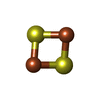
ChemComp-FES:
FE2/S2 (INORGANIC) CLUSTER

ChemComp-MGD:
2-AMINO-5,6-DIMERCAPTO-7-METHYL-3,7,8A,9-TETRAHYDRO-8-OXA-1,3,9,10-TETRAAZA-ANTHRACEN-4-ONE GUANOSINE DINUCLEOTIDE

ChemComp-6MO:
Unknown entry

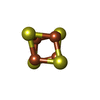
ChemComp-SF4:
IRON/SULFUR CLUSTER

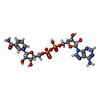
ChemComp-NAD:
NICOTINAMIDE-ADENINE-DINUCLEOTIDE / NAD*YM

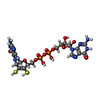
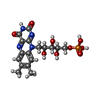
ChemComp-FMN:
FLAVIN MONONUCLEOTIDE

Source
  • rhodobacter aestuarii (bacteria)
KeywordsOXIDOREDUCTASE / formate dehydrogenase / formate oxidation / carbon dioxide redcution / FMN / NAD

+
About Yorodumi Papers

-
News

-
Feb 9, 2022. New format data for meta-information of EMDB entries

New format data for meta-information of EMDB entries

  • Version 3 of the EMDB header file is now the official format.
  • The previous official version 1.9 will be removed from the archive.

Related info.:EMDB header

External links:wwPDB to switch to version 3 of the EMDB data model

-
Aug 12, 2020. Covid-19 info

Covid-19 info

URL: https://pdbj.org/emnavi/covid19.php

New page: Covid-19 featured information page in EM Navigator.

Related info.:Covid-19 info / Mar 5, 2020. Novel coronavirus structure data

+
Mar 5, 2020. Novel coronavirus structure data

Novel coronavirus structure data

Related info.:Yorodumi Speices / Aug 12, 2020. Covid-19 info

External links:COVID-19 featured content - PDBj / Molecule of the Month (242):Coronavirus Proteases

+
Jan 31, 2019. EMDB accession codes are about to change! (news from PDBe EMDB page)

EMDB accession codes are about to change! (news from PDBe EMDB page)

  • The allocation of 4 digits for EMDB accession codes will soon come to an end. Whilst these codes will remain in use, new EMDB accession codes will include an additional digit and will expand incrementally as the available range of codes is exhausted. The current 4-digit format prefixed with “EMD-” (i.e. EMD-XXXX) will advance to a 5-digit format (i.e. EMD-XXXXX), and so on. It is currently estimated that the 4-digit codes will be depleted around Spring 2019, at which point the 5-digit format will come into force.
  • The EM Navigator/Yorodumi systems omit the EMD- prefix.

Related info.:Q: What is EMD? / ID/Accession-code notation in Yorodumi/EM Navigator

External links:EMDB Accession Codes are Changing Soon! / Contact to PDBj

+
Jul 12, 2017. Major update of PDB

Major update of PDB

  • wwPDB released updated PDB data conforming to the new PDBx/mmCIF dictionary.
  • This is a major update changing the version number from 4 to 5, and with Remediation, in which all the entries are updated.
  • In this update, many items about electron microscopy experimental information are reorganized (e.g. em_software).
  • Now, EM Navigator and Yorodumi are based on the updated data.

External links:wwPDB Remediation / Enriched Model Files Conforming to OneDep Data Standards Now Available in the PDB FTP Archive

-
Yorodumi Papers

Database of articles cited by EMDB/PDB/SASBDB data

  • Database of articles cited by EMDB, PDB, and SASBDB entries
  • Using PubMed data

Related info.:EMDB / PDB / SASBDB / Yorodumi / EMN Papers / Changes in new EM Navigator and Yorodumi

Read more