 Movie
Movie Controller

[English] 日本語
 Yorodumi
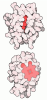
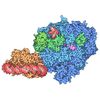
- PDB-9wxb: Cryo-EM structure of reduced form of formatedehydrogenase from Rh... -
+ Open data

- Basic information
| Entry | Database: PDB / ID: 9wxb | |||||||||||||||||||||||||||
|---|---|---|---|---|---|---|---|---|---|---|---|---|---|---|---|---|---|---|---|---|---|---|---|---|---|---|---|---|
| Title | Cryo-EM structure of reduced form of formatedehydrogenase from Rhodobacter aestuarii (RaFDH) with NADH | |||||||||||||||||||||||||||
 Components Components | (Formate dehydrogenase ...) x 4 | |||||||||||||||||||||||||||
 Keywords Keywords | OXIDOREDUCTASE / formate dehydrogenase / formate oxidation / carbon dioxide redcution / FMN / NAD | |||||||||||||||||||||||||||
| Function / homology |  Function and homology information Function and homology informationformate metabolic process / oxidoreductase complex / formate dehydrogenase (NAD+) activity / molybdopterin cofactor binding / NADH dehydrogenase activity / NADH dehydrogenase (ubiquinone) activity / respiratory electron transport chain / 2 iron, 2 sulfur cluster binding / FMN binding / 4 iron, 4 sulfur cluster binding ...formate metabolic process / oxidoreductase complex / formate dehydrogenase (NAD+) activity / molybdopterin cofactor binding / NADH dehydrogenase activity / NADH dehydrogenase (ubiquinone) activity / respiratory electron transport chain / 2 iron, 2 sulfur cluster binding / FMN binding / 4 iron, 4 sulfur cluster binding / oxidoreductase activity / metal ion binding / membrane Similarity search - Function | |||||||||||||||||||||||||||
| Biological species |  Rhodobacter aestuarii (bacteria) Rhodobacter aestuarii (bacteria) | |||||||||||||||||||||||||||
| Method | ELECTRON MICROSCOPY / single particle reconstruction / cryo EM / Resolution: 2.9 Å | |||||||||||||||||||||||||||
 Authors Authors | Zhang, K. / Zhang, L. | |||||||||||||||||||||||||||
| Funding support |  China, 1items China, 1items
| |||||||||||||||||||||||||||
 Citation Citation | Journal: Adv Sci (Weinh) / Year: 2026 Title: Understanding the Catalytic Determinant role of Diaphorase-Like Subunit in Formate Dehydrogenases via Redox Couples. Authors: Kuncheng Zhang / Weisong Liu / Hao Su / Huijuan Cui / Yuanming Wang / Zhiguang Zhu / Chun You / Lingling Zhang / Abstract: Multi-subunit formate dehydrogenases (FDHs), which catalyze the interconversion of formate and carbon dioxide (CO), have drawn increasing attention for mitigating climate change and advancing ...Multi-subunit formate dehydrogenases (FDHs), which catalyze the interconversion of formate and carbon dioxide (CO), have drawn increasing attention for mitigating climate change and advancing environmental protection owing to their advantages of oxygen tolerance and easy heterogenous expression. However, differently sourced multi-subunit FDHs exhibit distinct catalytic biases, and the reasons remain unclear. On the basis of the exceptional observation of Rhodobacter aestuarii FDH favoring CO reduction, this study unveiled an oxidation inhibition effect in exclusively NADH/NAD-involved catalysis via kinetics analysis in terms of different redox couples. Substrate truncation positioned Fdhβ as the predominant subunit. Further studies based on structural and electrochemical insights interpreted that the slow desorption of NADH is the underlying determinant for the apparent catalytic bias. Knowledge-based rational design helped obtain a beneficial variant, RaFDH β E260Y, with a 10-fold increased catalytic activity in CO reduction, highlighting its potential for CO biotransformation and applications in low-carbon biomanufacturing. Eventually, bioinformatic analysis suggested that the diaphorase-like subunits and the catalysis regulation mechanism may widely exist in living organisms for modulating the redox balance of oxidoreductases, providing new insights into metabolism and catabolism. | |||||||||||||||||||||||||||
| History |
|
- Structure visualization
| Structure viewer | Molecule: MolmilJmol/JSmol |
|---|
- Downloads & links
-Download
| PDBx/mmCIF format | 9wxb.cif.gz | 644.4 KB | Display | PDBx/mmCIF format |
|---|---|---|---|---|
| PDB format | pdb9wxb.ent.gz | 511.5 KB | Display | PDB format |
| PDBx/mmJSON format | 9wxb.json.gz | Tree view | PDBx/mmJSON format | |
| Others |  Other downloads Other downloads |
-Validation report
| Arichive directory | https://data.pdbj.org/pub/pdb/validation_reports/wx/9wxbftp://data.pdbj.org/pub/pdb/validation_reports/wx/9wxb | HTTPS FTP |
|---|
-Related structure data
| Related structure data |  66342MC M: map data used to model this data C: citing same article ( |
|---|---|
| Similar structure data |
-Links
 PDBj
PDBj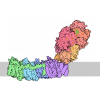
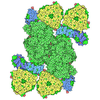
- Assembly
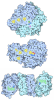
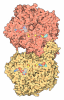
| Deposited unit | 
|
|---|---|
| 1 |
|
-Components
-Formate dehydrogenase ... , 4 types, 8 molecules GHEFBACD
| #1: Protein | Mass: 7180.213 Da / Num. of mol.: 2 Source method: isolated from a genetically manipulated source Source: (gene. exp.) Rhodobacter aestuarii (bacteria) / Gene: SAMN05421580_102355 / Production host:  Escherichia coli MC1061 (bacteria) / References: UniProt: A0A1N7KD80, formate dehydrogenase Escherichia coli MC1061 (bacteria) / References: UniProt: A0A1N7KD80, formate dehydrogenase#2: Protein | Mass: 19331.008 Da / Num. of mol.: 2 Source method: isolated from a genetically manipulated source Source: (gene. exp.) Rhodobacter aestuarii (bacteria) / Gene: SAMN05421580_102359 / Production host: Escherichia coli MC1061 (bacteria) / References: UniProt: A0A1N7KDI2#3: Protein | Mass: 103750.953 Da / Num. of mol.: 2 Source method: isolated from a genetically manipulated source Source: (gene. exp.) Rhodobacter aestuarii (bacteria) / Gene: SAMN05421580_102357 / Production host: Escherichia coli MC1061 (bacteria) / References: UniProt: A0A1N7KDD5#4: Protein | Mass: 52942.566 Da / Num. of mol.: 2 Source method: isolated from a genetically manipulated source Source: (gene. exp.) Rhodobacter aestuarii (bacteria) / Gene: SAMN05421580_102358 / Production host: Escherichia coli MC1061 (bacteria) / References: UniProt: A0A1N7KDE1 |
|---|
-Non-polymers , 6 types, 24 molecules 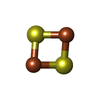
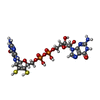

| #5: Chemical | ChemComp-FES / 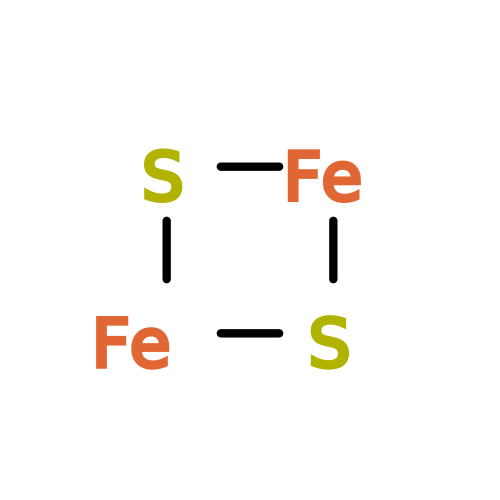 Mass: 175.820 Da / Num. of mol.: 4 / Source method: obtained synthetically / Formula: Fe2S2 / Feature type: SUBJECT OF INVESTIGATION Mass: 175.820 Da / Num. of mol.: 4 / Source method: obtained synthetically / Formula: Fe2S2 / Feature type: SUBJECT OF INVESTIGATION#6: Chemical | ChemComp-MGD / 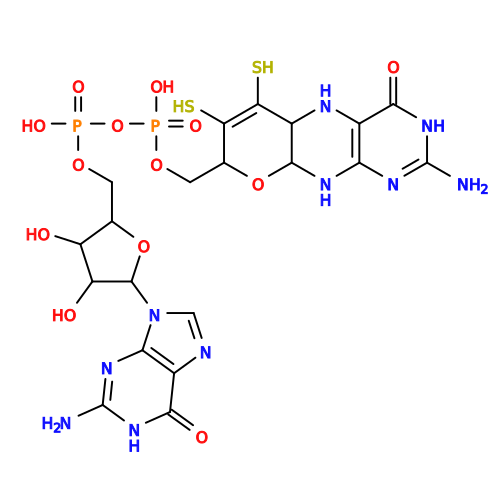 Mass: 740.557 Da / Num. of mol.: 4 / Source method: obtained synthetically / Formula: C20H26N10O13P2S2 / Feature type: SUBJECT OF INVESTIGATION Mass: 740.557 Da / Num. of mol.: 4 / Source method: obtained synthetically / Formula: C20H26N10O13P2S2 / Feature type: SUBJECT OF INVESTIGATION#7: Chemical |  Mass: 95.940 Da / Num. of mol.: 2 / Source method: obtained synthetically / Formula: Mo / Feature type: SUBJECT OF INVESTIGATION Mass: 95.940 Da / Num. of mol.: 2 / Source method: obtained synthetically / Formula: Mo / Feature type: SUBJECT OF INVESTIGATION#8: Chemical | ChemComp-SF4 / 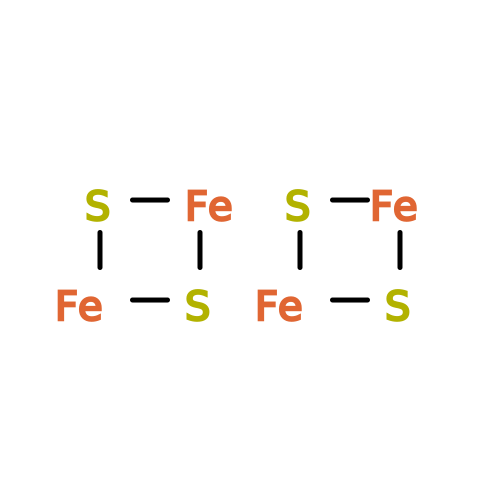 Mass: 351.640 Da / Num. of mol.: 10 / Source method: obtained synthetically / Formula: Fe4S4 / Feature type: SUBJECT OF INVESTIGATION Mass: 351.640 Da / Num. of mol.: 10 / Source method: obtained synthetically / Formula: Fe4S4 / Feature type: SUBJECT OF INVESTIGATION#9: Chemical | 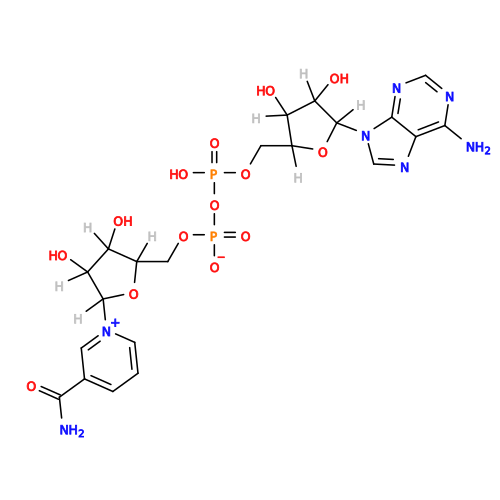 Mass: 663.425 Da / Num. of mol.: 2 / Source method: obtained synthetically / Formula: C21H27N7O14P2 / Feature type: SUBJECT OF INVESTIGATION / Comment: NAD*YM Mass: 663.425 Da / Num. of mol.: 2 / Source method: obtained synthetically / Formula: C21H27N7O14P2 / Feature type: SUBJECT OF INVESTIGATION / Comment: NAD*YM#10: Chemical | 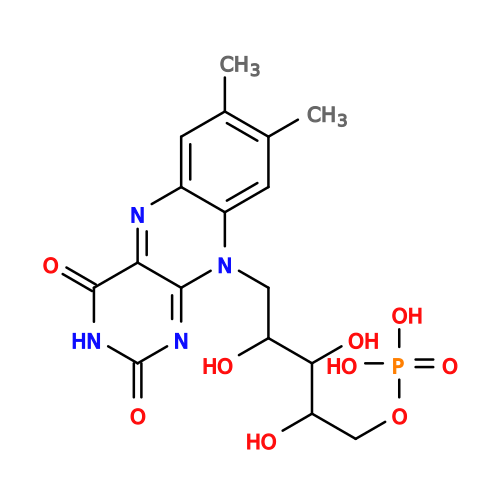 Mass: 456.344 Da / Num. of mol.: 2 / Source method: obtained synthetically / Formula: C17H21N4O9P / Feature type: SUBJECT OF INVESTIGATION Mass: 456.344 Da / Num. of mol.: 2 / Source method: obtained synthetically / Formula: C17H21N4O9P / Feature type: SUBJECT OF INVESTIGATION |
|---|
-Details
| Has ligand of interest | Y |
|---|---|
| Has protein modification | Y |
-Experimental details
-Experiment
| Experiment | Method: ELECTRON MICROSCOPY |
|---|---|
| EM experiment | Aggregation state: PARTICLE / 3D reconstruction method: single particle reconstruction |
- Sample preparation
| Component | Name: Formate dehydrogenase from Rhodobacter aestuarii / Type: COMPLEX / Entity ID: #1-#4 / Source: RECOMBINANT |
|---|---|
| Molecular weight | Value: 0.359 MDa / Experimental value: NO |
| Source (natural) | Organism: Rhodobacter aestuarii (bacteria) |
| Source (recombinant) | Organism: Escherichia coli MC1061 (bacteria) |
| Buffer solution | pH: 7.5 / Details: 10mM NaN03, 100mM PBS |
| Specimen | Conc.: 1 mg/ml / Embedding applied: NO / Shadowing applied: NO / Staining applied: NO / Vitrification applied: YES Details: The protein was obtained after overexpressionin Escherichia coli MC106l and purified usingHis-tagged nickel affinity chromatography and size-exclusion chromatography. |
| Specimen support | Grid material: COPPER / Grid mesh size: 400 divisions/in. / Grid type: Quantifoil |
| Vitrification | Instrument: FEI VITROBOT MARK IV / Cryogen name: ETHANE |
- Electron microscopy imaging
| Experimental equipment |  Model: Titan Krios / Image courtesy: FEI Company |
|---|---|
| Microscopy | Model: TFS KRIOS |
| Electron gun | Electron source:  FIELD EMISSION GUN / Accelerating voltage: 300 kV / Illumination mode: FLOOD BEAM FIELD EMISSION GUN / Accelerating voltage: 300 kV / Illumination mode: FLOOD BEAM |
| Electron lens | Mode: BRIGHT FIELD / Nominal defocus max: 5000 nm / Nominal defocus min: 1200 nm |
| Image recording | Electron dose: 50 e/Å2 / Film or detector model: FEI FALCON IV (4k x 4k) |
- Processing
| EM software |
| ||||||||||||||||||||||||
|---|---|---|---|---|---|---|---|---|---|---|---|---|---|---|---|---|---|---|---|---|---|---|---|---|---|
| CTF correction | Type: PHASE FLIPPING AND AMPLITUDE CORRECTION | ||||||||||||||||||||||||
| 3D reconstruction | Resolution: 2.9 Å / Resolution method: FSC 0.143 CUT-OFF / Num. of particles: 192652 / Symmetry type: POINT | ||||||||||||||||||||||||
| Refinement | Highest resolution: 2.9 Å Stereochemistry target values: REAL-SPACE (WEIGHTED MAP SUM AT ATOM CENTERS) | ||||||||||||||||||||||||
| Refine LS restraints |
|
